
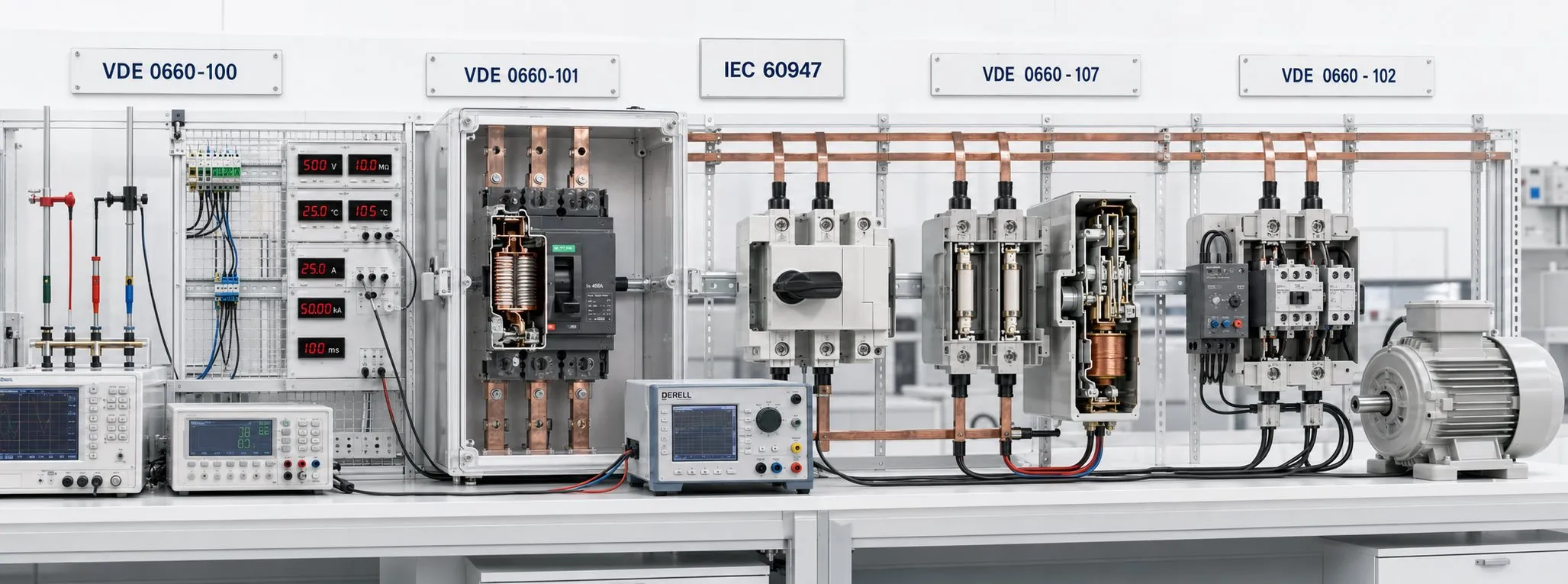
Understanding VDE 0660: From Component Ratings to Complete Assemblies
A switchgear datasheet may list VDE 0660 alongside an IEC or EN reference. That short designation identifies a group within the German VDE standards system. To understand what it means for a particular product, you need the full part number, document designation and edition.
Many component standards in this group correspond to the IEC 60947 family. A familiar example is DIN EN IEC 60947-1 (VDE 0660-100), which sets out general rules for low-voltage switchgear and controlgear. Other VDE 0660 parts address complete assemblies, so the suffix makes a substantial difference.
What Does VDE 0660-100 Cover?
The general rules in IEC 60947-1 provide common terminology, equipment characteristics, service conditions, construction requirements and methods for verifying performance. They apply as referenced by the relevant product standard. A circuit breaker or contactor therefore also needs its specific product part.
The general scope covers equipment connected to circuits with rated voltages up to 1,000 V AC or 1,500 V DC. These are scope limits. An individual device still has its own voltage ratings, permitted applications and installation conditions. An AC rating does not establish suitability for a DC circuit.
A Practical Map of the Main Parts
| VDE designation | Related IEC part | Subject |
|---|---|---|
| VDE 0660-100 | IEC 60947-1 | General rules for switchgear and controlgear |
| VDE 0660-101 | IEC 60947-2 | Circuit breakers |
| VDE 0660-107 | IEC 60947-3 | Switches, disconnectors, switch-disconnectors and fuse-combination units |
| VDE 0660-102 | IEC 60947-4-1 | Electromechanical contactors and motor starters |
| VDE 0660-200 | IEC 60947-5-1 | Electromechanical control circuit devices and switching elements |
| VDE 0660-208 | IEC 60947-5-2 | Proximity switches |
| VDE 0660-600-1 | IEC 61439-1 | General rules for low-voltage switchgear and controlgear assemblies |
The table identifies subject areas; it does not select an edition for your project. Record amendments and corrigenda as well as the base document. For example, DIN EN IEC 60947-1 (VDE 0660-100):2022-03 has associated corrections published in 2023 and 2024.
Start with the Job Each Device Performs
Consider a motor feeder. The contactor switches the load, the overload relay monitors motor overload conditions, and the selected circuit breaker provides the protection specified by its design and settings. Sharing an enclosure does not give these devices identical duties.
Use IEC 60947-2 to identify the circuit-breaker framework, IEC 60947-3 for switches and disconnectors within its scope, and IEC 60947-4-1 for electromechanical contactors and motor starters.
The same approach helps with control signals. A mechanical switching device feeding a PLC input may fall under IEC 60947-5-1. A proximity switch within the relevant scope is addressed by IEC 60947-5-2. The broad label industrial sensor alone does not identify the applicable product standard.
Read the Utilization Category Alongside the Current Rating
Switching a heater and starting an electric motor place different demands on a contactor. The meaningful rating is the one stated for the actual voltage, load and switching duty.
AC-1 covers non-inductive or slightly inductive loads. Suitable resistance-heating applications are a common example.
AC-3 covers duties such as starting squirrel-cage motors and switching them off once running normally.
AC-4 addresses more demanding duties, including inching and plugging. These operations can subject the contacts to substantially different switching conditions.
A contactor's AC-1 current rating cannot simply be carried over to an AC-3 or AC-4 application. Check the manufacturer's selection data, operating frequency and ambient-temperature limits before deciding that a replacement is equivalent.
Separate Load Current from Fault Performance
A breaker's normal current rating tells only part of the story. Icu is its rated ultimate short-circuit breaking capacity; Ics is its rated service short-circuit breaking capacity. Both must be read at the stated operating voltage. A “63 A” label, by itself, says nothing sufficient about the fault current the device can interrupt.
For motor starters, short-circuit coordination also concerns the combination of protective device, contactor and overload protection. Type 1 coordination allows repair or replacement to be necessary after the specified short-circuit event. Type 2 coordination requires suitability for further use, with manufacturer instructions addressing any permitted contact welding. Both require the tested combination to avoid danger to people and the installation.
Coordination is established for a specified combination under specified conditions. Select from the manufacturer's coordination tables using the relevant voltage and prospective fault current. Matching the ampere ratings of separate components does not establish Type 2 performance.
The Finished Panel Has Its Own Verification Requirements
A collection of compliant components does not automatically produce a compliant assembly. The IEC 61439 assembly standards address the completed arrangement. Part 1 supplies general rules and is used with the applicable assembly product part.
Design verification establishes that the design meets the relevant requirements. Routine verification applies to each manufactured assembly. Temperature rise, insulation, protective circuits and connections all matter at this level.
Installing a variable frequency drive, for example, can change heat dissipation and spacing requirements inside the enclosure. Cable entries and ventilation openings also need to be considered when establishing the finished assembly's IP rating.
Where Do Fuses Fit?
Fuse-combination units appear within the switchgear standards, while low-voltage fuse requirements are addressed separately by the IEC 60269 family. A fuse-switch assembly and its replaceable fuse-link can therefore have different applicable product references. VDE 0660 should not be used as a blanket description of fuse standards.