
What protection classes does the device have?
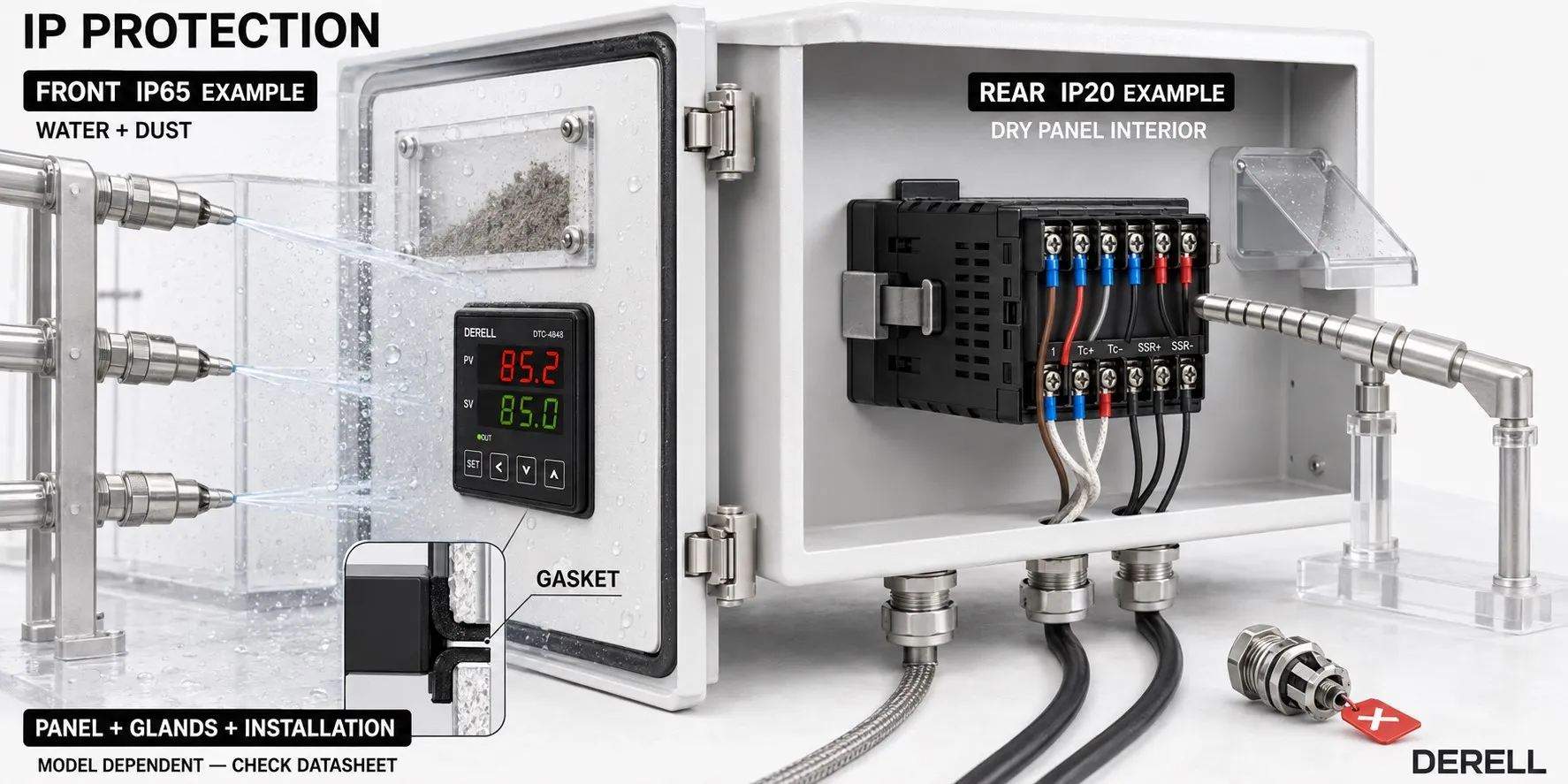
Read the rating together with the installation and operating environment
Hello, protection for a temperature controller cannot be described by one number. An IP rating addresses dust and water ingress, a NEMA Type covers specified enclosure conditions, and electrical safety concerns different hazards. Impact resistance, electromagnetic compatibility and explosion protection require separate assessment. Do not assume that every version within a product family provides identical protection.
Editor's note: “IP66 front panel” does not mean IP66 protection from every direction. For example, OMRON specifies an IP66 front panel, IP20 rear case and IP00 terminals for the E5CC/E5CC-B. These values cannot be generalized to other models; connections inside the cabinet need appropriate protection.
What do the IP digits actually describe?
Under IEC 60529, the first digit, 0–6, describes protection against solid foreign objects and access to hazardous parts. The second, 0–9, describes water protection. A first digit of 5 permits limited dust ingress provided it causes no harmful effects; 6 means dust-tight. An X means that a rating for that position is not specified; it does not mean either zero protection or maximum protection.
IP20: Defined protection against finger access to hazardous parts and solid objects of 12.5 mm or larger, with no declared water protection. It may be suitable inside a protective cabinet, but does not justify mounting the device where water can reach it.
IP54: Dust-protected and tested against splashing water from any direction; it is not dust-tight. IP55 retains the same dust category but adds protection against water jets. The two codes describe different water exposure conditions.
IP65 and IP66: Both are dust-tight because their first digit is 6. IP65 covers water jets, while IP66 covers more powerful jets. Neither rating alone establishes suitability for hot, high-pressure cleaning or immersion.
IP67: Protection against temporary immersion under standardized water-level and duration conditions. IP68 addresses continuous immersion under specified manufacturer-agreed conditions. Read the declared depth and duration; IP68 does not mean operation at any depth.
IP69: A separate test category for high-pressure, high-temperature water jets. IP67/IP68 do not automatically establish compliance with IP65/IP66 jet tests, and IP69 does not automatically establish immersion protection. Look for a multiple rating when both are required. When comparing IP69 and IP69K markings, also check the referenced standard and test conditions.
Why assess the front, rear and cabinet separately?
A panel controller normally faces the operator while its connections remain inside the cabinet. Front protection often depends on the correct gasket, panel cutout and mounting pressure. During installation, burrs, uneven surfaces, incorrect panel thickness or a missing gasket can compromise the seal. Excessive tightening is not a remedy; follow the specified dimensions and torque.
A concrete model distinction is that the waterproof packing specified for E5CC/E5CC-B does not make the E5CC-U waterproof. The manufacturer explicitly states this limitation. An aged gasket, open service connection, unsuitable cable gland or unprotected fan opening can weaken the installed assembly. During maintenance, assess cabinet doors, penetrations and seals as well as the controller itself.
NEMA Types are not a numerical performance ranking
NEMA enclosure classification is not a scale that becomes stronger in every respect from 1 through 13. Lettered variants and different operating conditions matter. Type 12 concerns indoor dust, dirt and specified dripping/seepage conditions; its larger number does not make it suitable for outdoor exposure or hose washing.
Type 4 includes specified indoor/outdoor environmental protection and hose-directed water. Type 4X adds corrosion-resistance requirements, not unlimited resistance to every chemical. Type 6 addresses occasional temporary submersion at a limited depth, while Type 6P addresses prolonged submersion conditions. Do not treat NEMA Types and IP as interchangeable, two-way equivalents: “IP66 = NEMA 4X” is insufficient technical evidence.
Electrical shock, EMC and impact are different issues
IEC/EN 61010 safety requirements address issues such as insulation and electrical hazards in measurement and control equipment. Electrical shock protection classes such as Class I and Class II are not IP digits. A plastic housing does not establish double insulation. Follow the manual's earthing, supply and terminal requirements.
IEC/EN 61326-1 concerns electromagnetic emissions and immunity; it is not a water or dust protection code. Sensor wiring and shielding still matter near drives, contactors and heater power cables. The IK code under IEC 62262 concerns external mechanical impacts. An IP66 marking does not establish that a display will withstand impact or a forklift collision.
A high IP rating is insufficient for an explosive atmosphere
ATEX requirements and IECEx certification address matters beyond ordinary enclosure sealing. Different techniques include Ex d flameproof enclosures, Ex i intrinsic safety and Ex p pressurization; they cannot all be described as containing an internal explosion. The hazardous-area classification, gas/dust group, temperature limitations and certificate conditions must match the application. Putting a standard controller inside an arbitrary sealed box does not create Ex compliance.
High IP protection does not solve condensation or overheating
Ambient operating temperature and humidity are separate from the measured process temperature. A 400 °C display reading does not mean the electronics can operate in a 400 °C atmosphere. Temperature changes can also produce condensation inside a water-resistant enclosure. Where non-condensing conditions are required, an IP rating alone is insufficient.
Assess internal heat dissipation, solar loading, moisture and ventilation together. Better sealing does not remove the need for thermal management. Chemical compatibility also requires separate checking: detergents, oils, solvents and salt water can affect gaskets and front materials differently. An IP test using fresh water does not establish resistance to these substances.
How does this translate into a practical selection?
Dry production cabinet: If there is no external high-pressure washing, the highest available IP number may not be the main priority; assess internal dust, access and electronics temperature. Washed food-processing machine: Establish water pressure, temperature, distance, cleaning chemicals and whether washing reaches only the front or the entire cabinet. Outdoor installation: Assess sunlight, UV exposure, freezing and condensation alongside rain. These are assessment examples, not automatic assignments of a rating.
Before ordering, compare the exact model code, the surfaces covered by the rating, required gaskets/covers, environmental limits and conformity documentation. Ask for a verifiable rating and installation conditions instead of a vague “waterproof” claim. Neither IP nor NEMA establishes that a heater will be safely disconnected after a sensor failure; fault behavior needs separate design.
Related products and technical guidance
Products and selection: Temperature controllers, temperature controller prices, controller selection considerations.
Measurement and control: compatible sensor types, temperature measurement accuracy, ON/OFF and PID control algorithms.
Faults and further questions: error codes and troubleshooting, temperature controller questions and answers.
Sources
WIKA — IN 00.64: IP ingress protection of electrical thermometers
Auer Signal — IP ratings and electrical protection classes
OMRON — E5CC/E5CC-B/E5CC-U: Specifications
OMRON — E5CC: Mounting accessories and waterproof packing
Siemens — Degrees of protection provided by enclosures
Bud Industries — NEMA Rating Guide for Electronic Enclosures
IEC — IEC 61010-1: General safety requirements
IEC — IEC 61326-1: EMC requirements