
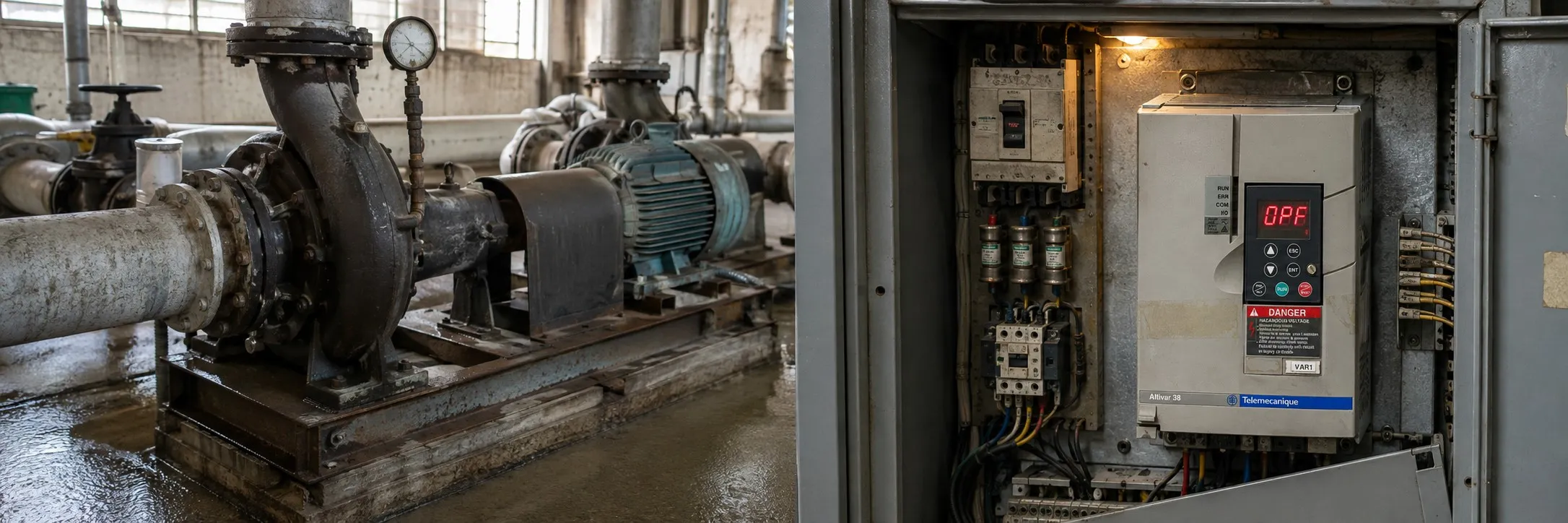
ATV 38 fault codes
Auto Restart: This function allows the drive to automatically restart if a fault has disappeared. Automatic restarting is possible after faults such as line overvoltage, DC bus overvoltage, external fault, motor phase loss, serial link fault, communication fault, loss of 4-20 mA signal, motor overload (with the condition that the motor thermal state is less than 100%), drive overheating (with the condition that the drive thermal state is less than 70%), and motor overheating (with the condition that the resistance of probes is less than 1,500 Ohms). The drive attempts to start every 30 seconds, with a maximum of 6 attempts. If all attempts fail, the drive remains locked with the fault relay open until it is reset by being switched off.
Reset Type (RSP/RSG): This function allows for either a partial reset (RSP) or a general reset (RSG) of faults. A partial reset affects faults such as line overvoltage, motor overload, motor overheating, motor phase loss, serial link fault, communication fault, DC bus overvoltage, loss of 4-20 mA, overhauling, drive overheating, external fault, and overspeed. A general reset (RSG) inhibits all faults for forced operation. To configure a general reset, display RSG, press the "ENT" key, and then press ▲, ▼, and "ENT" as instructed.
OutPhaseLoss: This setting enables the detection of motor phase loss faults. The fault is eliminated if an isolator is used between the drive and the motor. The option can be set to Yes or No.
InPhaseLoss: This setting enables the detection of line phase loss faults. The fault is eliminated if there is a direct power supply via a DC bus. The option can be set to Yes or No.
ThermProType (tHt): This parameter defines the type of indirect motor thermal protection provided by the drive. Options include:
- No protection (N0)
- Self-cooled motor (ACL): The drive accounts for derating depending on the rotation frequency.
- Force-cooled motor (FCL): The drive does not account for derating depending on the rotation frequency.
LossFollower (LFtL): This parameter is used to enable the loss of 4-20 mA reference fault. Options include:
- No: No fault
- Yes: Immediate fault
- Stt: Stop according to the Stt parameter, without a fault, restart when the signal returns
- LSF: Stop according to the Stt parameter, then fault at the end of stopping
- LFF: Force to the fallback speed set by the LFF parameter
- RLS: Maintaining the speed reached on appearance of the loss of 4-20 mA signal, without a fault, restarting when the signal returns.
4-20 Flt Spd (LFS): This parameter sets the fallback speed in the event of loss of 4-20 mA signal. It can be adjusted from 0 to the maximum speed (HSP).
Catch On Fly (FLrr): This parameter enables a smooth restart after events such as loss of line supply, fault reset, freewheel stop, or uncontrolled loss downstream of the drive. Options are Yes or No.
Cont. Stop (StPP): This parameter controls the stop on a line phase loss. It is only operational if the InPhaseLoss (IPL) parameter is set to No. Options include:
- No: Locking on loss of line supply
- MMS: Maintain Bus: The drive control unit continues to be powered by the kinetic energy generated by the inertia forces until the USF fault (undervoltage) occurs.
- FRP: Follow Ramp: Deceleration following the programmed deceleration ramp (dEC or dE2) until a stop or until the USF fault (undervoltage) occurs.
RampNotFoll (Sdd): This parameter locks the drive if a speed error is detected (difference between the stator frequency and the measured speed) when a tachogenerator or pulse generator feedback has been programmed. Options are Yes or No.
External Fault (EPFL): This parameter defines the type of stop on external fault. Options include:
- Yes: Immediate fault
- LSF (Stop+flt): Stop according to the Stt parameter, then fault at the end of stopping.