
Step-Up and Step-Down Transformers
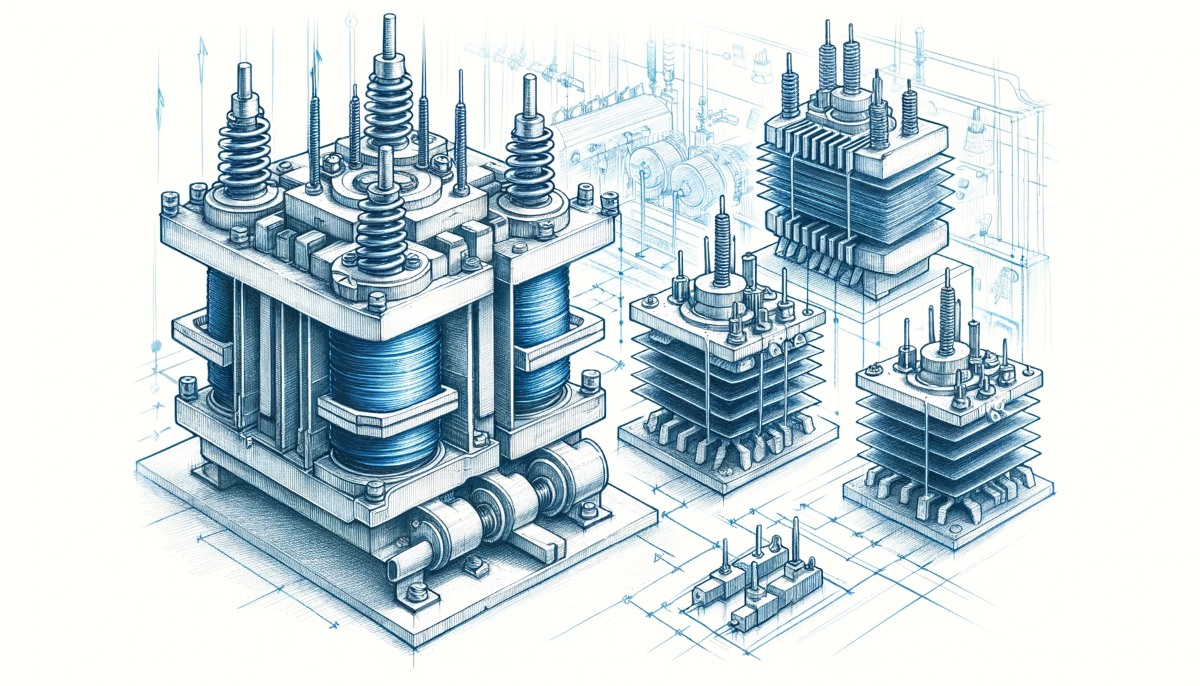
Hi everyone,
Step-up and step-down transformers are specialized types of transformers used to increase or decrease the voltage level of an alternating current (AC) electrical power supply. The core principle behind their operation is the same as for any transformer: electromagnetic induction.
Common Elements
Core: Made usually of laminated iron or ferrite, the core serves as the medium for the magnetic flux.
Windings: Primary and secondary windings made of conductive material like copper are wrapped around the core. The number of turns in these windings determines the voltage transformation.
Step-Up Transformer
A step-up transformer increases the voltage from the primary winding to the secondary winding. This is achieved by having more turns on the secondary winding than on the primary winding.
Applications:
Power generation stations use step-up transformers to increase the voltage for long-distance transmission.
Medical devices like X-ray machines require high voltage, often supplied by step-up transformers.
Microwave ovens also use step-up transformers to convert the household voltage to the high voltage required for cooking.
Implications:
As the voltage increases, the current decreases to keep the power (nearly) constant, according to the principle of conservation of energy.
Usually less efficient for low power applications because of losses like core loss and copper loss.
Step-Down Transformer
A step-down transformer does the opposite: it decreases the voltage from the primary to the secondary winding. This is achieved by having fewer turns on the secondary winding compared to the primary winding.
Applications:
Used in local distribution networks to reduce the voltage for household and industrial use.
Adapters for electronic gadgets like laptops and mobile phones.
Industrial machines that require lower voltages.
Implications:
As the voltage decreases, the current increases, maintaining (nearly) the same power level.
Generally more efficient for high power applications, although efficiency is also influenced by the quality of construction and materials.
Equations
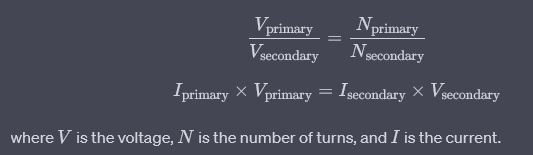
The transformation of voltage and current can be represented mathematically:
Vprimary*Vsecondary=Nprimary*Nsecondary
Vsecondary*Vprimary=Nsecondary*Nprimary
Iprimary×Vprimary=Isecondary×Vsecondary
Iprimary×Vprimary=Isecondary×Vsecondary
where VV is the voltage, NN is the number of turns, and II is the current.
By manipulating these equations, you can understand the relationships between voltage, current, and number of turns in step-up and step-down transformers.
"The topic of electronic components and Transformers is broad in scope, encompassing a diverse range of products. Here are the answers to the most common questions posed by our valued visitors."
- Step-Up and Step-Down Transformers
-------------
- What is an integrated circuit?
- What is a crystal oscillator?
- What is an LED (Light Emitting Diode)?
- What is a radio frequency (RF) module?
- What is a ceramic resonator?
"These questions often include those that many people might have about the component parts of electronic devices. Each user or student will have their own specific questions depending on a particular situation or application. The answers provided are not binding and do not express absolute certainty. You are free to share the article above, citing it as a source. 01/2020."
Your shopping cart is empty!