
IEEE 1625
Reliable battery packs need coordinated cells, controls and charging
IEEE 1625 establishes qualification, quality and reliability criteria for rechargeable multi-cell battery systems in mobile computing devices. Its battery technologies are lithium-ion and lithium-ion polymer. A cell is an individual energy unit; a battery pack brings cells together with connections, packaging and management electronics.
Edition and status: IEEE lists 1625-2008 as Inactive-Reserved, with an inactivation date of 7 November 2019. CTIA’s published Battery Compliance Program v6.1 references that edition. Check the IEEE publication status separately from the reference used by a certification program.
Read the cell configuration before comparing capacity
Series connections raise pack voltage. Parallel connections increase capacity at the same voltage. A 3S2P arrangement has three groups in series, with two parallel cells in each group. When comparing battery types or assembled packs, an mAh rating is only part of the picture: voltage and energy in Wh matter too.
A plausible pack voltage can hide an overcharged cell
Consider this example: Three series cells measure 3.3 V, 3.3 V and 4.5 V. Their total is 11.1 V. If the cell manufacturer specifies a 4.2 V upper charging limit for this example, the third cell is already above it. Measuring only the total misses the problem. These figures illustrate the principle; actual limits come from the cell specification.
A battery management system (BMS) may monitor individual cell or cell-group voltages, current and temperature, then restrict charging or discharging when necessary. Cell balancing helps reduce differences in state of charge; it does not replace protection. An NTC temperature sensor and a protective fuse address different aspects of the design.
Evaluate the complete energy path
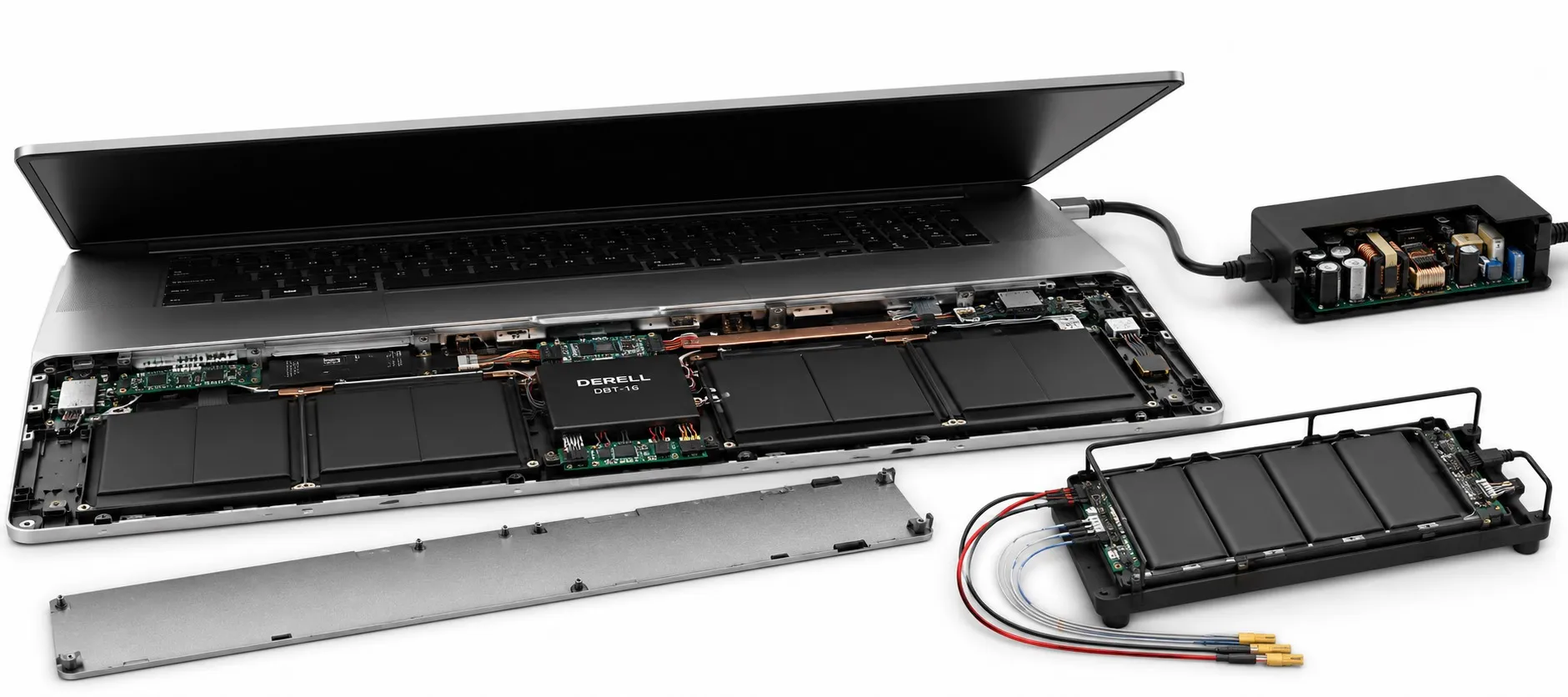
IEEE 1625 considers the relationship between cells, pack, host device and adapter. The charging equipment must operate within the conditions accepted by the pack. Battery status communication and appropriate information for the user also belong to the system. A percentage on the screen is not evidence that its protective functions have been evaluated.
Relevant power supply standards and product safety subjects such as IEC 62368 complement the adapter and host assessment. A report covering one component does not automatically establish conformity of the entire battery and charging system.
Ask for production evidence as well as test results
Cell sourcing, reliable connections, insulation, production records and verification of protection functions all matter. Mixing old and fresh cells in a pack raises concerns beyond its advertised capacity. Traceable test records and control of the production design help ensure that a successful prototype represents the units being supplied.
In the CTIA program, subsystem recognition for cells, packs and adapters is distinct from certification of the complete system. Ask a supplier which model, components, standard edition and evaluation scope the evidence covers. IEEE publishes the technical standard; a certification program administers its own assessment process.
Place IEEE 1625 alongside related standards
IEEE 1725 is the related standard for mobile-phone battery systems. Selecting a reference requires checking the battery architecture and program scope, rather than relying solely on the device’s product name. UL 1642 is used for lithium-cell safety evaluation; UL 2054 addresses household and commercial batteries. IEC 62133-2 covers safety requirements for portable rechargeable lithium cells and batteries. Our battery standards guide connects these different scopes.
Official and technical sources: IEEE 1625-2008 | CTIA Battery Compliance | CTIA Program v6.1 | CTIA 1625 CRD v1.12 | TI: battery monitoring