
About Siemens Contactors
From a telegraph workshop to industrial motor control
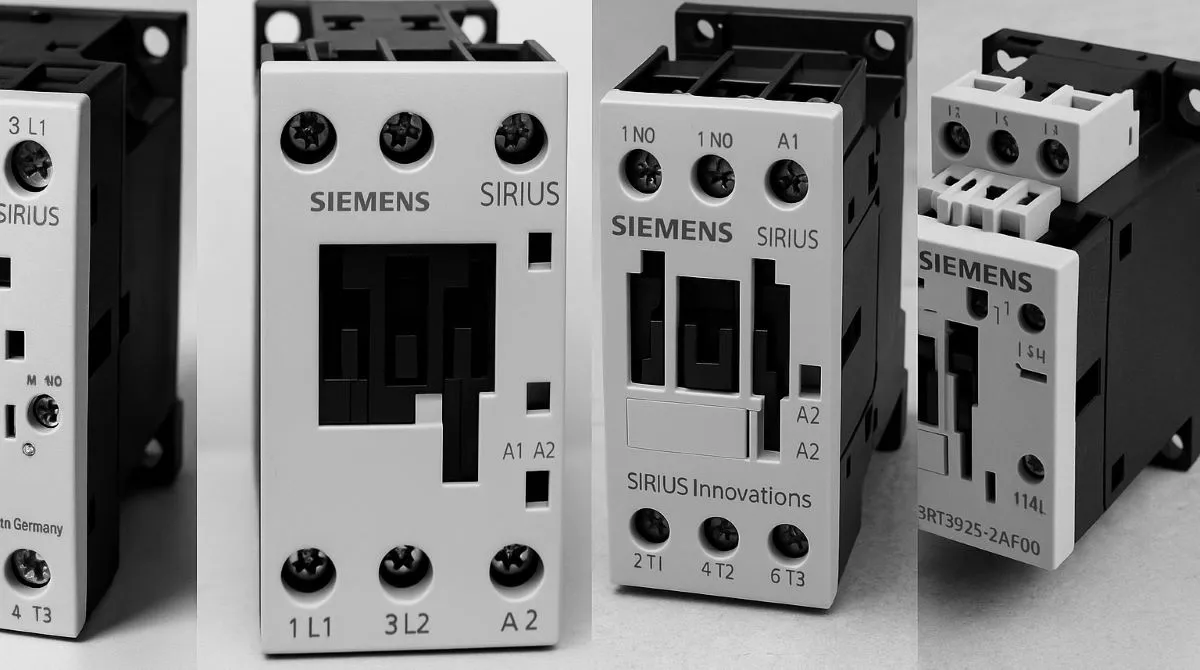
Siemens contactors form part of the company’s long history in electrical engineering and industrial automation. Used to control motors, pumps, fans and other electrical loads, these electromechanical switching devices connect the power circuit with the control functions of a machine within the wider Siemens automation portfolio. The basic principle of a contactor has remained familiar, while product families, connection methods and integration with automation systems have developed over time.
1847: the origins of Siemens & Halske
The history of Siemens begins in Berlin in 1847, when Werner von Siemens and precision mechanic Johann Georg Halske established Telegraphen-Bauanstalt von Siemens & Halske. Its initial focus was telegraph technology. The company’s story therefore starts with electrical communications equipment and its subsequent expansion into wider engineering activities, rather than with contactor production from the outset.
In 1866, Werner von Siemens’s work on the dynamo-electric principle marked an important step in the company’s development in electrical generation and heavy-current engineering. As electricity spread through industry, electric motors and the equipment used to control them became increasingly important. In 1966, the consolidation of Siemens & Halske, Siemens-Schuckertwerke and Siemens-Reiniger-Werke into Siemens AG marked another major milestone in the company’s corporate development.
The product history behind 3TB, 3TF and SIRIUS
The history of the Siemens contactor portfolio includes familiar designations such as 3TB, 3TF and 3RT. Siemens’s 2009 LV 1 catalogue presents these families within the same motor-switching section. This documents the coexistence of different contactor designs and power ranges. It should not be interpreted as evidence that every product was replaced by a single new family on one particular date.
This history also includes auxiliary contacts, coils, connection components and overload relays. The need for compatible components within a motor control assembly helps explain the later emphasis on modular systems.
SIRIUS and modular motor control
SIRIUS is Siemens’s broad family of industrial control products. Within the SIRIUS product range, contactors work alongside motor protection, overload monitoring and control components. Its development can be understood as a move beyond individual switching devices towards a system of compatible accessories and motor starter combinations.
A Siemens application document dated 2010 describes SIRIUS Innovations load feeders connected to a control system through AS-Interface and integrated into STEP 7. It illustrates how development extended beyond mechanical switching to include communication and integration with the wider control system. SIRIUS Innovations describes this development of the system; it is not a separate contactor type in its own right.
3RT and 3RH: different roles within the same portfolio
SIRIUS 3RT is the power contactor family used to switch electrical loads, particularly motors. The portfolio includes options for different loads and connection arrangements. SIRIUS 3RH devices are contactor relays used in control circuits for switching control signals and implementing interlocking functions. The two families serve different requirements within an automation system.
From conventional control panels to PLC-controlled machines
The continuing role of contactors becomes clear when looking at how machine controls have changed. Whether a machine uses conventional relay logic or a PLC system such as SIMATIC S5 or SIMATIC S7, a contactor can still perform the task of connecting and disconnecting an electrical load. Operation may begin with a start button and a stop button; arrangements such as star-delta starting use combinations of contactors to carry out the switching sequence.
Editor’s note: 1847 is the company’s founding year, not the launch year of its contactors or the SIRIUS family. A catalogue date does not establish when a product first entered production either. Company history and the development of individual product families should be read separately.
Related pages: Siemens automation products, Siemens contactors and switchgear.