
About Siemens
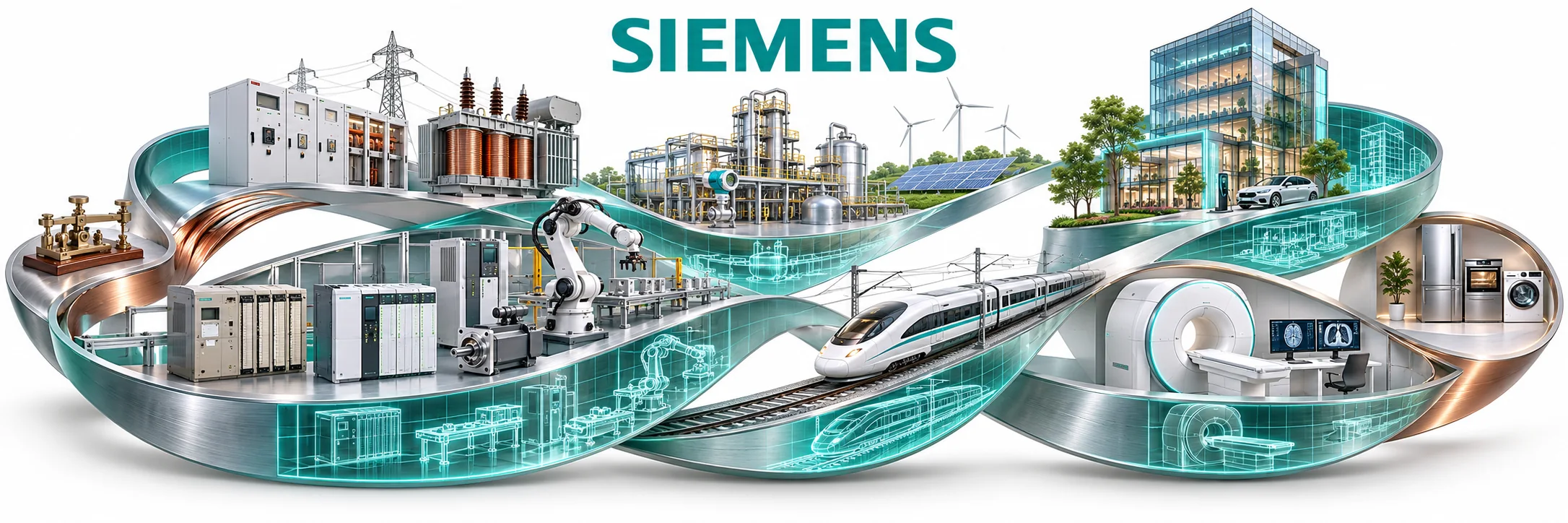
From a Berlin telegraph workshop to industrial automation
Hello everyone. Siemens is a technology company of German origin with roots in nineteenth-century electrical engineering and communications. A PLC, contactor or motor drive in an automation cabinet represents just one part of that history. Its development connects telegraph systems, electricity generation, motors, railways, medical equipment, electronic control and industrial software.
Editor's note: Siemens traces its origins to 1847, while the merger under the name Siemens AG took place in 1966. These dates describe different events. Similarly, SIMATIC, SINAMICS, SIRIUS and SITOP are product families with different roles, rather than alternative names for one product.
1847: Werner von Siemens and Johann Georg Halske
The business began in Berlin through the partnership of Werner von Siemens and precision mechanic Johann Georg Halske. Their company, Telegraphen-Bauanstalt von Siemens & Halske, started operating on October 12, 1847. Its initial focus was manufacturing the pointer telegraph, which communicated letters through a moving indicator. Werner's electrical developments and Halske's precision manufacturing expertise came together in this work.
A contract awarded in 1848 for a long-distance telegraph line between Berlin and Frankfurt helped the business expand; the line entered service in 1849. Operations in Russia and England grew during the 1850s. Siemens therefore became international long before the PLC era, initially as an engineering business building communications infrastructure.
1866–1881: The dynamo and electric transport
Werner von Siemens' work on the dynamoelectric principle in 1866 was one of his central contributions to electrical engineering. The self-excited dynamo was an important step in developing machines that converted mechanical energy into electricity. Wider use of electricity for lighting, motors and industrial facilities also expanded the company's activities beyond telegraphy.
Siemens & Halske demonstrated an electric railway at the Berlin Industrial Exposition in 1879. It provided a prominent public example of an electric motor powering transport. The opening of an electric tram line at Lichterfelde near Berlin in 1881 represented a move from exhibition demonstrations to regular passenger services. Siemens' involvement in railway technology dates back to this period.
1903–1966: Bringing different engineering businesses together
Siemens-Schuckertwerke was established in 1903 by combining Siemens & Halske's heavy-current engineering activities with the Schuckert business. Electrical machinery and power systems were important areas of work. Medical technology activities consolidated under Siemens-Reiniger-Werke in 1932 formed another distinct branch of the company's development.
Munich and Erlangen became important management centers during the rebuilding after World War II. On October 1, 1966, Siemens & Halske, Siemens-Schuckertwerke and Siemens-Reiniger-Werke were combined under Siemens AG. The corporate name therefore reflects the consolidation of different engineering businesses, rather than simply a workshop changing its name.
The beginnings of SIMATIC and the S5 and S7 generations
SIMATIC emerged in the late 1950s as an important milestone in Siemens' electronic automation business. Its earliest transistorized control components should not be confused with today's software-programmable PLCs. Over time, this development enabled more flexible control logic and electronic management of production lines.
SIMATIC S5, introduced in 1979, became a PLC family used across many machines and industrial plants. The SIMATIC S7 generation, beginning in 1994, brought a new approach to hardware, programming and communication. The distinction between STEP 5 and STEP 7 is part of that transition. An older S5 cabinet and a later S7 installation sharing the same brand does not make their programs and modules directly interchangeable.
History in Türkiye: From telegraphy to local manufacturing
Siemens' relationship with Türkiye dates to 1856 and telegraph infrastructure projects during the Ottoman period. Its Türkiye sustainability report also identifies a factory established in Eskişehir in 1928 as a milestone. This history shows that Siemens' activities in the country extend well beyond a recently established import or sales operation.
Simko, founded in partnership with the Koç Group in 1959, was another important step. The Kartal factory established in 1961 was a manufacturing investment of that period. When Siemens acquired all Simko shares in 2001, the company became Siemens Sanayi ve Ticaret A.Ş. Communications, electrification, transport and factory infrastructure featured prominently at different stages of its activities in Türkiye.
What roles do Siemens products perform in an automation cabinet?
The control layer includes PLCs and LOGO! logic modules for smaller applications. The ET 200 family provides distributed I/O and, depending on configuration, control solutions. Operators can monitor a machine and issue commands through HMI panels. SIMATIC Ident addresses industrial identification and product tracking.
At the field and switching layers, sensors and switches provide status information, while components in the SIRIUS family perform motor-control and related tasks. Contactors switch power circuits, and SITOP power supplies provide DC power for control electronics. Communication components such as PROFIBUS connectors form part of the physical network. These products perform different, complementary roles within a cabinet.
For speed and motion control, Siemens AC drives represent a broad historical product area. Names such as MICROMASTER, SIMODRIVE 611 and MASTERDRIVES MC identify families associated with different periods and control requirements. SINAMICS families such as G120C and V20 likewise differ in purpose and capability. Assessing motion-control systems involves considering the drive, motor, feedback and controller together.
Expansion from hardware into industrial software
Siemens' development extended beyond building more capable PLCs and drives. Acquisitions including UGS, Mentor Graphics, LMS and Mendix expanded its scope in design, simulation, product lifecycle management and software development. A digital twin uses an appropriate digital model to examine the behavior of a physical product or process. It involves more engineering work than simply displaying a three-dimensional image.
In a production line, the control program, operator interface, drive settings, engineering data and maintenance information are connected. Understanding Siemens' role in automation therefore involves looking at this system integration alongside individual devices. A shared brand nevertheless does not make every product generation and software version automatically compatible.
Difficult chapters in the company's history
The company's history cannot be described solely through technical achievements. Siemens businesses used forced labor during the Nazi period. Siemens acknowledges this in its own historical accounts, while the United States Holocaust Memorial Museum documents forced labor at Siemens facilities around Ravensbrück and Uckermark. This period includes grave human rights abuses within the company's history.
The international corruption investigations resolved in 2008 were another major corporate turning point. According to the US Department of Justice, coordinated proceedings involving Siemens AG and relevant subsidiaries resulted in US$800 million in payments to US authorities and a combined total exceeding US$1.6 billion when German penalties were included. These events contributed to changes in the company's compliance and internal-control arrangements.
Distinguishing Siemens AG, Siemens Energy and Siemens Healthineers
The Siemens Healthineers stock-market listing in 2018 and the Siemens Energy spin-off and listing in 2020 were important recent corporate milestones. Siemens AG, Siemens Energy AG and Siemens Healthineers AG are separate legal entities. When researching industrial automation and infrastructure, energy technology or healthcare technology, identify the relevant company and product business.
Siemens information and product pages
Siemens main page, S7 PLCs, HMI panels, Drive manuals, Siemens contact page
Sources
Siemens Historical Institute: company development timeline
Siemens: detailed chronology of its technology history since 1847
Deutsches Museum: development of the electric railway
Siemens: SIMATIC S5 and the transition to S7
Siemens Türkiye 2023 report: historical origins and manufacturing in Türkiye
Investment Office of Türkiye: Siemens, Simko and local investment
United States Holocaust Memorial Museum: Uckermark and forced labor at Siemens
US Department of Justice: Siemens announcement dated December 15, 2008