
About sick sensor
From optics to industrial data: the development of a sensor company
SICK AG is a technology company headquartered in Waldkirch, Germany, working in industrial detection, identification, measurement and machine safety. Describing it simply as a photoelectric sensor manufacturer understates its scope. Its products range from switches detecting a small component to systems measuring a load in a warehouse, motor feedback devices and protective-field monitoring. Although these products share a brand, they do not share one operating principle or safety function.
The founder’s optical background and the early years
Founder Erwin Sick began his career in optics. After working at companies including Siemens, Bosch and Askania, he managed an optical laboratory in Munich. This background shaped his approach of evaluating light electronically to solve an industrial problem.
On September 26, 1946, in Vaterstetten near Munich, he received permission to establish an engineering office. Initially, he helped support his family by selling radios he built himself. Orders followed at ACHEMA in 1949. He presented a light-curtain prototype in 1951 and applied for a patent. Orders after the 1952 Hanover machine-tool exhibition helped expand series production.
The company moved to Oberkirch in 1954 and Waldkirch in 1956, arriving in Waldkirch with 25 employees. Its foundation should therefore not be located in Waldkirch in 1946. An Institute for Automation established in Munich in 1960 focused on developing new optoelectronic technologies.
Expanding technologies and an international organization
SICK’s technology timeline records barcode identification for pharmaceutical packaging in 1967, fiber-optic detection in confined spaces in 1973 and in-situ gas measurement in 1978. Placing the start of its automatic-identification activities in the late 1980s therefore overlooks earlier work.
A French subsidiary established in 1972 marked an important stage in international expansion; the US organization also developed during the 1970s. The company adopted the GmbH structure in 1976 and moved into its new Waldkirch headquarters in 1977. The addition of businesses including Maihak and Stegmann broadened expertise in gas measurement and motion feedback. Annual sales first exceeded EUR 1 billion in 2013.
Following Erwin Sick’s death in 1988, Gisela Sick supported the company’s independence and management’s long-term decisions. She had also handled accounting and patent correspondence in the early business. Her involvement in education and employee initiatives influenced the company’s culture. She died on November 1, 2024.
The transition to an Aktiengesellschaft, or AG, in 1996 and the introduction of employee shares in 1999 were further corporate milestones. AG status does not mean a company is publicly listed. According to SICK’s ownership disclosure, the family holds more than 95% of its shares; SICK is not a publicly listed company.
Other technology milestones include laser time-of-flight distance measurement in 1989, a safety area scanner in 1993, SMART technology for reading damaged barcodes in 1997, RFID and IO-Link in 2005, and HIPERFACE DSL motor feedback in 2011. Together, these developments show how different product branches evolved.
From sensing components to software and integrated solutions
SICK AppSpace, announced in 2017, provides a concrete example of this shift through programmable sensors and application-development tools. Components including AppStudio, AppManager and SIM4000 were designed to process data from multiple sensors or cameras for a specific application. The practical objective is turning measurements into information a machine can act on.
The extension of Nova to 3D applications in 2024 follows the same direction. Used with suitable cameras and processing hardware, the software supports configurable tasks such as shape and dimensional inspection. However, machine-vision performance depends on lighting, part presentation, optics and representative samples. Advanced software cannot compensate for an unsuitable installation or inadequate application testing.
The 2025 partnership and the company’s reported scale
The partnership implemented with Endress+Hauser in 2025 was not a sale of the whole SICK company. Worldwide sales and service for gas analysis and gas flow measurement moved to Endress+Hauser. The associated development and manufacturing activities were brought together in Endress+Hauser SICK, a 50/50 joint venture. Factory and logistics automation remained outside the agreement. This change matters when arranging support for an older SICK gas analyzer.
According to the 2025 annual report, sales were EUR 1.85 billion, R&D expenditure EUR 238.9 million, EBIT EUR 54.7 million and headcount 10,158 on December 31, 2025. Reported sales growth of 6.5% uses a continuing-operations comparison. It should not be calculated directly against older whole-group sales figures. These are period-specific figures for 2025, rather than permanent company characteristics.
What do the main product families do?
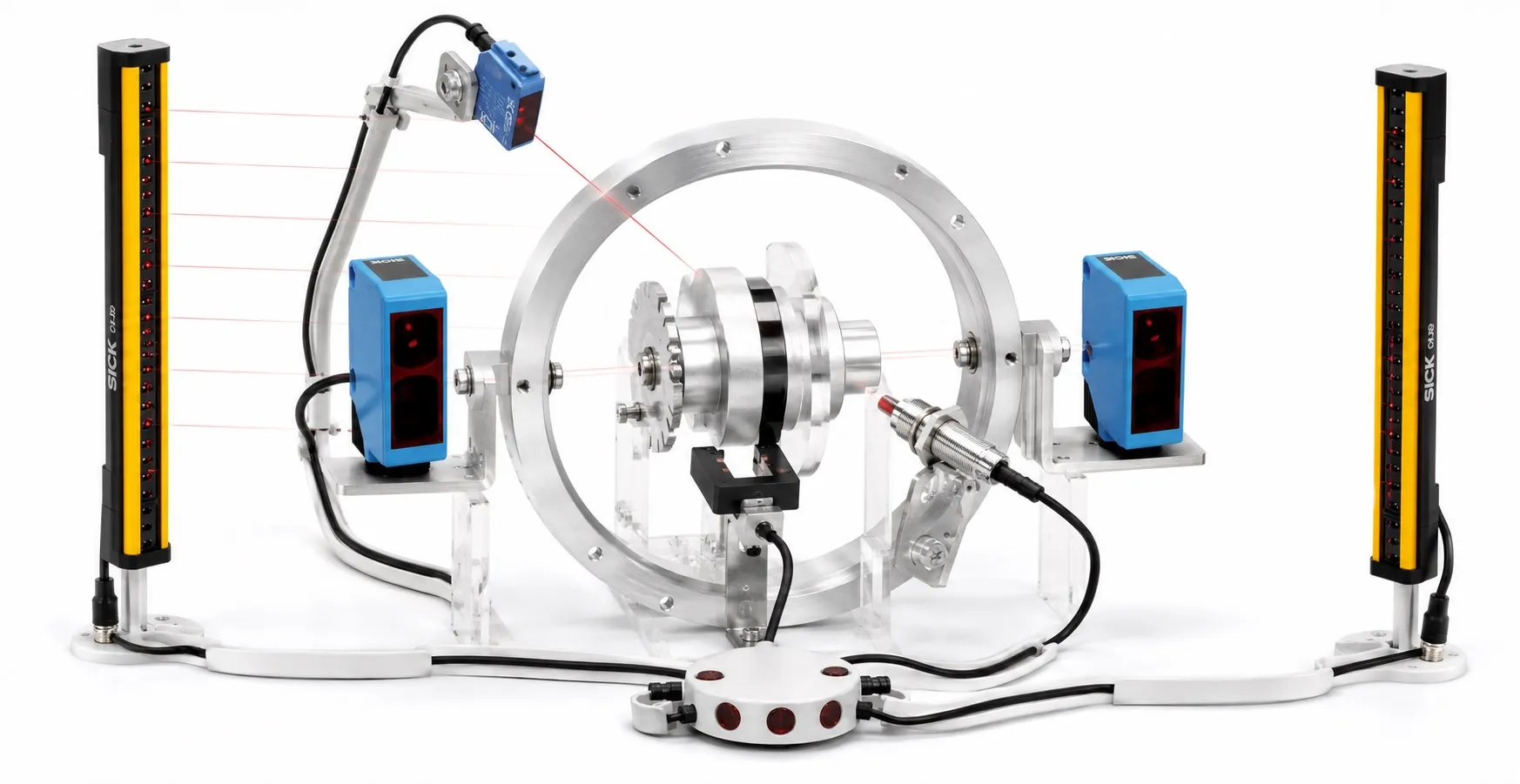
Object detection: Inductive sensors detect metal targets, while capacitive sensors serve applications that use changes in dielectric properties. Ultrasonic sensors evaluate sound propagation. Target material, geometry and mounting conditions all influence selection. An identical nominal sensing distance does not guarantee identical results on every target.
Photoelectric and application-specific detection: Photoelectric sensors differ in how light is transmitted and received. One device should not be expected to suit small components, transparent bottles, shiny packaging and printed registration marks equally well. Contrast, color and luminescence detection are also distinct tasks. Define the property to be detected first, then select the sensing family.
Distance and geometric measurement: Distance-measuring sensors, LiDAR systems and 2D/3D imaging provide position, profile or dimensional information. Detecting that a load is present differs from measuring its height. Alongside measurement range, assess accuracy, repeatability, resolution and measurement rate separately.
Identification and traceability: Barcode and 2D-code readers evaluate optical codes, while RFID systems read radio-frequency tags. In logistics, associating an identity with the correct carton or pallet is as important as obtaining a successful read. Ident Gate in the 2024/2025 innovations catalogue illustrates the integration of identification technologies with warehouse-management data.
Motion and motor feedback: Encoders supply rotation, speed and position information. Measuring-wheel solutions can derive length or speed from surface movement. For motor feedback, interface, resolution and drive compatibility are decisive. An interface name such as HIPERFACE DSL does not establish that any two motors and drives will work together.
Machine safety: Safety light curtains and safety laser scanners are selected for defined protective functions. The 2024/2025 catalogue presents microScan3 as a safety scanner and LMS4000 for measurement and inspection tasks. The selected model’s safety documentation, protective fields and connection to the control system require application-specific assessment.
Communication and practical selection
IO-Link provides bidirectional, point-to-point communication between a device and a master; it is not itself a fieldbus. Compatible devices can exchange parameters and diagnostic information, with an IODD file describing the device for integration. Not every SICK sensor supports IO-Link, and a standard IO-Link connection does not automatically provide safety communication.
Sensor selection should consider the target, working distance and cycle time alongside ambient light, contamination, vibration, temperature and mounting space. Electrically, match the supply, PNP/NPN output arrangement, pin assignment and PLC input characteristics. Matching housings and connectors do not prove electrical compatibility. Measurement and communication interfaces must also be checked for the exact model.
For example, counting transparent bottles on a conveyor, detecting a registration mark and measuring carton height are three different tasks. Optical arrangement and material effects dominate the first; contrast and response time matter in the second; measurement geometry is central to the third. Testing real samples at the actual operating speed reveals more than selecting a device solely by its maximum catalogue range.
Maintenance, replacement and used equipment
Contamination, a shifted mounting bracket or a changed target surface can resemble a sensor fault. Maintenance should consider optical surfaces, connections, alignment and diagnostic records together. Preserve teach-in settings, parameter backups and wiring information when replacing a device. After replacing safety equipment, the relevant protective function needs to be validated.
When assessing used SICK equipment, compare the complete order code, accessories, cable condition and required application functions. A power LED illuminating is particularly inadequate as an acceptance test for a safety device. The manufacturer’s technical experience is useful, but the purchasing decision should rest on the correct model, verified function and maintainable support arrangements.
Editor’s note: A LiDAR’s ability to measure its surroundings does not establish suitability for protecting people. A safety scanner’s protective field must account for machine stopping behavior, measurement tolerances and the manufacturer’s supplementary distances. A field drawn on screen is not, by itself, a validated safety distance.
Related technical guides
Sensor selection: Diffuse photoelectric sensors, through-beam sensors, retroreflective sensors, fiber-optic photoelectric sensors, and factors affecting sensor prices.
Control and system integration: How PLCs work, industrial communication, safety relays, risk assessment under ISO 12100, and IO-Link sensor connections.
References
SICK: Company and technology timeline
SICK Inc.: 1946–1971: foundation and early development
SICK Inc.: International expansion and corporate development
SICK: Gisela Sick’s role in the company’s history
SICK: Shares and ownership structure
Endress+Hauser: Scope of the 2025 gas analysis and gas flow partnership
SICK: 2017 AppSpace and SIM4000 announcement
SICK: Smart Sensor Solutions: historical portfolio and connectivity overview
SICK: Innovations 2024/2025: product and application examples
SICK: 3D machine vision with Nova
IO-Link Community: IO-Link, IODD and communication architecture
DGUV / IFA: Protective fields and supplementary distances for safety laser scanners
SICK: Basic sensor configuration, wiring and training scope
Information checked: October 18, 2026. Company figures relate to fiscal year 2025. Historical catalogues do not establish current product availability.