
What is Electronic gearing?
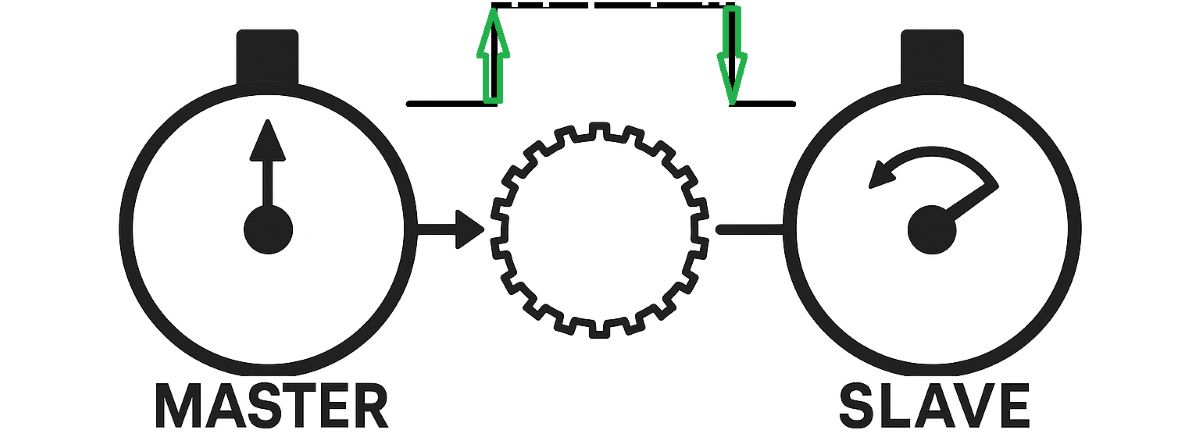
"Electronic gearing" in servo systems is a control technique commonly used to synchronize the movement of one servo motor with another motor or an encoder, serving as a reference signal. This technique replaces physical gears and establishes precise proportional relationships between two different motion systems, crucial for applications requiring accurate positioning and synchronized motion.
+ Master-Slave Relationship: In electronic gearing, one motor (typically referred to as the "master" or "leader") provides the reference for movement. Other motors (often called "slaves" or "followers") move in proportion to this reference motion.
+ Ratio Setting: Electronic gearing sets a ratio that determines how many turns the slave motor will make for each turn of the master motor. This ratio can be adjusted to meet the precise control and positioning requirements of the application.
+ Flexibility and Precision: Unlike physical gears, with electronic gearing, the ratios can be easily changed through software. This allows for quick adaptation to variable application requirements and achieves a high degree of precision.
+ Synchronization: Electronic gearing is used to synchronize the movements of multiple motors, which is critical in applications like printing machines, packaging machines, and CNC machines, where the coordinated movement of multiple axes is required.
Electronic gearing provides the flexibility to control and adjust motor movements independent of mechanical constraints, making system design more flexible and reducing maintenance needs.
One of the most important advantages of electronic gearing is the elimination of mechanical wear. Since no physical gears are involved, there is no friction-based degradation, which increases the reliability of the entire drive system. This benefit becomes highly valuable in high-speed production lines where downtime directly impacts productivity.
Another benefit is the potential for energy efficiency. With fewer mechanical losses, the system can deliver power more directly from the servo to the load. Especially in packaging and printing machines, this not only saves energy but also ensures consistent quality by maintaining precise motion profiles even under varying loads.
In practice, electronic gearing allows multiple motors to operate in perfect synchronization. This is crucial in multi-axis control systems such as CNC machines or roll-feed mechanisms, where even minor discrepancies in timing can lead to errors in final production. Electronic gearing minimizes these risks by ensuring absolute coordination.
Ultimately, electronic gearing has become a standard solution in modern automation systems. Its ability to adapt through software, reduce mechanical dependencies, and maintain high precision makes it indispensable. As industries demand faster and more flexible production systems, the use of electronic gearing will continue to expand across diverse applications.
Your shopping cart is empty!