
What is the difference between a vacuum sensor and a pressure sensor?
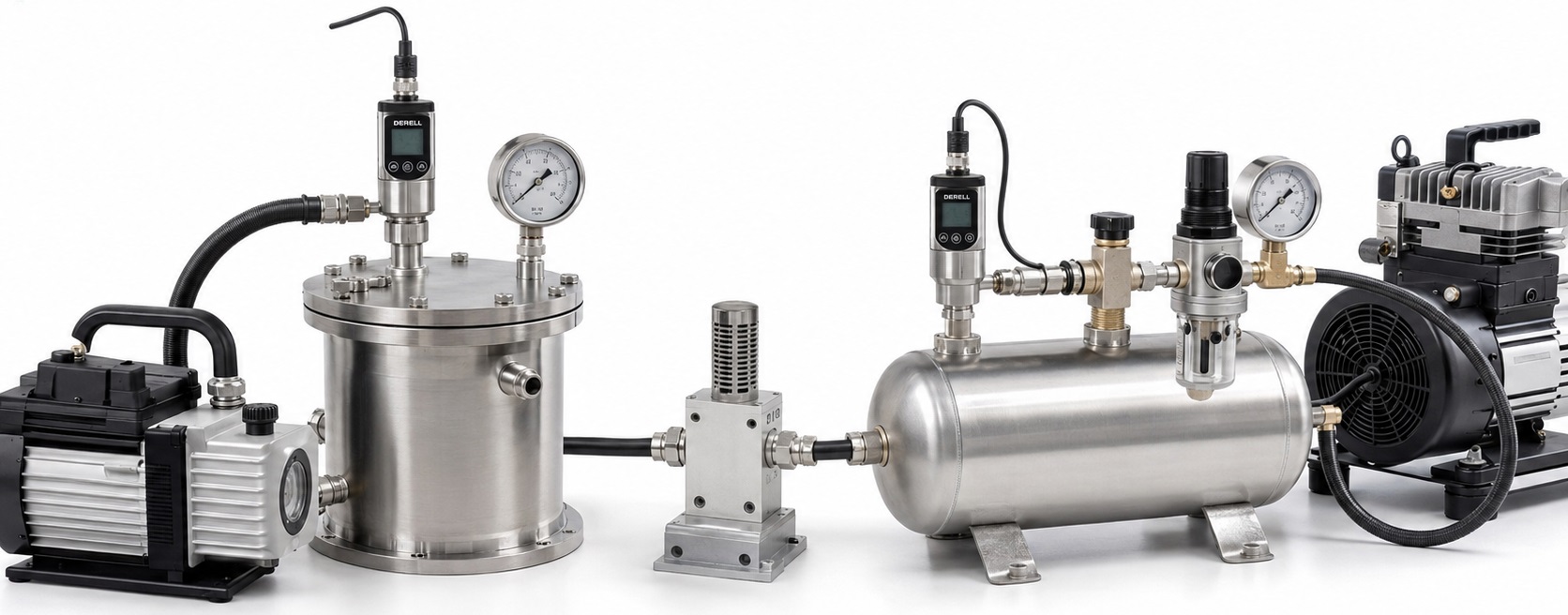
Vacuum sensors and pressure sensors both measure the same physical quantity: pressure. The main differences are the pressure range they are designed for, the reference used for measurement and the sensing technology inside the instrument.
It is therefore too simple to say that a pressure sensor only measures positive pressure while a vacuum sensor only measures negative pressure.
For the broader industrial pressure-sensing section, see our Pressure Sensors homepage.
What is a pressure sensor?
A pressure sensor converts the pressure of a gas or liquid into an electrical signal that can be measured or used by a control system.
Depending on its design, a pressure sensor may measure:
• Gauge pressure
• Absolute pressure
• Differential pressure
• Positive or negative gauge pressure
The term pressure sensor therefore describes a very broad family of measuring devices.
Pressure instruments and measurement methods are covered further under pressure measuring devices.
What is a vacuum sensor?
A vacuum sensor is designed specifically for measuring pressure in regions below ambient atmospheric pressure.
That pressure can be expressed in more than one way.
Gauge vacuum: pressure is referenced to local atmospheric pressure and may therefore be displayed as a negative gauge value.
Example:
-0.7 bar(g)
Absolute vacuum measurement: pressure is referenced to 0 Pa absolute, or ideal perfect vacuum.
Example:
300 mbar absolute
These values describe pressure using different reference points.
For the operating principles, see how a vacuum sensor works.
Gauge, absolute and differential pressure
The pressure reference is often more important than whether the product is marketed as a “pressure sensor” or “vacuum sensor”.
Gauge pressure is measured relative to ambient atmospheric pressure.
A pressure above atmosphere gives a positive gauge value, while a pressure below atmosphere can give a negative gauge value.
Absolute pressure is measured relative to 0 Pa absolute.
Differential pressure is the pressure difference between two measurement points.
A sensor specification should therefore always state or imply its pressure reference.
Why can a vacuum sensor show a negative value?
A negative gauge reading does not mean that absolute pressure itself has become negative.
For example, if atmospheric pressure is approximately 1.013 bar absolute and the sensor reads:
-0.8 bar gauge
then:
Pabsolute = Patmospheric + Pgauge
and approximately:
1.013 + (-0.8) = 0.213 bar absolute
The absolute pressure is still positive.
Can a pressure sensor measure vacuum?
Yes, if its measuring range and reference are suitable.
For example, a compound sensor with a range such as:
-1 to +1 bar gauge
can measure both vacuum relative to atmosphere and positive gauge pressure.
An absolute-pressure sensor may also measure pressures well below atmospheric pressure.
However, this does not mean that every ordinary pressure sensor can measure high vacuum.
At much lower absolute pressures, specialised technologies may be required, including:
• Pirani gauges
• Capacitance diaphragm gauges
• Cold-cathode gauges
• Hot-cathode ionization gauges
You can compare these technologies under different types of vacuum sensors.
Is a vacuum sensor a type of pressure sensor?
From a physics point of view, yes. A vacuum sensor is still measuring pressure.
In industrial terminology, however, the name “vacuum sensor” is useful because it identifies instruments designed specifically for pressure below atmospheric pressure.
For example:
Hydraulic pressure sensor: 0 to 250 bar gauge
Pneumatic pressure sensor: 0 to 10 bar gauge
Machine vacuum sensor: -1 to 0 bar gauge
High-vacuum gauge: very low absolute-pressure ranges
These are all pressure-measuring instruments, but their practical applications are very different.
Main differences between vacuum and pressure sensors
Measured quantity:
Both measure pressure.
Typical operating range:
Pressure sensors can cover many positive, negative or absolute-pressure ranges; vacuum sensors are specifically intended for pressure below atmosphere.
Pressure reference:
Depending on the design, either type may use gauge or absolute pressure reference.
Sensing technology:
Machine vacuum may use diaphragm or piezoresistive sensors, while high vacuum can require Pirani or ionization gauges.
Output signal:
Industrial devices may provide 4–20 mA, 0–10 V, switching outputs or digital communication.
When should I use a vacuum sensor?
A vacuum-range sensor may be appropriate for applications such as:
• Vacuum grippers
• Vacuum packaging
• CNC vacuum tables
• Vacuum chambers
• Vacuum furnaces
• PVD and CVD systems
• Laboratory vacuum systems
The sensor should be selected by its actual pressure range, pressure reference, process gas and required accuracy rather than by product name alone.
For a practical checklist, see vacuum sensor selection criteria.
Vacuum sensor vs pressure sensor in simple terms
Pressure sensor is the broader instrument category.
Vacuum sensor describes a pressure-measuring device intended specifically for pressure below ambient atmosphere.
The useful distinction is therefore not simply:
positive pressure vs negative pressure
but rather:
pressure range + reference type + sensing technology.
Related pressure and vacuum topics
Pressure Sensors homepage | Pressure measuring devices | How vacuum sensors work | Vacuum sensor types | Choosing a vacuum sensor
Main sections:
Pressure Sensors |
Vacuum Sensors |
Vacuum Pumps |
Vacuum FAQ
When selecting either a vacuum or pressure sensor, check the measuring range, gauge/absolute/differential reference, process medium and sensor technology rather than relying only on the product name.
You may share this article with attribution to Otomasyon AVM.