
How sustainable are vacuum technologies for the environment?
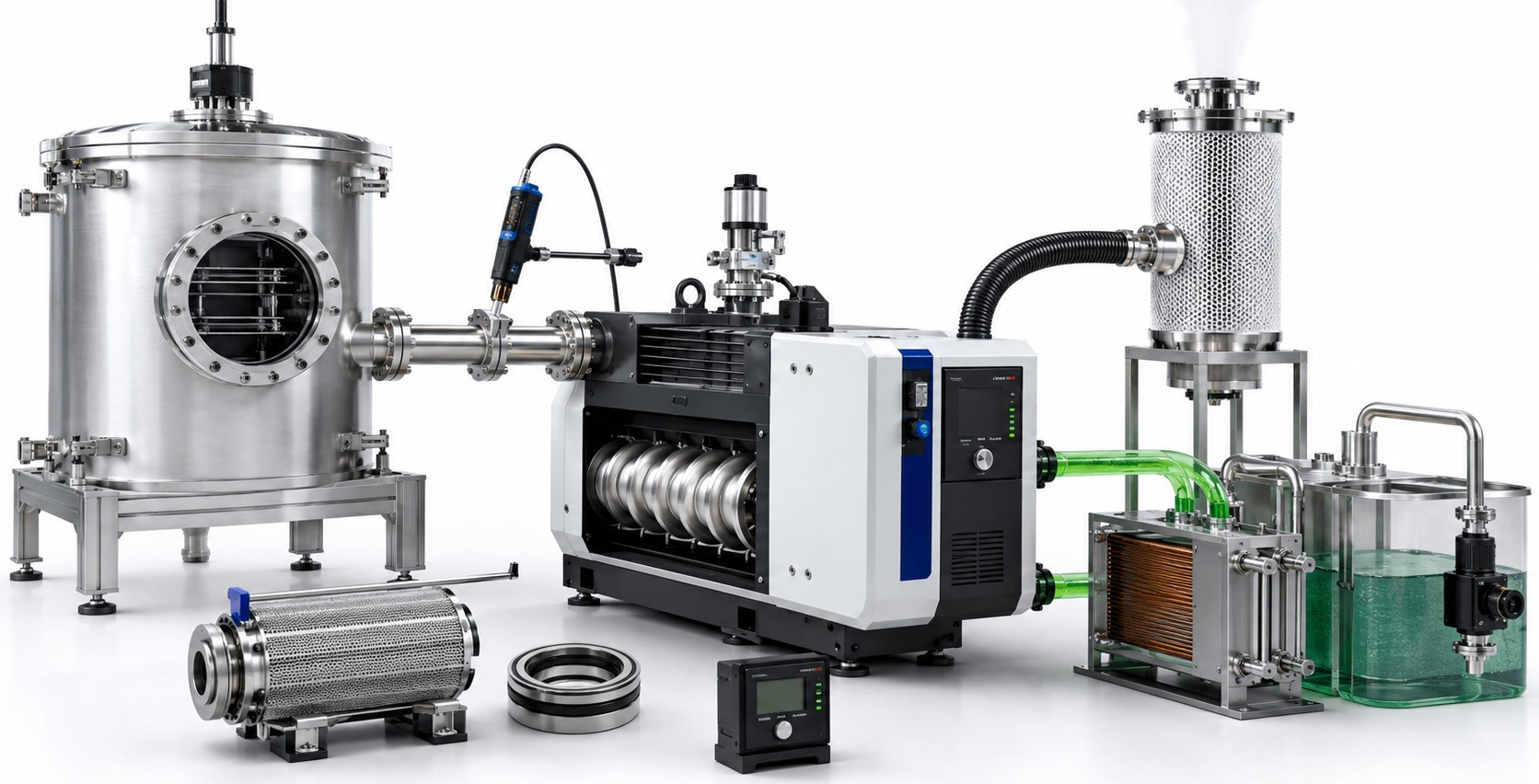
There is no single sustainability rating for vacuum technology. A small intermittently operated handling system, a pharmaceutical freeze dryer and a continuously running semiconductor vacuum plant have very different environmental profiles.
The useful question is therefore not simply whether vacuum technology is environmentally friendly. It is how efficiently the required vacuum is produced, maintained and used throughout the life of the equipment.
For the energy side of the subject, see energy efficiency in vacuum technology.
Electricity use is only one part of the environmental picture
Vacuum generation can consume significant electrical energy, particularly where pumps operate for long periods or continuously.
But motor power alone does not tell the full story.
The actual impact depends on factors such as:
+ How many hours the pump operates
+ Whether the pump is correctly sized
+ How much leakage enters the system
+ The pressure required by the process
+ Pump condition and maintenance
+ The way several pumps are controlled together
A larger pump is not automatically a better solution. If the process demand is modest, an oversized system may spend much of its life operating inefficiently.
This is one reason why correct vacuum pump selection matters both economically and environmentally.
The most sustainable vacuum level is usually the one the process actually needs
Vacuum systems are sometimes operated at a lower absolute pressure than the process really requires.
That does not necessarily improve the product or machine performance.
A better approach is to define:
+ The required operating pressure
+ Acceptable pressure variation
+ Required pump-down time
+ Expected gas load
and then design the system around those conditions.
The relationship between pressure and power is not identical for every pump technology, so it is also misleading to say that deeper vacuum always means proportionally higher instantaneous electrical power.
Leaks can turn into a permanent energy load
A leak allows gas to enter continuously while the pump continuously removes it.
The machine may still appear to work normally, but the vacuum system can spend more time running or may require additional pumping capacity.
This can mean:
+ Higher electricity consumption
+ Longer operating hours
+ Increased heat generation
+ More frequent maintenance
For that reason, leak control is not only a vacuum-performance issue. It can also be part of the site's energy-management programme.
Oil, filters and service parts also have an environmental cost
Oil-sealed vacuum pumps use consumables that have to be manufactured, transported, replaced and eventually handled as waste.
Typical items include:
+ Vacuum pump oil
+ Oil filters
+ Exhaust filters
+ Seals and service kits
Changing these parts unnecessarily wastes resources, while leaving them in service for too long may reduce pump performance or shorten equipment life.
The practical aim is therefore correct maintenance at the correct interval, using fluids and parts appropriate for the pump and process.
For fluid selection, see vacuum pump oils and compatibility.
Does a dry vacuum pump automatically have a lower environmental impact?
Not necessarily.
Dry pumping can be attractive where avoiding oil in the process chamber is important. It may reduce some oil-related consumables and contamination concerns.
However, a complete comparison still has to consider:
+ Electricity consumption
+ Cooling demand
+ Maintenance requirements
+ Service life
+ Suitability for the process gas
No single pump principle is the most sustainable option for every application.
Cooling can be a hidden part of vacuum-system consumption
Large pumps and some process vacuum installations require significant cooling.
Depending on the plant, the environmental load may therefore include:
+ Cooling-water consumption
+ Chiller electricity
+ Pumps used in the cooling circuit
+ Heat rejected into the plant environment
A vacuum system that looks efficient when only the motor nameplate is considered may look different once auxiliary equipment is included.
This is why whole-system evaluation is more useful than comparing pump motors alone.
Long equipment life can be a sustainability advantage
Keeping a well-designed machine in reliable service can reduce the need for replacement equipment, spare parts and manufacturing resources.
Good maintenance can help:
+ Preserve pumping performance
+ Avoid secondary damage
+ Extend pump service life
+ Reduce unnecessary component replacement
That makes maintenance part of environmental performance as well as reliability.
See vacuum pump maintenance and repair for the practical side.
Process chemicals may matter more than pump electricity
In some vacuum processes, the pump is only one part of the environmental footprint.
Coating, chemical and other manufacturing operations may involve process gases, solvents or other substances that require controlled handling.
The environmental assessment can therefore include:
+ Chemical consumption
+ Recovery or recycling opportunities
+ Exhaust treatment
+ Waste handling
+ Prevention of accidental releases
A highly efficient vacuum pump cannot by itself make an inefficient or poorly controlled process sustainable.
Gas and exhaust management are also closely related to vacuum-system safety.
Materials affect sustainability over the complete service life
Stainless steel, aluminium, elastomers, technical plastics, ceramics and other vacuum-compatible materials all require resources and energy to manufacture.
But material choice should not be judged from manufacturing impact alone.
A suitable material may also provide:
+ Longer component life
+ Lower leakage
+ Fewer seal replacements
+ Better chemical resistance
+ Less process contamination
The more useful comparison is therefore often based on the complete working life of the component.
Material compatibility is discussed further under materials used in vacuum technology.
Vacuum technology can also support energy-saving processes
The environmental effect of vacuum should not be measured only by the electricity used to generate it.
Vacuum can also enable processes that reduce energy or material losses elsewhere.
Examples include:
+ Vacuum insulation
+ Low-pressure drying
+ Vacuum distillation
+ Food packaging that can support longer product life
+ Controlled manufacturing processes that reduce scrap
Vacuum insulation panels, for example, can provide very low thermal conductivity in suitable building and refrigeration applications.
In cases like these, the value of the vacuum process has to be compared with the energy or materials saved during the product's use.
Central vacuum systems: efficient solution or hidden loss?
A central vacuum plant can be efficient where many machines require vacuum at similar pressure levels.
It can allow:
+ Pump staging according to demand
+ Centralised maintenance
+ Standby capacity
+ Better utilisation of installed pumping capacity
But a poorly designed central system may lose much of that advantage through long pipe runs, undersized pipework or persistent leaks.
The architecture has to suit the factory rather than following a universal rule.
Measurement and control can reduce waste
A vacuum sensor does not save electricity by itself, but it gives the controller information needed to avoid unnecessary operation.
Pressure feedback can be used to:
+ Stop or unload pumping when demand falls
+ Stage pumps in a central station
+ Detect loss of vacuum earlier
+ Prevent unnecessarily deep vacuum
This is one reason smarter control and condition monitoring are receiving more attention in new vacuum technology developments.
A lifecycle view gives a better answer
For an industrial vacuum system, environmental performance can be considered across several stages:
+ Equipment manufacture
+ Electricity used during operation
+ Cooling requirements
+ Oils, filters and service parts
+ Maintenance and repair
+ Equipment service life
+ End-of-life reuse, recycling or disposal
Two pumps with similar motor ratings can therefore have very different total environmental profiles over ten or fifteen years of operation.
Can vacuum technology become more sustainable?
The direction of development suggests several opportunities:
+ Better pump and motor efficiency
+ Demand-based control
+ Improved condition monitoring
+ Longer service intervals
+ Cleaner pumping methods
+ More durable materials and seals
+ Better integration with plant energy management
These themes also connect with the future development of vacuum technology.
So, how sustainable is vacuum technology?
The answer depends on the application.
A correctly sized system with controlled leakage, appropriate maintenance and demand-based operation can remain efficient for many years.
A poorly sized system that runs continuously, leaks heavily and produces more vacuum than the process needs can waste both energy and maintenance resources.
The more sustainable approach is not to generate the deepest possible vacuum, but to produce the vacuum the process actually needs with the lowest practical total resource use.
Related vacuum topics
Vacuum energy efficiency | Vacuum pump selection | Pump maintenance
Vacuum pump oils | Vacuum materials | Vacuum technology innovations
Main sections:
Vacuum Sensors |
Vacuum Pumps |
Pumps |
Vacuum FAQ
The environmental performance of a vacuum system depends on much more than pump efficiency. Correct sizing, leakage control, maintenance, consumables, cooling, process chemistry and equipment life all contribute to the final result.
You may share this article with attribution to Otomasyon AVM.