
About Square D
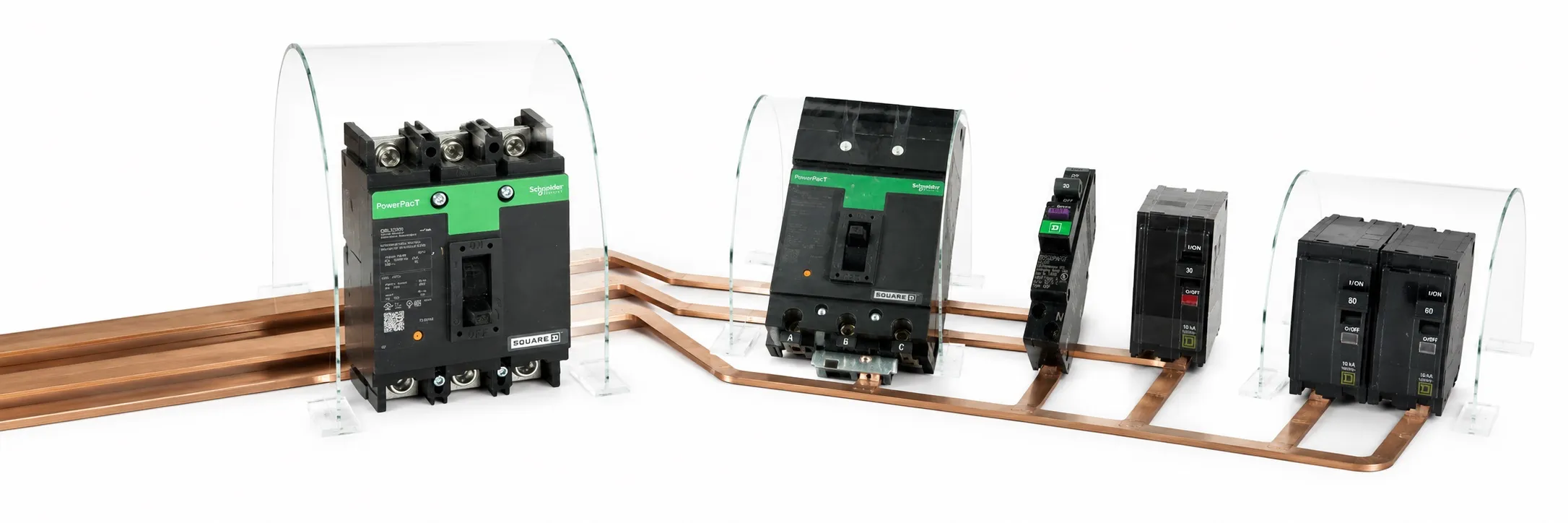
From safety switches to power distribution and motor control
Square D is an American brand with roots in Detroit in 1902, developed around circuit protection, electrical distribution and industrial control. It has been part of Schneider Electric since 1991. Identifying the brand only with residential circuit breakers misses much of its scope: its product world extends from load centers and distribution equipment to motor controls, transformers and busway systems.
The most useful way to understand Square D is to consider its business history alongside the technical suitability of individual products. Equipment carrying the same logo may have been manufactured in different periods for different markets and standards. The brand name alone therefore does not establish voltage suitability, mechanical compatibility or interchangeability.
Origins and history
Product families and applications
Selection, legacy equipment and maintenance
1902–1917: Detroit origins and the D inside a square
1902: Electrical engineer Bryson D. Horton established McBride Manufacturing Company, subsequently known as Detroit Fuse and Manufacturing. Enclosed fuses and fused switches were among its early products.
The Square D name came from the familiar D inside a square on its products, rather than a patent for a square enclosure. A 1955 US appellate court opinion records that Detroit Fuse & Manufacturing obtained trademark registration 103,050 in 1914. Recognition of the symbol influenced the corporate identity, and the Square D name was adopted in 1917.
The 1920s and 1930s: Panelboards, industrial control and circuit breakers
Its first power distribution panelboard followed in 1926. The 1929 merger with Industrial Controller Company expanded industrial control, alongside circuit breaker production under a Westinghouse licence. Square D's own breaker range followed in 1935.
One contemporary technical record is circuit breaker patent US2009050A, assigned to Square D: it was filed on April 24, 1933, and published on July 23, 1935. Such a record establishes the history of a particular design. It does not establish that circuit breaker technology as a whole was invented on that date or solely by that company.
1936–1955: Residential panelboards and the arrival of QO
Schneider's product chronology distinguishes the 1936 MO-4 residential panelboard, the 1951 plug-on connection milestone, and the 1955 introduction of the Qwik-Open, or QO, circuit breaker. The development involved more than a tripping mechanism: the breaker's connection and installation within the panelboard formed part of the product system.
Plug-on describes a connection designed to engage with a particular bus arrangement. It does not mean every plug-on breaker fits every panel. Likewise, the long history of QO does not establish unconditional interchangeability between all original components and every current product.
The 1950s to the 1980s: International expansion and electronic control
European expansion began in the 1950s. I-Line panelboards, Type S starters and Visi-Trip followed in 1966–1967; the Symax PLC and Watchdog energy management system arrived in 1978.
This history helps explain why an older factory may contain contactors, circuit breakers, PLCs and energy management equipment bearing the same Square D name. Historical breadth does not, however, mean all these devices remain in production or have identical service support.
1991: Becoming part of Schneider
Schneider acquired Square D in 1991. The acquisition formed part of the group's transformation towards electrical distribution and automation. Historical names such as Telemecanique and Merlin Gerin represent other branches of that corporate development. Bringing brands into the same group does not make their products technically identical.
The name remains in use in the United States as Square D by Schneider Electric. The transition of particular legacy UK offers to the Schneider Electric name should not be interpreted as worldwide withdrawal of the Square D brand. Market, product family and period all matter when interpreting branding.
What needs do the product families address?
QO and Homeline: These are separate families encountered in residential and suitable light commercial load centers and branch circuit protection. The manufacturer's comparison identifies single-phase and three-phase QO options, while Homeline options are single-phase. QO and Homeline branch circuit breakers are not interchangeable. The permitted breaker types shown on the panel labeling govern selection.
NQ, NF, I-Line and QED: NQ and NF serve lighting and final circuit distribution; I-Line uses a distinctive breaker engagement system for power distribution. QED identifies more extensive switchboard families. For example, QED-6 is a rear-connected switchboard solution. These names are not alternative labels for one breaker: equipment layout, service access and accepted devices differ.
PowerPacT: This is a molded-case circuit breaker family. Frame, trip unit, mounting arrangement and electrical ratings depend on the catalog reference. B-frame documentation, for example, describes unit-mount and I-Line options, overload and short-circuit protection, and ratings under different standards. Read IEC 60947-2 values and North American ratings from the documentation for the actual model.
MasterPacT MTZ: This family addresses higher-current main distribution and power circuit breaker applications. The North American UL/ANSI range page identifies an 800–6,000 A range; that does not mean every frame covers the entire range. PowerPacT and MasterPacT are different product families. Fixed or drawout construction, trip and metering equipment, applicable standards and maintenance arrangements require separate review.
Model 6 MCC: A motor control center groups control and protection equipment for multiple motors. Standard MCC arrangements, communicating iMCC systems, AR arc-resistant designs and CDR closed-door racking options are distinct. Do not assume every Model 6 installation includes all these features.
Contactors and motor starters: Select a contactor by more than its ampere rating. Square D classifications distinguish 8502 for motor control, 8903 for lighting loads, and 8910 for definite-purpose applications. Coil details, switching frequency, load characteristics and auxiliary contacts all matter. In an IEC-based project, consider the selection framework of IEC 60947-4-1 as well; a NEMA size and an IEC utilization category cannot be reduced to one current figure.
Safety switches and other distribution equipment: Fusible and non-fusible disconnects require consideration of voltage, current, motor duty, enclosure and short-circuit ratings. The broader portfolio also includes busway, transformers, surge protection and metering solutions. Isolation, overcurrent protection and motor control perform different tasks; the appropriate combination depends on the project.
Editor's note: “Both are Square D and have the same current rating” is not a replacement criterion. In particular, do not confuse QO with Homeline. Check the panel label, complete catalog reference and manufacturer-approved equipment combination.
Selecting equipment for Türkiye or an international project
Voltage, frequency and supply configuration: Ratings in a North American catalog should not be transferred directly to an installation in Türkiye. Conversely, it is incorrect to claim that all Square D products operate only at 60 Hz. The manufacturer identifies 50/60 Hz ratings for certain standard QO breakers and 60 Hz-only ratings for particular electronically protected types. The exact product label and current data sheet determine suitability. An AC rating does not establish DC suitability unless separately specified.
Standards and approvals: UL 489 and IEC assessments are not two names for the same testing framework. At the same time, the Square D portfolio includes IEC-certified examples such as QOXD and QOBXD. An IEC option within a family does not confer the same approval on every market reference in that family. Review the required documentation for the individual product and installation.
Short-circuit ratings and the complete assembly: Read a breaker's interrupting rating with its specified voltage and test conditions. A panel's SCCR cannot simply be equated with the kA rating of one installed breaker. UL 508A industrial control panels require assessment of the components and protective arrangement together. Series ratings apply only to the documented device combination and application conditions.
Enclosures and mounting: NEMA enclosure types and IP codes are different classification systems. Do not invent an IP rating for a safety switch documented only with a NEMA type. Bus connections, mounting kits, terminals, conductor types and tightening torques also form part of the selection record. Physical fit does not prove an approved replacement.
Legacy Square D, Sy/Max and second-hand equipment
Before upgrading an older installation, record complete catalog numbers, series information, accessories, wiring diagrams and control voltages. For historical control systems such as Sy/Max, choosing a new PLC without establishing the program backup, I/O arrangement, communications and available software tools reduces the exercise to comparing input and output counts. Modernization requires engineering across power circuits, control circuits and software.
Operating manuals and technical documents are the starting point when investigating replacements. With second-hand Schneider Electric equipment, appearance does not verify protective performance. Review label legibility, mechanical condition, modified parts and previous service conditions; carry out the necessary functional and protection tests using appropriate methods. Brand reputation cannot compensate for an unknown equipment history.
Check product safety records by model as well. On June 16, 2022, the US CPSC announced a recall of certain QO Plug-on-Neutral load centers because of overheating hazards. The notice concerns particular catalog and manufacturing codes; it should not be generalized to all Square D or all QO products. Where applicable, follow the manufacturer's procedure and assessment by a qualified electrician.
Related brands and technical archives
Schneider Electric history and profile
About Merlin Gerin
About Telemecanique
Schneider Electric user manuals
Schneider Electric second-hand category
Supporting selection and panel topics
Contactors
IEC 60947-2 circuit breakers
UL 489 circuit breakers
UL 508A industrial control panels
Determining panel SCCR
Sources and technical documentation
Schneider Electric: 170 years of history, archived copy
US Seventh Circuit: Square D trademark record, 1955 opinion
US patent record: US2009050A circuit breaker
Schneider Electric: residential panelboard, plug-on and QO chronology
Schneider Electric: group history and acquisitions
Schneider Electric UK: Square D history and local branding transition
Square D: current US brand and product scope
QO and Homeline: differences and non-interchangeability
NQ, NF and QED distribution equipment
I-Line: connection architecture and application conditions
PowerPacT B-frame: official technical catalog
MasterPacT MTZ: North American UL/ANSI range
Model 6 MCC: standard, iMCC, AR and CDR options
8502, 8903 and 8910 contactor classes
QO: frequency ratings and electronic-type exceptions
IEC-certified QO products: QOXD and QOBXD
Safety switches: electrical ratings and selection
Safety switches: NEMA enclosure classification
UL Solutions: circuit breaker marking and application guide
UL Solutions: industrial control panels
CPSC: 2022 notice for specified QO Plug-on-Neutral load centers