
About Merlin Gerin
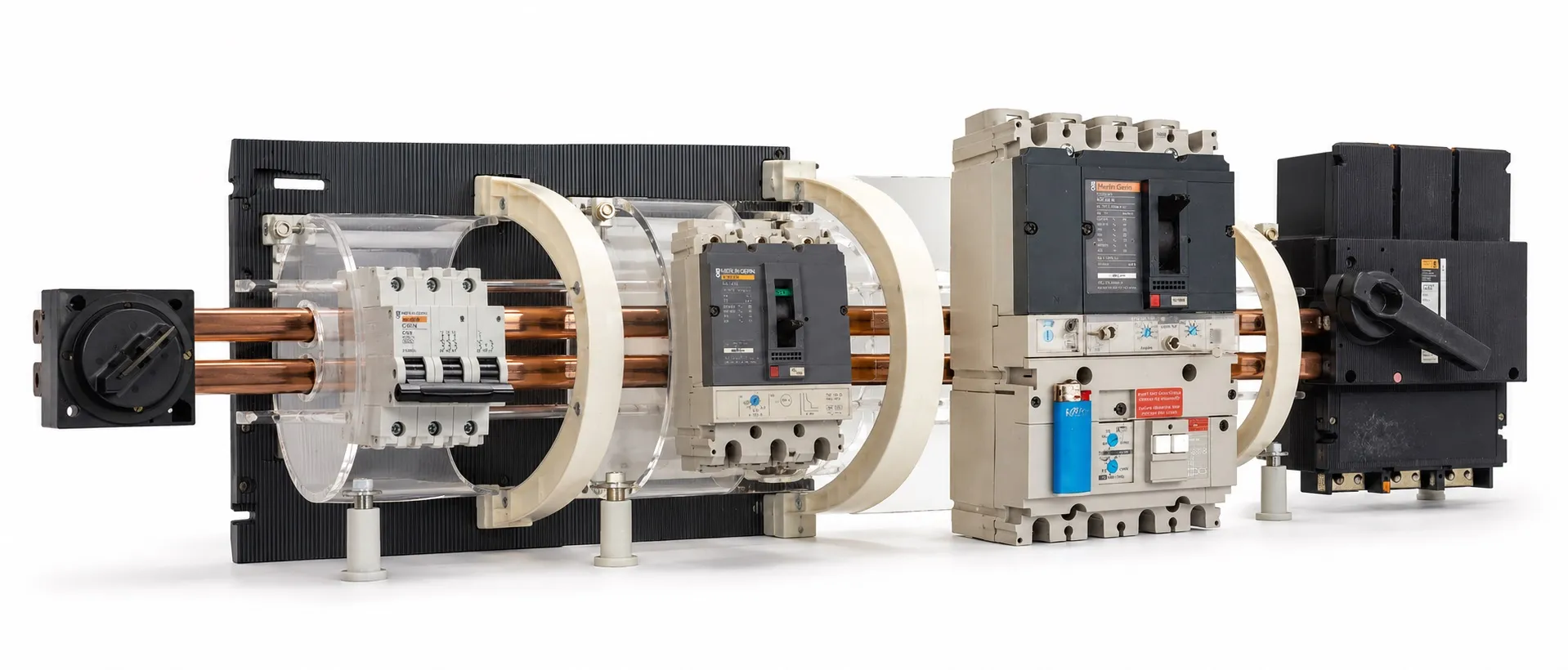
From Grenoble engineering to modern electrical distribution
Merlin Gerin is a French name associated with electrical distribution and protection, whose heritage continues within Schneider Electric. It remains familiar from factory switchboards, commercial buildings and older installations. Understanding the brand requires separating its foundation, its acquisition by Schneider, the branding transition and successive product generations. For users of switchgear, that history also helps identify equipment still in service.
1920–1933: foundation and manufacturing capabilities
Paul-Louis Merlin and Gaston Gerin founded the business in Grenoble in 1920; it became a joint-stock company in 1922. Electro-Porcelaine joined in 1924 and Dauphinoise Electrique in 1933, strengthening electrical insulation and metalworking capabilities.
Early expertise included medium- and high-voltage oil circuit breakers. The Volta laboratory opened in 1921, followed by an apprenticeship school in 1929.
1930s–1951: networks and circuit-breaker development
Marine, mining and network projects became important markets in the 1930s. After the war, French hydroelectric investment and electrification supported expansion. Transformer activities also predated this period; describing them simply as a diversification that began in the 1960s misses part of the history.
Milestones included a pneumatic breaker in 1937 and a 1946 breaker with 15 kV and 10 kA interruption ratings. Compact low-voltage breakers followed under a Westinghouse licence in 1951.
1950s–1974: international distribution and modular protection
An international subsidiary and distribution network expanded from the 1950s. Growth therefore depended on more than a single invention: product ranges, technical support and access to customers developed together. The F32 miniature circuit breaker for residential use, introduced in 1972, was one low-voltage example.
The Multi 9 modular protection system arrived in 1974. Its name reflects a modular dimensional approach based on multiples of 9 mm. This helped organize final-distribution devices into orderly, expandable assemblies. Modularity does not establish busbar or accessory compatibility between every generation.
1975–1992: Schneider investment and the Masterpact era
The Schneider group acquired an interest in Merlin Gerin in 1975, followed by the acquisition in 1992. A merger date of 1981 is therefore incorrect; that year belongs to the period in which Schneider refocused on the electrical industry. The group also acquired Telemecanique in 1988 and Square D in 1991. The Schneider Electric name was adopted in 1999.
A major product milestone was the 800–6300 A Masterpact air circuit breaker introduced in 1986. Main incomers and bus couplers in large switchboards require more than high current capability: protection settings, coordination and maintainability are also central considerations.
1996–2007: UPS activities and the MGE connection
Merlin Gerin’s history extends beyond circuit breakers. According to a 2006 decision by the French competition authority, the UPS business historically developed by Merlin Gerin became a separate MGE company in 1996. Schneider regained control of MGE in 2004. This business line deserves separate treatment when tracing its uninterruptible power supply heritage.
In 2007, APC and MGE UPS Systems activities were brought together within Schneider’s Critical Power & Cooling Services organization. That year, MGE’s small UPS business below 10 kVA was sold to Eaton. Consequently, “all of MGE became Eaton” and “APC is the new name for Merlin Gerin” are both misleading simplifications.
2008–2009: a branding transition distinct from acquisition
Schneider’s 2008 annual report records the start of the Merlin Gerin and Telemecanique transition towards the Schneider Electric name, with Schneider colours appearing on packaging from the end of 2008. The current corporate account states that Merlin Gerin products, services and solutions migrated to the Schneider Electric brand in 2009. 1992 refers to the acquisition; 2009 refers to the branding transition.
Editor’s note: A Merlin Gerin label does not mean that a device was discontinued in 2009. Brand migration, product lifecycle and compatibility with a newer generation are separate matters. Decisions about an older breaker should use its full reference, series, trip unit and applicable manufacturer documentation, rather than its logo.
Development in Türkiye: Emek and the İzmir connection
The Turkish Investment Office’s historical company profile records the start of Merlin Gerin medium-voltage breaker production under a licence granted to Emek in 1978. The 1988 acquisition of Emek and expansion of the low-voltage dealer network strengthened that presence. The Kemalpaşa medium-voltage factory was expanded in 1997 and became a global production centre in 1999. The brand’s Turkish history therefore includes local manufacturing as well as imported equipment.
Compact: a product family is not a drop-in replacement
Compact is particularly associated with moulded-case circuit breakers. Schneider identifies Compact NSX as the successor to the former Compact NS <630 A range. That does not provide one replacement reference for every old NS device. Current rating, number of poles, breaking capacity, connection arrangement and tripping characteristics must be matched for the actual product.
Masterpact generations and modernization
The Masterpact line subsequently developed through generations including NT, NW and MTZ. Schneider’s Plug&Play and Masterkit solutions for Masterpact M can retain the existing switchboard structure in specified applications. They do not establish that every new breaker fits every old chassis directly; the correct kit and application scope require confirmation.
Multi 9, Acti9 and the applicable protection standard
The Multi 9 heritage extends to families such as Acti9 and Resi9, while Multi9 also remains within Schneider’s current product structure, particularly for OEM applications. It is therefore inaccurate to say that every Multi9 product has disappeared. The scope of IEC 60898 for household and similar applications must also be distinguished from IEC 60947-2 for industrial circuit breakers. Read the device markings together with its applicable catalogue.
Medium voltage, measurement and protection
The company’s expertise was broader than small modular breakers. Medium-voltage distribution, circuit breakers and switchgear assemblies also belong to its historical profile. Schneider currently describes SM6-24 as modular air-insulated distribution switchgear up to 24 kV and points to the SF6-free SM AirSeT alternative. An air-insulated assembly does not, by itself, establish that every switching compartment is SF6-free.
An installation assessment also considers the measurement and protection chain. Current-transformer ratios and connections, protection settings, trip circuits and earthing arrangements need to be considered together. A switchboard is a system of components; its overall safety or performance cannot be established from the brand name on the front of one breaker.
Reading the identification of an older device
Record the complete product reference, frame rating, rated voltage, pole arrangement, Icu/Ics ratings and trip unit. References for auxiliary contacts, undervoltage releases, shunt releases, motor mechanisms and any drawout arrangement also matter. Two breakers with the same ampere rating may have different protection behaviour and incompatible accessories.
For example, replacing a Compact NS requires more than selecting another 250 A device. Review the installation’s prospective short-circuit current, protection settings, and selectivity and cascading coordination with upstream and downstream devices. Cascading suitability cannot be inferred from a current-limitation curve alone; use the manufacturer’s verified coordination tables.
Maintenance, used equipment and replacement decisions
An old brand name alone is not a reason to scrap equipment, while years of uninterrupted service are not sufficient proof of safety. Assess mechanical condition, tripping functions, fault history, spare-part availability and outage costs together. Dust, humidity, temperature and the enclosure’s IP protection characteristics also belong in that assessment.
For used Merlin Gerin equipment, establish identity and verifiable condition before judging appearance. Insulation-resistance measurement is only part of an appropriate assessment and does not, by itself, prove the protective tripping function. Test methods must suit the electronic trip unit and manufacturer instructions. Possible successors among Schneider Electric products require the same technical matching.
How to assess the brand’s value today
Merlin Gerin’s technical significance lies in the combined development of testing capabilities, circuit-breaker families, modular protection and distribution systems. For today’s user, the practical value is identifying installed equipment correctly and making a documented maintenance or replacement decision. Brand heritage cannot substitute for the condition of an individual product. The same distinction applies when selecting second-hand equipment.
Related products and technical topics
Distribution and protection: Moulded-case circuit breakers, residual-current protection, IEC 60947-3 switching and isolating devices, surge protective devices, switchgear main page.
Measurement and supporting systems: Current transformers, UPS systems, power supplies, resistance-to-earth measurement, insulation measurement.
Sources
Isère public archives: Merlin Gerin company records and development
Schneider Electric: foundation and product milestones
Schneider Electric 2015 report: the 1975, 1992 and 1999 chronology
Schneider Electric 2008 report: the beginning of brand migration
Schneider Electric: the 2009 transition and legacy trademark status
Turkish Investment Office: Emek and manufacturing history in Türkiye
French competition authority: MGE developments in 1996 and 2004
Schneider Electric 2007 report: APC, MGE and the small UPS business disposal
Schneider Electric 9 Series: Multi9, Acti9 and modular design
Schneider Electric: Compact NS and its NSX successor
Schneider Electric: Masterpact maintenance and modernization services
Schneider Electric: SM6-24 and the SM AirSeT alternative
Schneider Electric NSX guide: limitation and coordination tables