
What is Pulse Transformer?
Hi dear visitor,
A pulse transformer is a type of transformer optimized for transmitting rectangular electrical pulses. It operates on the principles of magnetic induction but is specialized for handling sharp pulses of electrical current rather than continuous sinusoidal waveforms. Pulse transformers are commonly used in digital logic, pulse processing, and timing applications.
Volt-second balance: Unipolar drive biases the core; if the limit is exceeded you get SATURATION. Bipolar drive restores balance.
Coupling k: As k→1, leakage decreases and the secondary pulse shape improves.
Key Features:
High Bandwidth: Pulse transformers often have high bandwidth capabilities to faithfully transmit fast-changing signals.
Isolation: Provides electrical isolation between the input and output circuits, reducing the risk of electrical noise and interference.
Turns Ratio: The transformer’s turns ratio helps determine the voltage and current relationship between the primary and secondary coils.
Minimal Phase Shift: Designed to have minimal phase shift to ensure that the pulse shape is maintained as closely as possible through the transformer.
Low Distortion: Engineered to have low distortion to ensure that the shape and amplitude of the pulse are preserved.
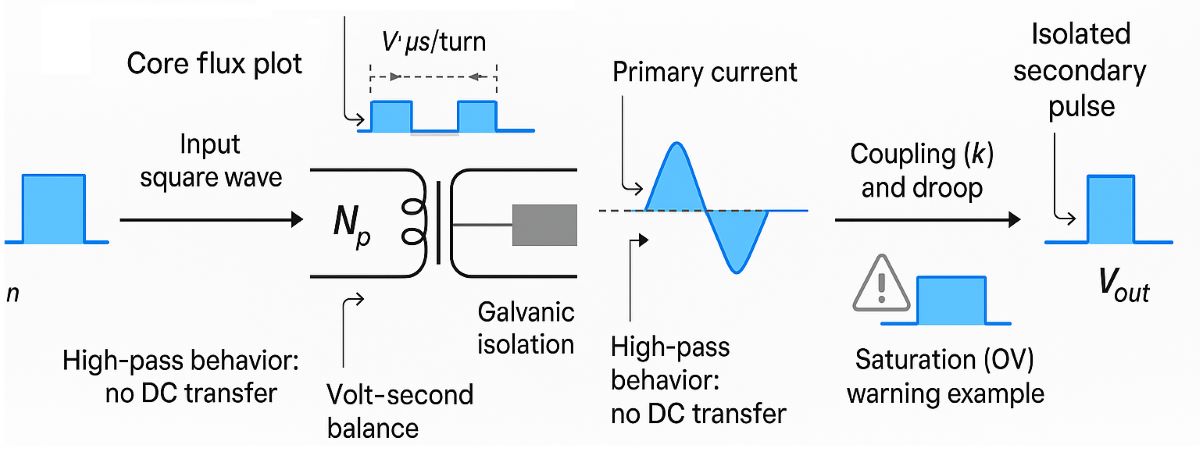
How It Works:
Primary Coil: The primary coil receives the pulse signal from the source.
Magnetic Core: The core serves to couple the primary and secondary coils. It may be made from ferrite or other materials that support high-frequency transmission.
Secondary Coil: The secondary coil outputs the transformed pulse to the next stage of the circuit or device.
Applications:
Telecommunications: For signal splitting and combining, as well as impedance matching.
Radar Systems: In pulse generation and signal processing.
Switching Power Supplies: To provide isolation and voltage transformation.
Data Transmission: Used in Ethernet and other data communication protocols.
Medical Equipment: In devices like defibrillators that require precise pulse delivery.
Limitations:
Limited Energy Storage: Due to their focus on high-frequency operation, they often have limited energy storage capacity.
Cost: High-bandwidth, low-distortion models can be expensive.
Size: Depending on the application, they may need to be relatively large to handle the required pulse parameters.
Pulse transformers are essential in various high-frequency and pulse-oriented applications, where they provide both functional and safety features like signal isolation and voltage transformation.
"The topic of electronic components and Transformers is broad in scope, encompassing a diverse range of products. Here are the answers to the most common questions posed by our valued visitors."
- Step-Up and Step-Down Transformers
-------------
- What is an integrated circuit?
- What is a crystal oscillator?
- What is an LED (Light Emitting Diode)?
- What is a radio frequency (RF) module?
- What is a ceramic resonator?
"These questions often include those that many people might have about the component parts of electronic devices. Each user or student will have their own specific questions depending on a particular situation or application. The answers provided are not binding and do not express absolute certainty. You are free to share the article above, citing it as a source. 01/2020."
Your shopping cart is empty!