
Omron 3G3FV fault codes
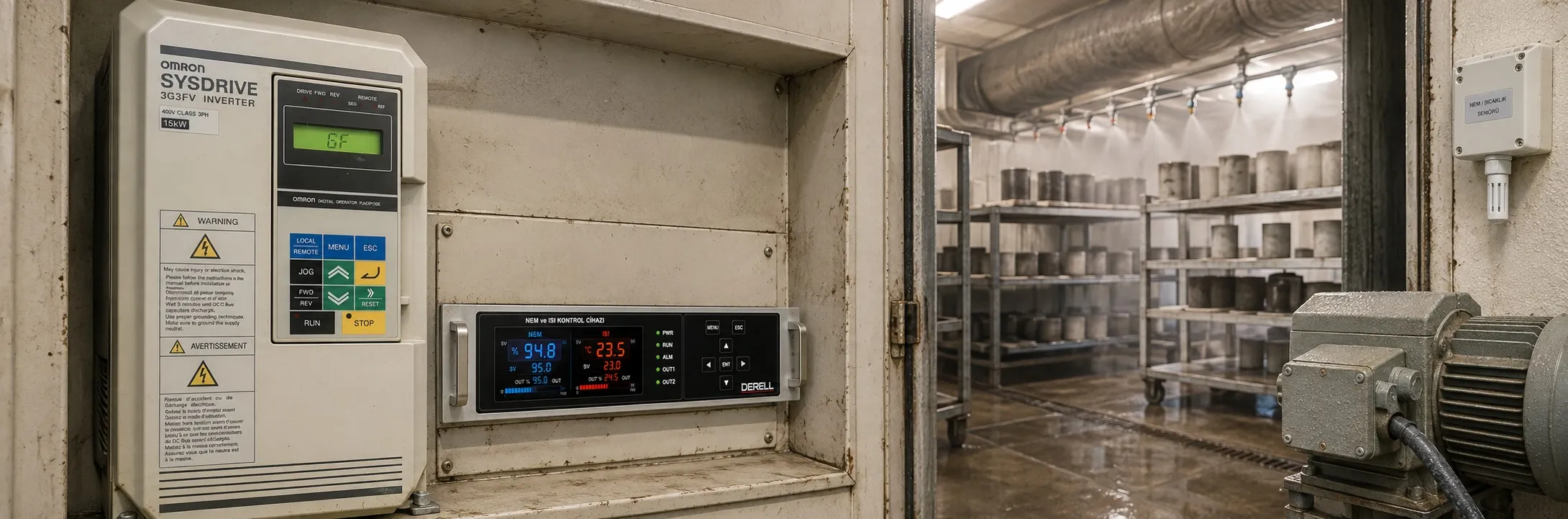
The Omron 3G3FV VFD (Variable Frequency Drive) fault detection and handling system is designed to protect both the drive and the motor from various types of faults. Here's a detailed explanation of each fault code, its probable causes, and the recommended remedies:
Overcurrent (OC)
- Causes: Short-circuit or ground fault at the inverter output, excessive load, too short acceleration/deceleration time, use of a special-purpose or oversized motor, or switching a magnetic switch at the inverter's output.
+ Remedies: Identify and correct the cause of the overcurrent, then reset the fault.
Ground Fault (GF)
- Causes: Ground fault at the inverter's output due to motor burn damage, worn insulation, or a damaged cable.
+ Remedies: Rectify the ground fault and reset the error.
DC Bus Fuse Open (PUF)
- Causes: Blown fuse in the main circuit due to a short-circuit or ground fault at the inverter's output.
+ Remedies: Check for short-circuits between terminals, replace the inverter after correcting the cause.
Short Circuit (SC)
- Causes: Short-circuit or ground fault at the inverter's output.
+ Remedies: Correct the cause of the short-circuit and reset the fault.
Overvoltage (OV)
- Causes: Excessive DC voltage in the main circuit, too short deceleration time, regenerative energy from the motor, surge from phase-advancer condenser switch, or high power supply voltage.
+ Remedies: Increase deceleration time, connect a braking resistor, add an AC reactor, or decrease the power supply voltage.
DC Bus Undervolt (UV1)
- Causes: Main circuit DC voltage below the undervoltage detection level due to phase loss, power interruption, loose wiring terminals, or large voltage fluctuations.
+ Remedies: Reset the fault after correcting its cause.
CTL PS Undervolt (UV2), MC Answerback (UV3)
- Causes: Drop in control power supply voltage or failure in the inrush prevention circuit.
+ Remedies: Try turning the power supply off and on, replace the inverter if the fault persists.
Input Phase Loss (PF)
- Causes: Phase loss in the input power supply, momentary power interruption, loose wiring terminals, large voltage fluctuations, or bad voltage balance between phases.
+ Remedies: Reset the fault after correcting its cause, replace the electrolytic condenser if necessary.
Output Phase Loss (LF)
- Causes: Broken wire in the output cable or motor's winding, loose output terminals, or using a motor with a capacity less than 10% of the inverter's maximum motor capacity.
+ Remedies: Check and correct the cause of the phase loss, check the motor and inverter capacity.
Heatsink Overtemperature (OH)
- Causes: High ambient temperature, nearby heat source, stopped cooling fan, or high carrier frequency.
+ Remedies: Install a cooling unit, remove the heat source, replace the cooling fan, or decrease the carrier frequency setting.
Dynamic Brake Resistor (RH) and Transistor (RR) Faults
- Causes: Overheated braking resistor due to short deceleration time and large regenerative energy, or malfunctioning braking transistor.
+ Remedies: Lighten the load, increase deceleration time, reduce motor speed, change to a Braking Resistor Unit, or replace the inverter if the fault persists.
Motor Overload (OL1), Inverter Overload (OL2)
- Causes: Excessive load, too short acceleration/deceleration/cycle times, high V/f characteristics voltage, or incorrect motor's rated current setting.
+ Remedies: Check the load size, adjust the acceleration/deceleration/cycle times, check the V/f characteristics, check the motor's rated current setting, or replace the inverter with a larger capacity one.
Overtorque Detection (OL3, OL4)
- Causes: Current greater than the setting in L6-02 or L6-05 for longer than the setting in L6-03 or L6-06.
+ Remedies: Ensure appropriate settings in L6-02, L6-03, L6-05, and L6-06, check the mechanical system and correct the cause of the overtorque.
Overspeed (OS)
- Causes: Speed greater than the setting in F1-08 for longer than the setting in F1-09, overshooting/undershooting, or too high reference speed.
+ Remedies: Adjust the gain, check the reference circuit and reference gain, check the settings in F1-08 and F1-09.
PG Open (PGO)
- Causes: Disconnected PG, no PG pulses being input while the inverter is outputting a frequency.
+ Remedies: Fix broken/disconnected PG wiring, correct the wiring, supply power to the PG properly, set F9-05 to 0 if the torque limit is set to 0 through CompoBus/D communications.
Speed Deviation (DEV)
- Causes: Large load, too short acceleration/deceleration time, locked load, or inappropriate settings in F1-10 and F1-11.
+ Remedies: Lighten the load, lengthen the acceleration/deceleration time, check the mechanical system, check the settings in F1-10 and F1-11.