
Low torque error
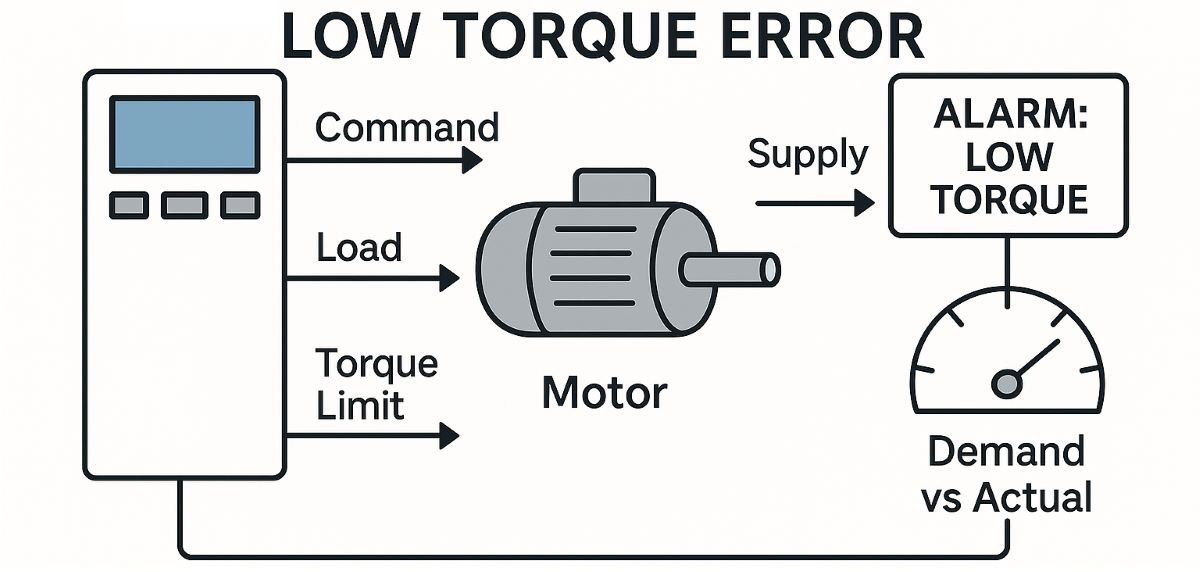
What Is a Low Torque, Undertorque or Underload Fault?
On many variable frequency drives, a Low Torque, Undertorque or Underload function monitors whether motor load, output current or estimated motor torque has fallen below a configured minimum level for a defined period of time.
The name can be misleading.
It does not always mean:
“The motor is too weak to produce enough torque.”
Very often it means something closer to:
“The motor is running, but the mechanical load that should be present appears to have disappeared.”
A broken conveyor belt, disconnected coupling, loss of pump load or missing process material can all reduce the motor's current or estimated torque while the motor itself continues to rotate normally.
This is why Undertorque should be distinguished from Motor Stall, overload and current limiting.
For the wider diagnostic tree, see the OtomasyonAVM VFD Fault Codes guide.
The basic Undertorque Detection principle
A typical function uses two main settings:
Underload threshold: how low may the measured load fall?
Detection delay: how long must the load remain below that threshold before the drive responds?
This prevents a very short load fluctuation from being treated as a genuine mechanical failure.
Yaskawa's Undertorque Detection, for example, can compare drive output current or torque against a configured level and applies a programmable detection time before producing an alarm or fault. :contentReference[oaicite:9]{index=9}
What does the VFD actually measure?
That depends on drive family and control mode.
In some V/F applications, output current may be used as an indirect indication of mechanical load.
With more advanced torque/vector control, the drive may calculate an estimated motor torque from its motor model and measured electrical quantities.
Therefore a setting called “Low Torque 20%” should not automatically be interpreted as a precision shaft-torque measurement. The manufacturer parameter definition matters.
Common causes of Undertorque / Underload
Broken conveyor belt: the motor continues running but no longer carries the normal mechanical load.
Broken or disconnected coupling: the motor becomes almost unloaded.
Pump load disappears: depending on pump type and operating condition, dry running or loss of process load can significantly reduce motor loading.
No product on the machine: feeders and conveyors may show much lower torque when process material is no longer present.
Mechanical clutch or load has disengaged: the motor is electrically healthy but disconnected from the actual work.
Underload threshold set too high: normal light-load operation is incorrectly identified as a fault.
Detection delay set too short: ordinary transient load changes produce nuisance alarms.
Why is Underload Detection useful?
Because not every machine failure causes high current.
A broken belt can produce the exact opposite condition:
motor current falls.
The motor can sound perfectly healthy, run at commanded speed and never trigger an overcurrent or overload alarm, while the production process has completely stopped.
Underload detection gives the VFD a way to recognise this “motor running but no useful work” condition.
How can a VFD detect a broken belt?
Imagine a conveyor normally running at approximately 55% motor load.
If the belt breaks, the motor can suddenly drop to 10% load while continuing to rotate at nearly the same speed.
If the configured underload threshold is 25% and the measured load stays below it for three seconds, the drive can generate an alarm, digital output or fault depending on its configuration.
Low Torque vs Motor Stall
These conditions can be almost opposite.
With Motor Stall, the machine load is too heavy or physically jammed and the motor cannot maintain the commanded motion.
With Underload / Undertorque, the load may have become unexpectedly light or disappeared completely.
STALL: “There is too much load for me to move.”
UNDERLOAD: “Where did the load go?”
Low Torque vs Torque Limit
They are not the same function.
A torque limit restricts how much torque the motor is permitted to produce.
Undertorque detection monitors whether the actual or estimated motor loading has become too small.
One manages maximum torque production; the other monitors minimum expected process load.
Does low supply voltage cause a Low Torque fault?
Low supply voltage can reduce available motor performance, but it should not automatically be treated as the primary explanation for an Undertorque Detection alarm.
First identify exactly what the manufacturer's “Low Torque” function measures.
If the motor is actually unable to accelerate or produce the torque demanded by the machine, the problem may belong to the stall, current-limit, torque-limit, motor-sizing or voltage side of troubleshooting rather than underload detection.
ABB Underload example
ABB drive documentation describes Underload as a condition where motor load is too low, with driven-equipment release or loss of mechanical load among the conditions to investigate. OtomasyonAVM's ABB fault pages preserve the same diagnostic meaning. :contentReference[oaicite:10]{index=10}
Yaskawa UL3 example
On Yaskawa drives, UL3 – Undertorque Detection can occur when output current or torque remains below the configured threshold for longer than the specified detection time.
Depending on parameter selection, the drive can continue running with an alarm or stop on a fault. :contentReference[oaicite:11]{index=11}
INVT Underload example
Some INVT drive families use LL – Underload or similar protection terminology.
See the OtomasyonAVM INVT Fault Codes page for manufacturer-specific examples; the LL entry is defined as an underload pre-alarm based on the configured threshold. :contentReference[oaicite:12]{index=12}
A practical Low Torque troubleshooting sequence
1. Record the exact message. Low Torque, Undertorque, Underload, UL3 or LL are not universal codes.
2. Read the manufacturer definition. Does the parameter monitor output current, calculated torque or another load indicator?
3. Check the underload threshold. A threshold above normal light-load operation will generate nuisance alarms.
4. Check the detection delay. A very short delay can interpret ordinary process transitions as faults.
5. Inspect the mechanical load. Check belts, couplings, chains, clutches, pump conditions and process material.
6. Review motor current immediately before the alarm. A significant fall in motor current supports an underload diagnosis.
7. Compare speed with load. A motor running happily at reference speed while load collapses is a classic underload signature.
8. If the motor cannot reach speed and current is high, look elsewhere. That condition is much closer to stall, overload or current limiting.
How should the underload threshold be set?
There is no universal percentage.
First observe the machine's normal operating load.
If a machine normally runs between 45% and 70% load but falls to 12% when the belt or coupling is disconnected, the threshold can be chosen to reliably distinguish those operating regions.
The detection delay should then be long enough to ignore legitimate short process transitions.
Learn the machine's normal load signature instead of copying a percentage from another machine.
Should a Low Torque event always trip the VFD?
No.
Depending on the drive, an undertorque event may be configured as:
digital-output indication only
warning while operation continues
fault / trip
The correct response depends on what low load means for the process.
Why may detection be disabled during acceleration?
Motor loading during acceleration, deceleration and low-speed operation can differ significantly from normal steady-state operation.
To reduce false detection, some drives allow Undertorque Detection only at speed agree or under specific RUN conditions.
Yaskawa provides separate parameter selections for undertorque detection at speed agree and during RUN. :contentReference[oaicite:13]{index=13}
Editor's field note
When I see a Low Torque alarm, my first instinct is not to increase torque boost.
I ask a different question:
“Where did the load go?”
Did the belt break? Did the coupling disconnect? Is the pump no longer loaded? Has the process material disappeared?
If the motor is happily running at 1500 rpm while its current has suddenly dropped in half, the motor may not be weak at all.
It may simply have nothing left to do.
Low Torque / Underload FAQ
Does Low Torque mean the motor is too weak?
Not necessarily. On many VFDs, Undertorque or Underload means that measured load has fallen below a configured minimum level.
Can a broken belt cause a Low Torque alarm?
Yes. The motor is suddenly unloaded, causing current or estimated torque to fall.
Can a pump generate an Underload alarm?
Yes, depending on the pump and process. Loss of hydraulic load or dry-running conditions can reduce motor loading substantially.
Are Low Torque and Motor Stall the same?
No. Stall usually involves too much load; underload involves unexpectedly little load.
Is Undertorque the same as torque limiting?
No. A torque limit restricts maximum torque. Undertorque detection monitors minimum expected load.
Does UL3 always mean Undertorque?
No. Fault codes are manufacturer-specific. It is Undertorque on certain Yaskawa families, but codes must always be checked against the exact drive manual.
Can I simply disable Underload Detection?
Only if the function is genuinely unnecessary for the application and the manufacturer permits it. Disabling a useful process-protection function simply to remove a recurring alarm hides the real cause.
Related VFD fault topics
VFD Fault Codes · Motor Stall · Motor Overload Protection
Related torque and application topics
Torque Control · Speed Control vs Torque Control · Selecting a VFD · INVT Fault Codes · ABB ACS150 Fault Codes