
Kw and Newton
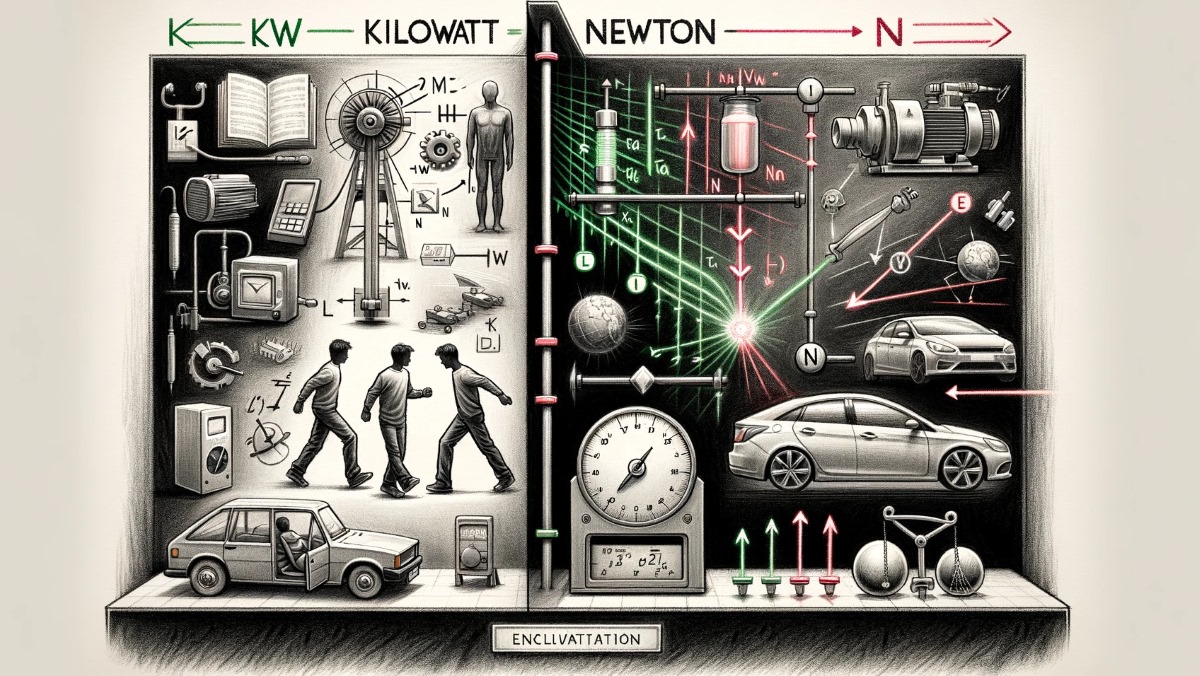
kW (kilowatt) and N (newton) are two different units used to measure different physical quantities.
kW (kilowatt): A kilowatt is a unit of power in the International System of Units (SI). It is equal to one thousand watts (1 kW = 1,000 W). Power is the rate at which work is done or energy is transferred over time. In the context of motors, power represents the motor's ability to perform mechanical work over time. It is usually used to indicate the motor's output power or its capacity to drive a certain load.
N (newton): A newton is a unit of force in the International System of Units (SI). It is defined as the force required to accelerate a one-kilogram mass by one meter per second squared (1 N = 1 kg·m/s²). In mechanics, force is the push or pull that can cause an object with mass to change its velocity, direction, or shape. In the context of motors, torque (measured in newton-meters, N·m) is often discussed, which is the force that causes rotation. Torque is the product of force (newtons) and the distance from the axis of rotation (meters).
While kW is used to measure the power of a motor, newtons are used to measure force, and newton-meters (N·m) are used to measure torque. These units are related but represent different physical quantities.
For servo and stepper motors, sometimes expressions are given in Newtons, and we should understand that these represent the force required for linear motion. It raises the question of whether there is an equivalent in kW or if it can be related to other units.
In the context of servo and stepper motors, expressions in Newtons typically represent the force that enables linear motion. In this case, the Newton value represents the force of the load that the motor needs to move. This force is related to the torque applied by the motor and the geometry of the mechanical system.
Expressions in Newtons are not directly comparable to kW, as kW is a unit of power, and Newtons are a unit of force. However, there is a relationship between power and force in the linear motion of a motor.
+ The relationship between power (P), force (F), and velocity (v) is as follows:
P = F × v
This equation calculates the motor's power by multiplying the applied force and the velocity of the motion. Therefore, when considering the linear motion of a motor, it is possible to calculate the motor's power using the force value given in Newtons and the motor's motion speed.
In summary, expressions in Newtons represent the force that the motor can apply for linear motion. kW and Newtons cannot be directly converted to one another, but there is a relationship between power and force for the linear motion of a motor. This relationship can be explained using the equation between power, force, and velocity.
Your shopping cart is empty!