
Inductive sensor standards
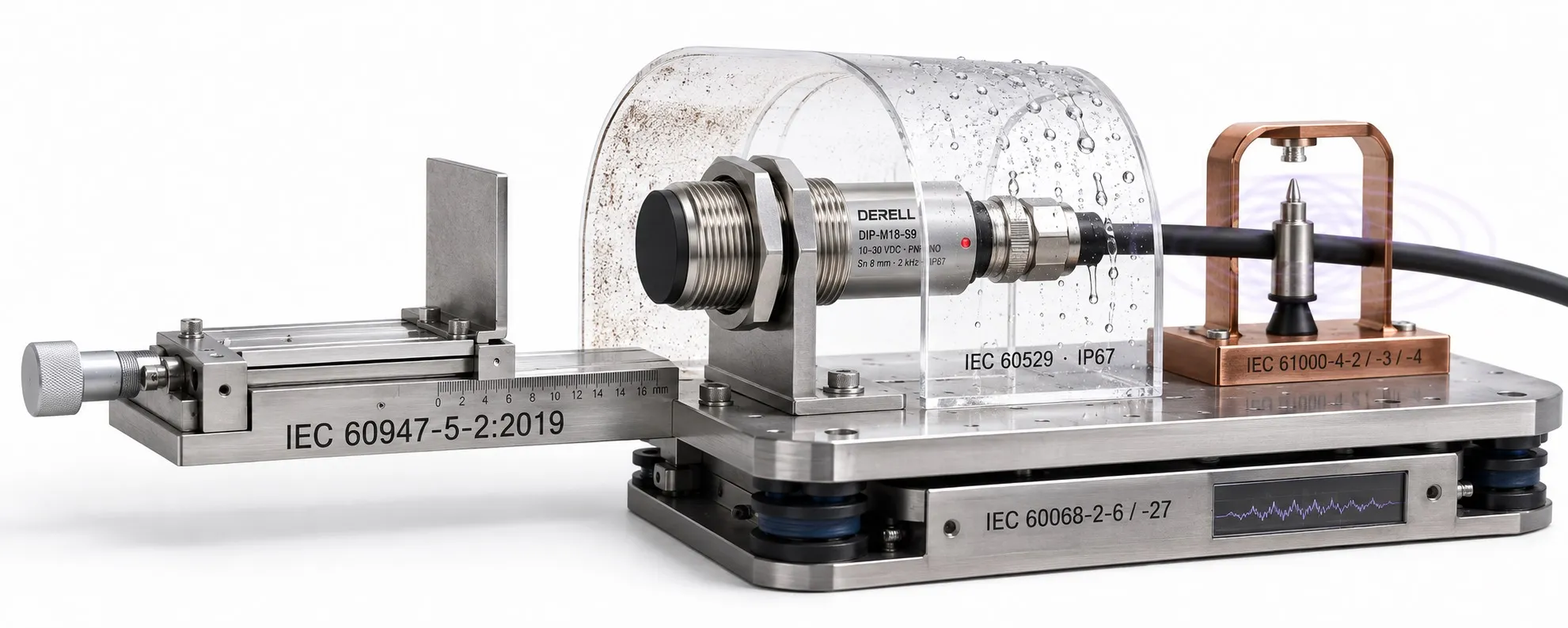
Reading conformity information in a data sheet
When selecting an inductive sensor, a standard reference helps explain how the product is specified and assessed. However, sensing distance, output type, mounting arrangement and environmental conditions still need to be checked against the exact product reference. Two sensors citing the same standard are not interchangeable in every application.
The main subject here is the inductive proximity switch, which detects a metal target without contact and provides a switching output. The applicable standards for inductive devices providing analogue measurement or position feedback must be assessed separately. Product standards, connector standards, IP ratings and PLC input compatibility answer different questions.
The main product standard: IEC 60947-5-2
IEC 60947-5-2 is the part of the low-voltage switchgear and controlgear series dealing with proximity switches. Its scope extends beyond inductive sensors to capacitive, photoelectric, ultrasonic and certain magnetic proximity switches. Calling it simply an “inductive sensor standard” therefore understates its scope.
IEC 60947-5-2:2019 addresses matters including sensing and operating distances, construction requirements and electromagnetic compatibility. The European publication can appear as EN IEC 60947-5-2:2020, with amendments such as A11:2022 also relevant to the publication being cited. IEC and EN publication dates need not match. Comparisons should use the complete standard reference, edition year and amendments declared for the product.
Comparing distance and mounting specifications
The rated operating distance Sn does not guarantee the same distance for every metal or mounting arrangement. The standard target’s material, dimensions and approach affect the measurement. Hysteresis is the difference between operating and reset points; repeatability describes how consistently the switching point is reproduced under the same conditions. These values serve different purposes in a sensor comparison.
For example, a specification of Sn = 10 mm is not sufficient justification for placing the target directly at the 10 mm limit. Assess the manufacturer’s assured operating range, the actual target and the installation tolerances together. The distinction between flush and non-flush mounting also matters: observe the specified clearances from surrounding metal and adjacent sensors.
Electrical connections and PLC input compatibility
PNP and NPN outputs require different connection arrangements. Check supply voltage, input common, output current and NO/NC behaviour together. With two-wire sensors, OFF-state leakage current and ON-state voltage drop are particularly relevant. A sensor can comply with its product standard and still be incompatible with the connected input.
IEC 61131-2 concerns functional and EMC requirements for PLC/PAC and associated control equipment; it does not replace the sensor’s main product standard. Match the sensor output to the input module’s switching thresholds and current requirements. A suitable DC power supply, cable voltage drop and shared loads are also part of this assessment.
Editor's note: “M18, PNP, NO and the same standard” is not enough information to select a replacement. Mounting arrangement, operating distance, pin assignment, switching speed and temperature range must also match. Even when a sensor fits mechanically, stable operation on the actual installation still needs to be verified.
NAMUR interfaces and hazardous-area suitability
For NAMUR sensors, the relevant interface standard is IEC 60947-5-6. It addresses the two-wire DC interface between a sensor and a switching amplifier. A NAMUR output must not be treated as an ordinary three-wire PNP output; a suitable evaluation unit is required.
A NAMUR interface alone does not establish hazardous-area approval. Applications using intrinsic safety require separate assessment of IEC 60079-11 Ex i requirements and the product’s applicable approval conditions. Assess the sensor, barrier or isolator and connecting circuit together.
IP protection and electromagnetic compatibility
IEC 60529 classifies the IP degrees of protection provided by enclosures. An IP rating does not establish resistance to every chemical or suitability at every temperature. Check the product’s separate limits for oil, cleaning fluids, temperature and mechanical stress.
EMC conformity concerns electromagnetic disturbances and immunity. Electrostatic discharge testing is one of the test methods that may be encountered in this assessment. Required tests and levels come from the applicable product standard; field cable routing, earthing and the manufacturer’s connection instructions must also be observed.
Why is DIN 43650 a separate matter?
The connection arrangements commonly referred to as DIN 43650 do not constitute a general product standard defining sensor detection performance. The EN 175301-803 family, which superseded the older DIN 43650-1 and DIN 43650-2 publications, covers particular rectangular connectors. An inductive sensor may use a different connector family. When choosing a cable or connector arrangement, check pin assignment and electrical ratings as well as mechanical compatibility.
Safety-related detection has additional requirements
IEC 60947-5-3:2026 addresses additional requirements for proximity devices with defined behaviour under fault conditions. Such a device can form the sensing subsystem of a safety-related control system designed according to ISO 13849-1 or IEC 62061. This does not turn an ordinary inductive sensor into a safety sensor.
For stopping hazardous motion or monitoring a guard position, assess the sensor, safety relay or safety controller and final switching elements together. A claim of product conformity and validation of the complete safety function are separate matters.
Selection and related product groups
For purchasing or maintenance comparisons, check that the full product reference, data sheet, wiring diagram, cited standard editions and any approval documents all refer to the same product. A standard number in a document does not, by itself, establish certification by an independent organisation.
Depending on the application, compare cubic inductive sensors, cylindrical inductive sensors and two-wire and NAMUR models. For general product selection, visit the Inductive Sensors Main Page.
References
IEC: Scope and product requirements of IEC 60947-5-2:2019
ELOT: European adoption of EN IEC 60947-5-2 and A11:2022
OMRON: Sensing distance, hysteresis, mounting and output terminology
IEC: IEC 60947-5-6 NAMUR DC interface
IEC: IEC 61131-2 control equipment requirements and tests
IEC: IEC 60529 enclosure degrees of protection
IEC: IEC 60947-5-3:2026 defined behaviour under fault conditions
DIN Media: DIN EN 175301-803 rectangular connectors