
IEEE 1725
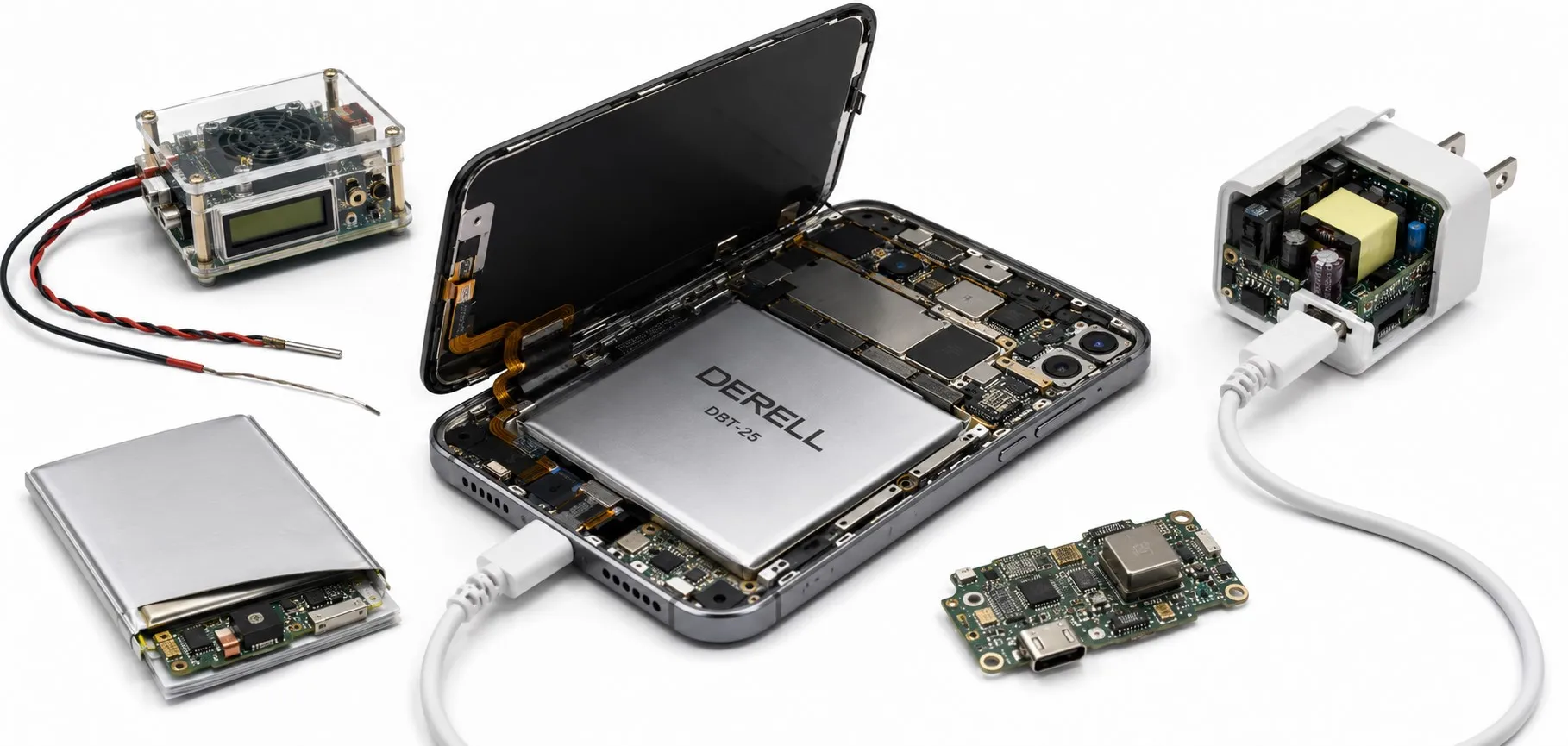
A phone battery is part of a complete charging system
IEEE 1725 establishes criteria for the qualification, quality and reliability of rechargeable lithium-ion battery systems used in devices such as mobile phones. IEEE lists IEEE 1725-2021 as the active edition. Its system approach connects the lithium-ion cell to the pack, phone and power supply, examining how those parts work together.
Follow the energy path
The cell stores energy. It is the electrochemical building block, including lithium-ion polymer formats. Understanding what a battery is helps distinguish a cell’s capacity rating from the conditions under which the finished product can operate reliably.
The pack integrates the cell. Connections, packaging and protective components turn it into a usable assembly. With battery packs, insulation, mechanical construction and reliable interconnections matter alongside cell selection. A cell evaluation alone does not establish the suitability of the completed pack.
The phone controls energy use and charging. The adapter supplies external power. Selecting charging equipment therefore involves more than matching a connector. The supply side also has its own requirements, covered by relevant power supply standards.
Agree on limits before choosing protection
Voltage, current and temperature limits must be consistent across the cell, pack and host specifications, using the cell’s operating limits as the starting point. Different battery types require different charging conditions. Nominal voltage should never be mistaken for the permitted charge termination voltage.
A simple example: A 5 V adapter label does not mean the cell is charged directly at 5 V. The charging circuit regulates the conditions delivered to it. An NTC temperature sensor and a protective fuse may serve different roles in that design; their presence alone does not prove the system has been evaluated.
Evidence extends beyond a successful prototype
Reliable production depends on manufacturing controls, traceability and change management as well as design and testing. A production change can alter the behaviour of an otherwise familiar product. Evaluation therefore brings together document review, product testing and scrutiny of manufacturing processes.
The CTIA Battery Compliance program distinguishes recognition of individual subsystems from certification of the complete system. Cells, packs and adapters have their own evaluation paths. When reviewing evidence, check the identified model, included components and scope. IEEE publishes the standard; CTIA administers its certification program.
Which standard answers which question?
UL 1642 is used for lithium-cell safety evaluation. UL 2054 addresses household and commercial batteries. Within the IEC 62133 family, Part 2 covers safety requirements for portable rechargeable lithium cells and batteries. These scopes differ from IEEE 1725’s focus on the integrated battery system.
IEEE 1625 is the related IEEE standard for multi-cell mobile computing batteries. Select the applicable standard according to the device and battery design. Product safety requirements such as IEC 62368 may also apply to the host or supply. Our battery standards guide provides a route into these related subjects.
Official sources: IEEE 1725-2021 | CTIA Battery Compliance | CTIA technical requirements | UL Solutions