
IEC 60674
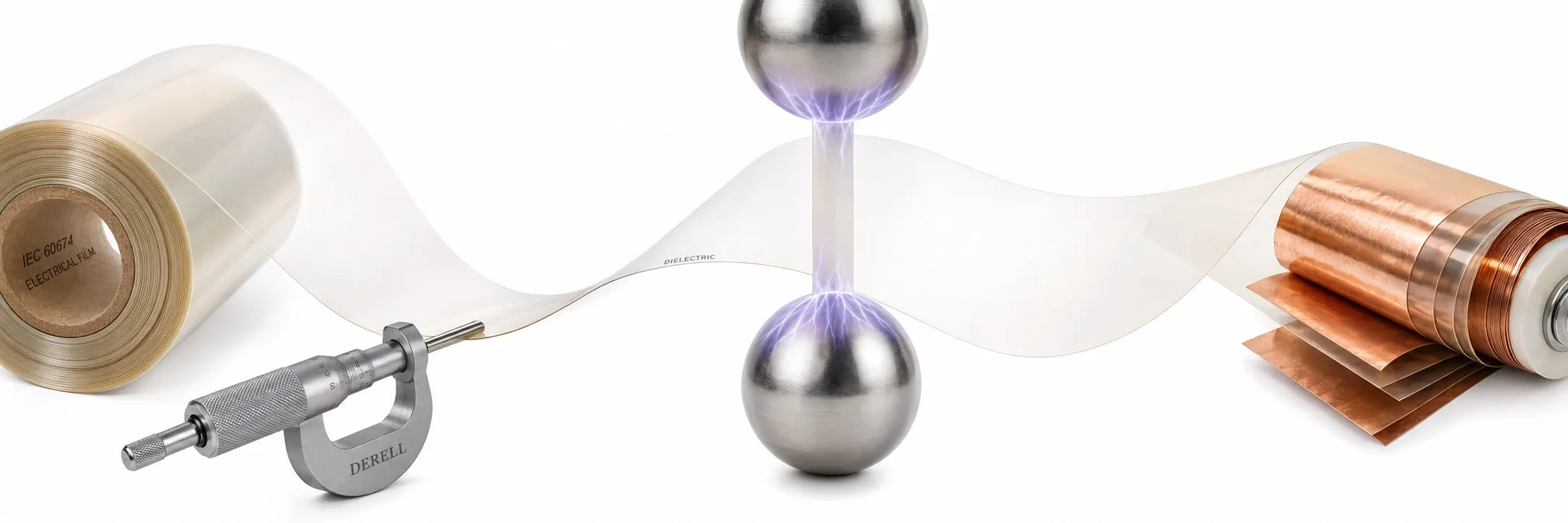
Selecting insulating film through measurable material properties
Hello, friends. IEC 60674 is a series covering general requirements, test methods and material-specific specifications for plastic films used for electrical purposes. A capacitor's dielectric film and a film separating winding layers are selected for different duties. The practical question is which film grade provides the required performance under the intended conditions, beyond simply identifying a plastic as an insulator.
Editor's note: Conformity of the film material does not establish that a finished capacitor, motor or device satisfies every applicable safety requirement. A breakdown voltage measured in a laboratory is not a continuous operating voltage rating. Film thickness, electrode arrangement, temperature, humidity and the application's insulation construction must be considered together.
How are the parts of the series used?
IEC 60674-1:1980 addresses definitions, general quality, rolls, joins, cores, dimensions, packaging and labelling. An older publication date does not, by itself, make a standard invalid; check the relevant edition and status. IEC 60674-2:2016+A1:2019 provides test methods, including the relationship between the DC electric strength method and IEC 60243-2.
The 60674-3 sheets specify individual materials. IEC 60674-3-1:2026 addresses biaxially oriented polypropylene, PP films used as capacitor dielectrics. Published on October 1, 2026, this edition expands the film thickness ranges. IEC 60674-3-2:2019 addresses balanced biaxially oriented PET films for electrical insulation. A purchase specification should identify the applicable part, film type, thickness and edition, rather than state only “IEC 60674”.
PP, PET and other films are not direct substitutes
PP used in film capacitors and PET used for general electrical insulation cannot be treated as equivalent simply because they look similar or have the same nominal thickness. Even within one polymer family, grades differ in heat resistance, hydrolysis resistance, surface treatment and processing behaviour. Toray's PET grades with enhanced heat and hydrolysis resistance illustrate this distinction.
Other film families, including polyimide, PI, also serve industrial applications. Qnity offers different polyimide grades for electrical insulation, flexible circuits, corona resistance and thermal management. A polymer name alone is therefore an incomplete technical specification. Bare film, adhesive-coated tape and metallized film must also be distinguished as different constructions.
Thickness, mechanical direction and surface quality
Nominal thickness and tolerance affect electric field stress and manufacturing behaviour. When comparing tensile strength and elongation, distinguish the machine and transverse directions. An oriented film need not behave identically in both directions. Wrinkles, creases, sharp edges, foreign particles and locally thin areas can create weak points even when the nominal thickness appears suitable.
Selecting an interlayer film for a transformer requires consideration of winding tension, edge geometry and possible assembly damage. For motors, distinguish an individual material property from evaluation of the complete insulation system.
Electric strength, insulation resistance and permittivity
Electric strength describes the electric field associated with breakdown under specified test conditions, commonly expressed in kV/mm. Insulation resistance or resistivity concerns how readily current leaks through a material or across its surface. These are different measurements: high resistance does not, by itself, demonstrate resistance to every form of voltage stress.
Relative permittivity describes polarization under an electric field, while the dielectric dissipation factor, tan δ, is used to describe losses. Comparisons require matching frequency, temperature, humidity and test conditions. NASA's polymer-film research also demonstrates that dielectric properties can vary with temperature and frequency. One catalogue value does not represent every operating condition.
A simple calculation: why micrometres matter
For an approximately uniform electric field, E = V / t. A film 25 µm = 0.025 mm thick with 1000 V across it therefore has an average field of 40 kV/mm. This is a field calculation, not approval of a safe operating voltage. Electrode-edge concentration, voids, ageing and manufacturing tolerances require separate consideration. A capacitor's voltage rating likewise cannot be derived from film thickness alone.
Separate thermal endurance from thermal conductivity
Thermal endurance concerns retention of properties under temperature over time. Thermal conductivity concerns how readily heat passes through the material. A high value for one does not establish a high value for the other. Thermal shrinkage, dimensional stability, ageing in humid conditions and compatibility with process chemicals should be assessed for the application. There is no single temperature, chemical-resistance or thermal-conductivity value applicable to every film.
What should a test report contain?
In electrical measurement and testing, the method matters as much as the result. Look for the film grade, specimen thickness, conditioning, temperature and humidity, electrode arrangement, AC/DC test selection and voltage application conditions. Mechanical results should identify direction; reported values should identify sample count and the statistic used. Do not treat a mean value as a minimum result or a guaranteed limit.
Safety of the electric strength test equipment and use of the correct material test method are separate matters. Equipment safety requirements such as IEC 61010-1 do not set the film's acceptance limits. Purchasing documentation should also specify roll width, joins, batch traceability, packaging and storage conditions.
Related topics
EN 60674 IEC standards IEC 61010 and laboratory safety Electrical and electronics guide
Sources
IEC 60674-1: definitions, general quality, dimensions and packaging
IEC 60674-2:2016+A1:2019: test methods
IEC 60674-3-1:2026: PP capacitor films
IEC 60674-3-2:2019: PET films for electrical insulation
Toray: PET film grades with enhanced heat and hydrolysis resistance
Qnity: application-specific polyimide film grades
NASA: research on temperature- and frequency-dependent dielectric properties of polymer films