
How is UPS runtime calculated?
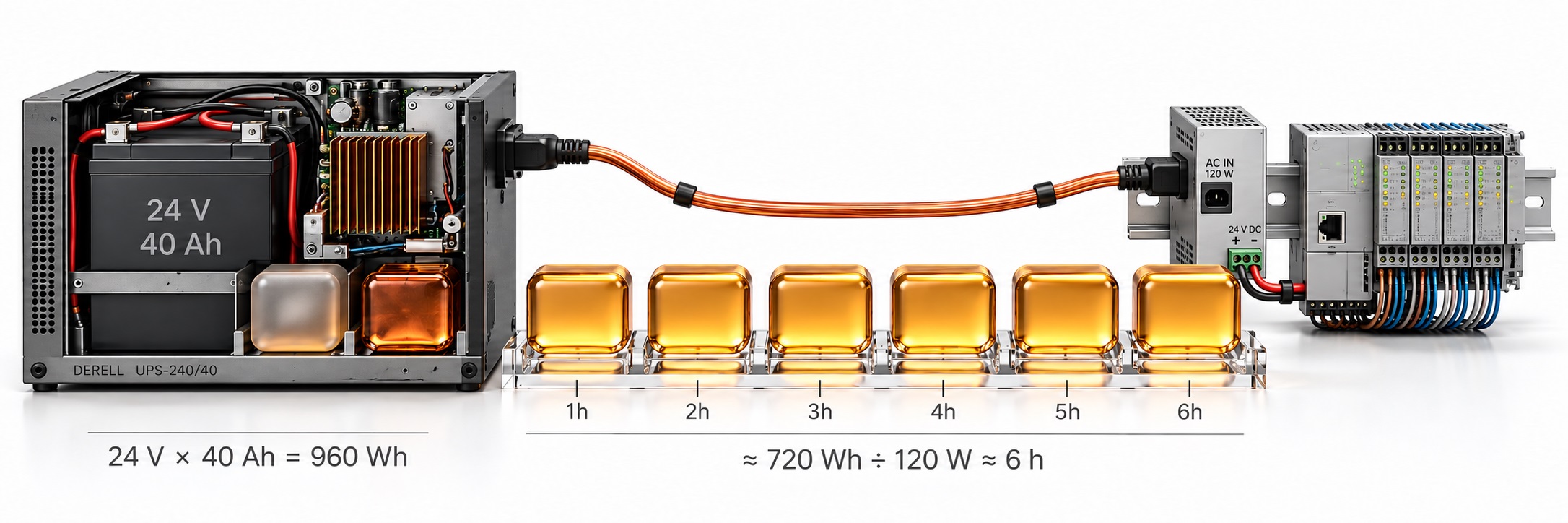
How to calculate UPS runtime
UPS runtime depends on the usable energy available to the connected equipment and the power that equipment consumes. The basic relationship is energy divided by power. For a purchase or a critical backup requirement, check the manufacturer’s runtime curve for the exact UPS model, battery configuration and load in watts. An energy calculation helps explain the result, but battery nameplate ratings alone cannot establish an accurate runtime.
Begin with two separate questions: Can the UPS support the load, and can it support it for long enough? The first concerns output power ratings. The second concerns battery energy and operating conditions. A larger VA number does not, by itself, answer the runtime question.
Find the load that must remain powered
Include the equipment that needs battery backup during an outage. Use its actual real-power demand in watts, under operating conditions that represent the work you intend to continue. If consumption varies, an idle reading may underestimate the requirement. The UPS output-power display or a suitable power measurement can help establish the load.
For an illustrative calculation, suppose a computer consumes 100 W, its monitor 30 W and the network equipment 20 W. The combined load is 150 W. These are example values, not typical ratings guaranteed for those devices. A computer with a 650 W power supply does not necessarily draw 650 W from the socket.
Measure at the right boundary. Power drawn from the wall by the UPS can include its own losses and battery charging, so it is not automatically the power consumed by the protected equipment. When using plug-in energy monitoring, establish what is being measured and confirm that the meter and connection are suitable.
Check watts and VA before estimating minutes
A UPS must satisfy both its watt limit and its VA limit. Watts describe real power; VA describes apparent power. If the load’s actual power factor is known, watts = VA × power factor. If you already have a watt measurement, do not apply power factor to that measurement again. See VA versus watts for the distinction.
Power factor is not conversion efficiency. Power factor relates the load’s watts and VA. UPS efficiency describes how much input energy reaches the load as useful output energy. Startup demands and short power peaks also matter: an overloaded UPS may shut down even when its battery still contains energy.
The useful runtime formula
For a reasonably steady load, an estimate can be written as:
Runtime (minutes) ≈ 60 × usable battery energy (Wh) × overall battery-mode efficiency / load (W)
Usable battery energy means the DC energy that can actually be delivered before the UPS reaches its cutoff condition, at the relevant load, temperature and battery condition. The efficiency term converts that usable DC energy into energy delivered at the AC output. Write 85% as 0.85.
In this model, overall battery-mode efficiency includes the UPS’s own consumption. Do not deduct that same loss again. A published ECO-mode or mains-operation efficiency is not automatically appropriate: the operating mode and load level must match. Without usable-energy data and a suitable efficiency figure, the formula remains an estimate rather than a reliable prediction.
What does the battery label tell you?
A nominal energy estimate is Wh ≈ nominal battery voltage × capacity in Ah. A battery marked 12 V and 9 Ah therefore represents about 108 Wh of nominal energy. Use the battery-system voltage here, not the UPS’s AC output voltage. The guide to mAh, Ah and Wh explains why ampere-hours need a voltage before they can describe energy.
If the manufacturer’s battery arrangement contains two 12 V, 9 Ah batteries in series, the pack is 24 V, 9 Ah. Its nominal energy is 24 × 9 = 216 Wh. The series connection does not create an 18 Ah pack. Increasing both voltage and ampere-hours in the calculation would count the added energy twice. Understanding series and parallel battery arrangements prevents this mistake; it is not permission to modify a UPS battery system.
Worked example: a 150 W load
Take the 24 V, 9 Ah pack and the 150 W load above. Dividing the nominal 216 Wh by 150 W gives 1.44 hours, or 86.4 minutes. That arithmetic assumes the nominal energy is fully available and the UPS has no losses. It is not a validated runtime for the UPS.
To demonstrate the more realistic calculation, suppose the pack can deliver 120 Wh of usable DC energy under the specified conditions, and the overall battery-mode efficiency at this load is 85%. The equipment would receive 120 × 0.85 = 102 Wh.
Illustrative runtime ≈ 60 × 120 × 0.85 / 150 = 40.8 minutes
The 120 Wh and 85% figures are assumptions chosen for this example. They are not test results for a product, and they are not universal correction factors. In particular, do not assume every 216 Wh battery pack delivers 120 Wh in UPS service. The usable energy must be established from appropriate battery data, system information or testing.
Why nominal energy can give an optimistic answer
Discharge rate changes the available capacity. A lead-acid battery’s Ah rating is specified under particular discharge conditions. Capacity measured over a long discharge, such as 20 hours, cannot simply be assumed available during a short, high-current UPS discharge. This rate dependence is commonly described by the Peukert effect. It is an important limitation of a basic ampere-hour runtime calculation.
Battery condition changes the starting point. Age, temperature and incomplete recharging after an earlier outage affect the energy available. The UPS also stops drawing from the battery when its cutoff criteria are reached. A fully charged indicator does not prove that an old battery retains its original capacity.
The UPS needs energy to operate itself. Its electronics, conversion stage and any running fans contribute to consumption. Those losses can become a significant share of the total at very light loads. Consequently, halving the equipment load does not guarantee exactly twice the runtime; battery behaviour and UPS efficiency also change.
Work backwards from the backup time you need
Suppose the requirement is to support 200 W for 30 minutes. The equipment needs 200 × 0.5 = 100 Wh of AC output energy. With an illustrative overall battery-mode efficiency of 85%, the required usable DC energy would be 100 / 0.85 ≈ 118 Wh.
This does not mean that a battery with a nominal 118 Wh rating is sufficient. It must deliver the required usable energy at the actual discharge rate and operating conditions. Check the manufacturer’s runtime data and allow for battery ageing, temperature, future load changes and the reserve needed by the application. Output power capability must still be checked separately.
Compare runtime curves at the same load
Match the full UPS model code and installed battery configuration, then find the runtime at your required watt load. “Half-load runtime” is not a fair comparison between differently rated UPS units. Half load may represent different watt values. Compare both products at the same real-power demand and review the stated test conditions.
The UPS topology also does not establish runtime on its own. Online, line-interactive and standby designs can have different battery arrangements and losses. If extended runtime is required, use a UPS that supports approved external battery packs and consider the recharge time before the next outage.
Verify runtime without turning testing into battery wear
The remaining time shown by a UPS is an estimate, and a short battery self-test is not the same as a full runtime test. When a manufacturer-recommended capacity test or calibration is needed, schedule it during a maintenance window in which a possible interruption can be managed. Repeated full discharges simply to check the displayed minutes cause unnecessary battery wear.
If the UPS shuts down much earlier than expected, investigate the actual load, charge state, battery condition and warning messages. The guide to UPS beeps and alarms helps distinguish low battery from overload and other faults.