
How does machine learning apply to robotics?
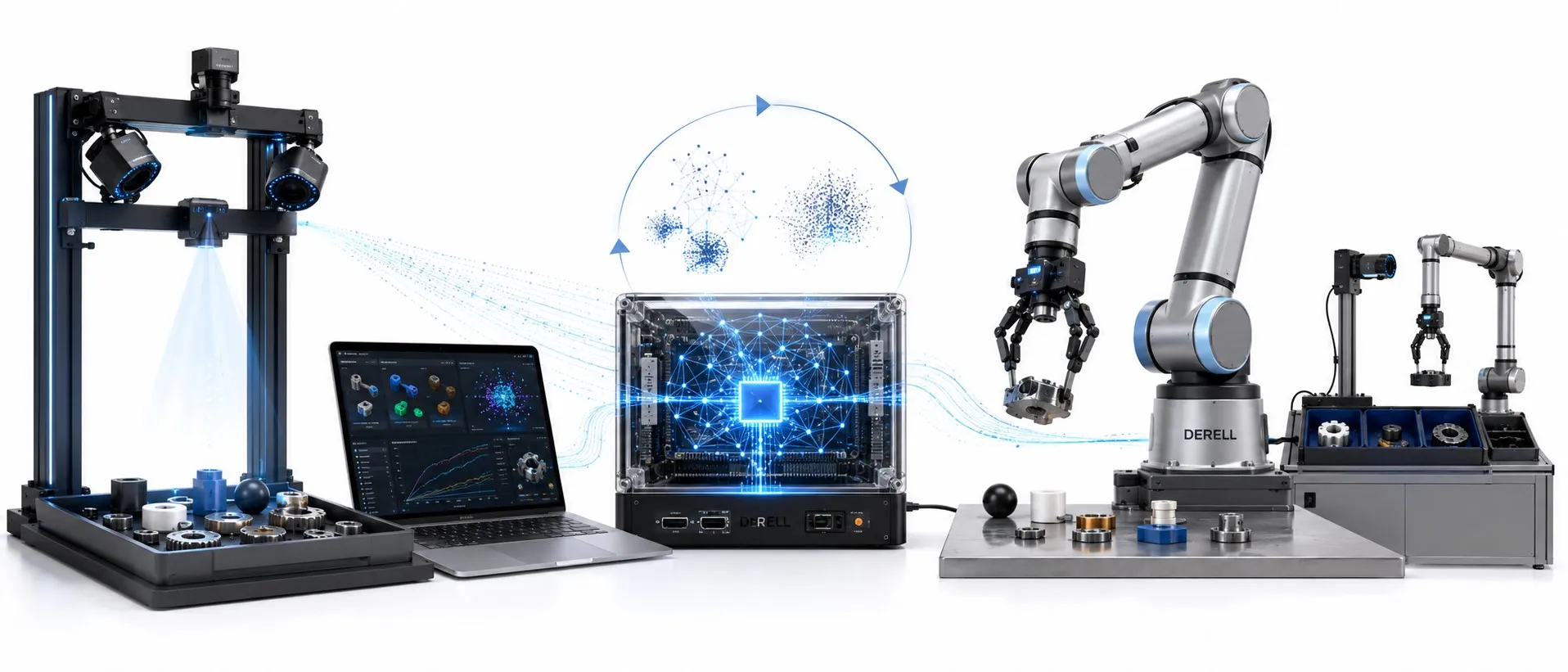
How robots turn experience into useful skills
A robot picking loose parts from a bin faces a problem that fixed coordinates cannot solve: each part may arrive in a different position and orientation. Machine learning can help it locate an object, estimate a suitable grasp or choose an action from sensor observations. The model learns relationships from examples rather than relying entirely on individually written rules. This is one practical connection between machine learning and robotic intelligence.
Learning is useful when the task varies. A repeatable operation with a well-designed fixture may work perfectly well with conventional control. Adding a learned model should solve a specific problem, such as variable appearance or uncertain contact. Engineers still need robot programming to define the task, integrate equipment and handle failures.
Training, inference and continued learning
Training changes a model's parameters using recorded examples or trial outcomes. Inference uses those parameters to process a new observation. A robot recognising an unfamiliar arrangement is performing inference; it is not necessarily updating its model. Updating the model during operation is called online learning and requires its own validation strategy.
The input may include images, joint positions, motor current or contact force. These measurements come from sensors, and their usefulness depends on the robot's hardware. Turning a prediction into a physical result requires coordinated sensing and actuation, not just an accurate model.
Four ways to learn from data
Supervised learning uses examples with known answers. Labelled images can teach a model where parts are located. The labels must be accurate, and the images must represent the conditions the robot will actually encounter.
Imitation learning uses demonstrations of a task, recorded through teleoperation or guided movement. The robot learns how observations relate to actions. Demonstrations provide a useful starting point, but unfamiliar situations can expose gaps in the learned behaviour.
Reinforcement learning improves an action policy using rewards from trial outcomes. Successful placement might earn a reward, while excessive force incurs a penalty. A poorly chosen reward can encourage the wrong behaviour. Demonstrations and reinforcement learning can also be combined.
Unsupervised learning finds structure without predefined answer labels. It can help group operating records or highlight unusual patterns. An unusual pattern is a reason to investigate; it does not establish the cause of a fault.
Inside a learned bin-picking task
Perception: A camera captures the bin, and a model estimates an object's pose or a promising grasp region. Calibration connects the camera's coordinates to the robot's coordinates. Even excellent recognition can produce a missed pick if that relationship is wrong.
Execution: The controller checks reachability and plans the movement. Servo motors move the arm, and the gripper closes. A cell PLC may coordinate conveyors, fixtures and the operating sequence. Learned grasp selection can work alongside conventional PID control; it does not have to replace the lower-level feedback loops.
Verification: The system checks whether the part was lifted, retained and placed correctly. Failed attempts can become useful training examples later. Recording a failure does not automatically mean the deployed model learns from it.
Why simulation success may not survive deployment
Simulation makes large numbers of training trials practical, particularly for reinforcement learning. Real equipment introduces different friction, payloads, lighting and delays. This mismatch is the simulation-to-reality gap. Varying conditions during simulated training and refining a model with real observations can help, but physical validation remains essential.
The learning task also changes with the robot platform. Autonomous vehicles may use learned perception and motion prediction, while industrial robots may use learning for sorting, inspection or grasp selection. Research into vision-language-action models links visual observations and language instructions to robot actions. This does not establish reliable performance on every unfamiliar task.
Technical references: RSS — Reinforcement and imitation learning · RSS — Real-to-sim-to-real learning · Google DeepMind — RT-2