
How does artificial intelligence relate to robotics?
Artificial intelligence can help a robot interpret its surroundings, select an action or perform a task learned from data. Robotics brings sensing, mechanical structures, motion and control together. Combining the two can allow a robot to distinguish objects in a bin and select one it can pick. However, a robot does not have to use AI, and an AI system does not have to be a robot.
Does every robot need AI?
No. A robot that picks a part from a fixed position and places it at a predefined location can run on programmed movements. Speed, precision and repeatability do not, by themselves, indicate AI. The difference between a robot and a machine cannot be reduced to the presence of artificial intelligence. A stable, clearly defined task may be handled well by conventional automation.
AI can become more useful when the object, its position or the environment varies. Yet the main components of a robot still operate within physical limits. AI does not automatically increase payload, reach or mechanical accuracy.
Perception: Turning camera images into useful information
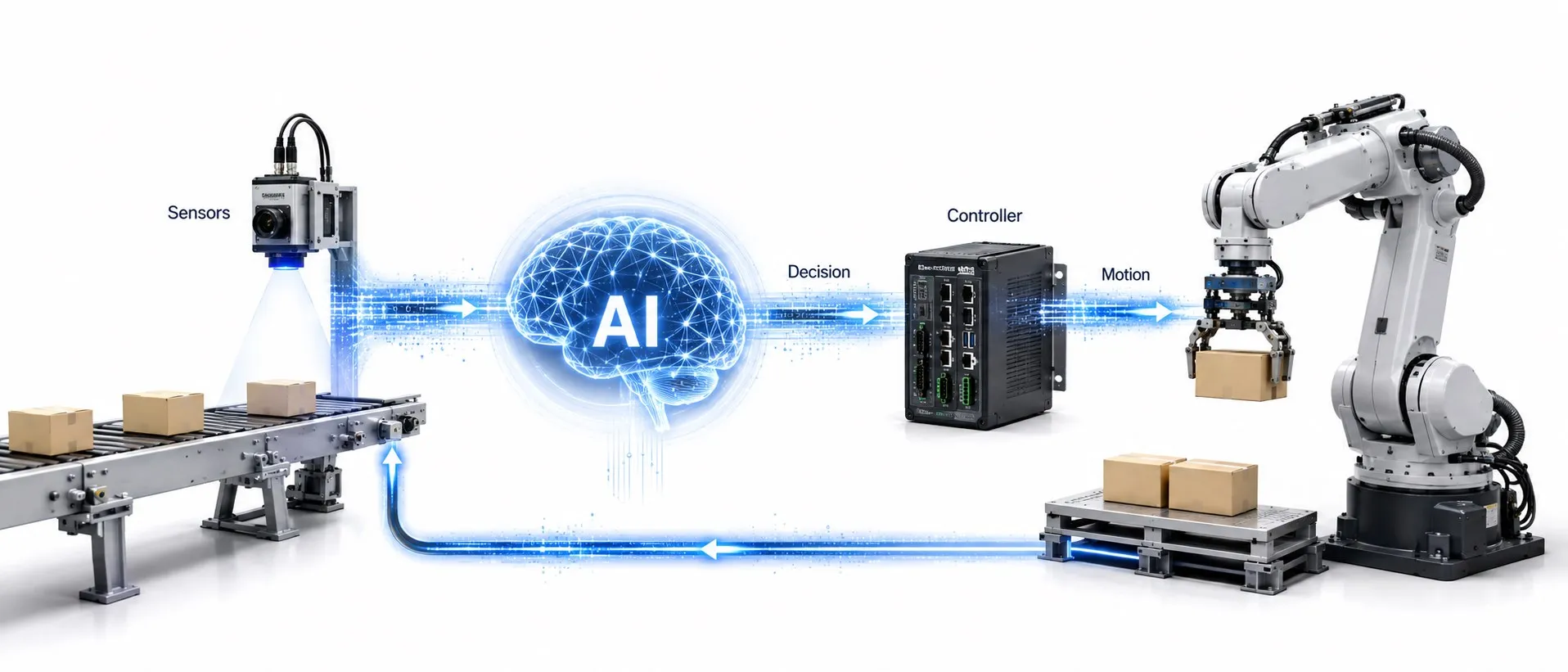
Sensors and actuators connect a robot to the physical world. A camera produces images; a force sensor measures contact force. An AI model using computer vision may identify a part, estimate its orientation or classify a surface defect. Capturing an image and interpreting it are different tasks.
Finding a metal part in an image does not automatically tell the robot how to grasp it. The detected position must be related to the robot's coordinate system. Camera calibration, lighting, depth information and overlapping objects affect the result. Simple colour or edge checks can also be performed without a learned model.
Decision-making, motion planning and servo control
AI may produce a goal, such as “pick this part”, or propose an action. Motion planning determines the joint movements and timing needed to reach the goal, accounting for reachability, collisions and motion limits. The controller turns that plan into commands for the servo motors. How a robot works depends on these layers working together.
Joint position and speed measurements support feedback control. Devices such as an absolute encoder can help track actual position. Recognising an object correctly and controlling motor position precisely are different problems. AI outputs must also be evaluated against the application's defined limits before they lead to physical movement.
This is an example architecture. Moving dots represent information and command flow, not actual processing times. Robot safety functions require their own design and validation.
Learning: Does a robot improve itself while it works?
Machine learning builds models from data. When applied to robotics, it may involve recognising parts from labelled images, learning movements from demonstrations or evaluating actions in simulation. Training a model and using that trained model to respond to new inputs, known as inference, are different stages.
A production robot may use a previously trained model with a fixed version. It does not need to learn automatically after every part. Adapting to new conditions may require data collection, a model update and further validation. A learned behaviour is not a guarantee of correct results in every unfamiliar situation.
What do natural language and autonomy add?
Natural language processing can help a suitably equipped robot turn an instruction such as “put the blue part in the box on the right” into task steps. Language, perception and action systems must work together. A chatbot that answers fluently does not, by itself, have the ability to control a physical robot. Language-based interaction is not limited to humanoid robots.
Autonomy describes how much of a defined task can be carried out without human intervention. The tasks and operating conditions vary across different robot types. In autonomous vehicles, perception, localisation and route selection work together. Autonomy does not mean unlimited decision-making authority, and using AI does not imply full autonomy.
Production example: Picking randomly arranged parts from a bin
Consider a robot cell that picks mixed parts from a bin and places them on a conveyor. This is a practical example of robots in industry. A possible workflow is:
Sense: A camera captures images and, where needed, depth information. Recognise and select: An AI model identifies parts, and the system selects a suitable grasp candidate. Plan: A motion planner generates a reachable trajectory. Execute: The robot controller operates the axes and gripper. Verify: Sensor readings help check whether the part was picked successfully.
The cell's PLC may coordinate the conveyor sequence, operating permissions and signals between stations, while the robot controller executes robot motion. Responses to no part found or failed grasp are defined in advance: retry, stop or request operator assistance. Success depends on the gripper, calibration and cell coordination as well as the AI model.
Limits: Does correct recognition guarantee safe operation?
No. Limitations of robotics include poor images, unfamiliar parts, sensor faults, processing delays and physical reach constraints. A model's confidence score is not a safety guarantee. Recognition accuracy needs to be evaluated alongside grasp success, cycle time and the system's behaviour when something goes wrong.
Robot safety requires a risk assessment of the cell and appropriate safety functions. Emergency stops, safeguard stops and relevant speed or workspace limits must not depend solely on an ordinary AI prediction. Camera data retention and the traceability of decisions also raise ethical and data responsibility questions.
Technical references: MoveIt — motion planning and control · Google DeepMind — vision, language and robot actions · Universal Robots — robot safety functions.
You may share this article with attribution to OtomasyonAVM.