
How are robots used in medicine and healthcare?
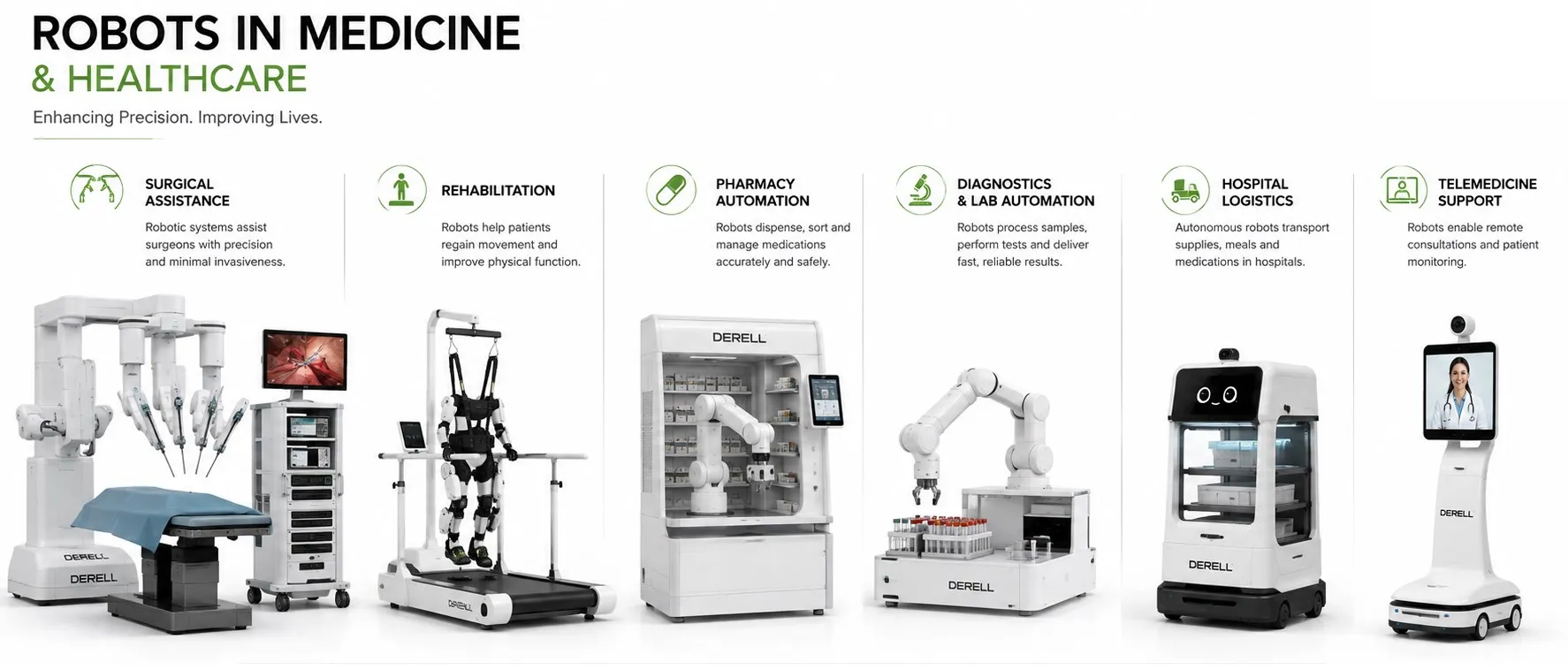
Robotics supports tasks such as controlling surgical instruments, assisting rehabilitation, preparing medicines and transporting supplies. These different types of robots have different capabilities: a surgical arm, a walking assistance system and a hospital delivery robot address separate needs. Understanding a healthcare robot means examining its task, who controls it and how its performance is assessed.
Surgical robots: Translating the surgeon's commands into movement
In robotically assisted surgical systems such as da Vinci, the surgeon watches the operating field and controls the instruments from a console. The system's main components include the control console, a camera and mechanical arms carrying surgical instruments. It can help surgeons work through small incisions and manipulate instruments in confined spaces. The surgeon directs the procedure and makes the clinical decisions. Using a robot does not guarantee better outcomes or faster recovery for every procedure.
Robot programming forms part of the system that translates the operator's commands into movements. Motion limits, image quality, instrument selection and staff training also matter. The ability to make small movements and the clinical benefit delivered to a patient are different measures.
Rehabilitation: Controlled repetition and measurable exercise
Rehabilitation robots can assist exercises involving arm movement or walking. Sensors and actuators work together to measure movement and apply assistance. The therapist selects exercises and assistance levels within the device's intended use. More repetitions alone do not establish a corresponding improvement in everyday function.
For example, the RATULS trial did not find that the robot-assisted arm training it tested improved post-stroke arm function more than the comparison treatments. This does not establish that all rehabilitation robots are ineffective. It shows why claims of faster recovery need to specify the patient group, device and outcome being measured.
Exoskeletons and robotic arms for daily activities
Exoskeletons are wearable systems that mechanically assist particular movements. Some are designed for rehabilitation settings under the supervision of trained professionals. Assistive robotic arms can support tasks such as reaching and grasping objects in an appropriate setup. In everyday robotics applications, the aim is to support a function the user needs. An exoskeleton is not automatically suitable for every user or for independent use at home.
Remote consultations and support at home
Telepresence robots can connect a patient with a remote healthcare professional through a camera, microphone and screen; mobile models can move between locations. They provide a means of remote communication. Telemedicine does not always require a robot: conventional video consultation systems can also be used. A video connection does not reproduce every function of a physical examination.
Home support systems may offer medication reminders, communication or help with organising daily activities. Vital sign measurement requires an appropriate, validated medical sensor for the measurement concerned. A reminder does not confirm that a medicine was taken, and social interaction does not fulfil every responsibility of human care.
Pharmacy automation: Picking a medicine and checking a prescription
Pharmacy robots can automate storing medicine packs, retrieving them and delivering them to staff. Their connection with industrial robotics is the controlled handling of repetitive material tasks. Used alongside inventory tracking and records, they support the dispensing workflow. Retrieving the correct pack does not, by itself, establish that a prescription is clinically appropriate. Dose, interaction and patient suitability checks remain part of pharmacy care.
Hospital logistics: Navigation and reliable delivery
Mobile delivery robots can transport supplies or enclosed containers to designated locations. As with autonomous vehicles, sensing the surroundings and assessing obstacles are important. Hospitals also require consideration of pedestrian traffic, doors, narrow passages and delivery to the correct destination. Protecting the load and recording its delivery matter as much as moving the vehicle.
Cleaning and disinfection: UV-C does not remove dirt
Cleaning robots and disinfection robots perform different tasks. In UV-C systems, effectiveness depends on dose, exposure time, distance and whether the light reaches the target surface. UV-C does not replace the removal of visible dirt; shaded or enclosed surfaces may receive insufficient exposure. Conditions for use around people depend on the device design and validated application. UV-C can injure the eyes and skin, so robot safety must address radiation exposure as well as movement.
Are artificial intelligence and robotics the same thing?
No. Artificial intelligence can contribute to particular perception or data assessment tasks, while robotics also involves physical movement and interaction. Machine learning is one approach to building models from data. Not every healthcare robot uses AI, and not every healthcare application is a robot. Producing a recommendation does not establish that it is clinically correct.
Control, data and reliability need to work together
The robot's operating sequence involves measurement, commands, movement and checking the result. Feedback control helps compare the measured state with the target. Depending on the healthcare application, motion and force limits, fault detection, cleaning and maintenance requirements also matter. An engineering solution cannot simply be transferred to every medical task.
Camera images, audio and patient measurements raise questions about access and privacy within robotics ethics. The limitations of the technology need to be explained, along with which decisions belong to healthcare professionals and how work continues if the system fails. Meaningful progress in the future of robotics depends on demonstrated benefit and reliable workflows as well as greater automation.
Technical and clinical references: FDA — Surgical systems · NIHR — RATULS trial · FDA — ReStore intended use · NHS — Pharmacy automation · CDC archive — UVGI study · FDA — UV-C safety.
You may share this article with attribution to OtomasyonAVM.