
GT1665M Series
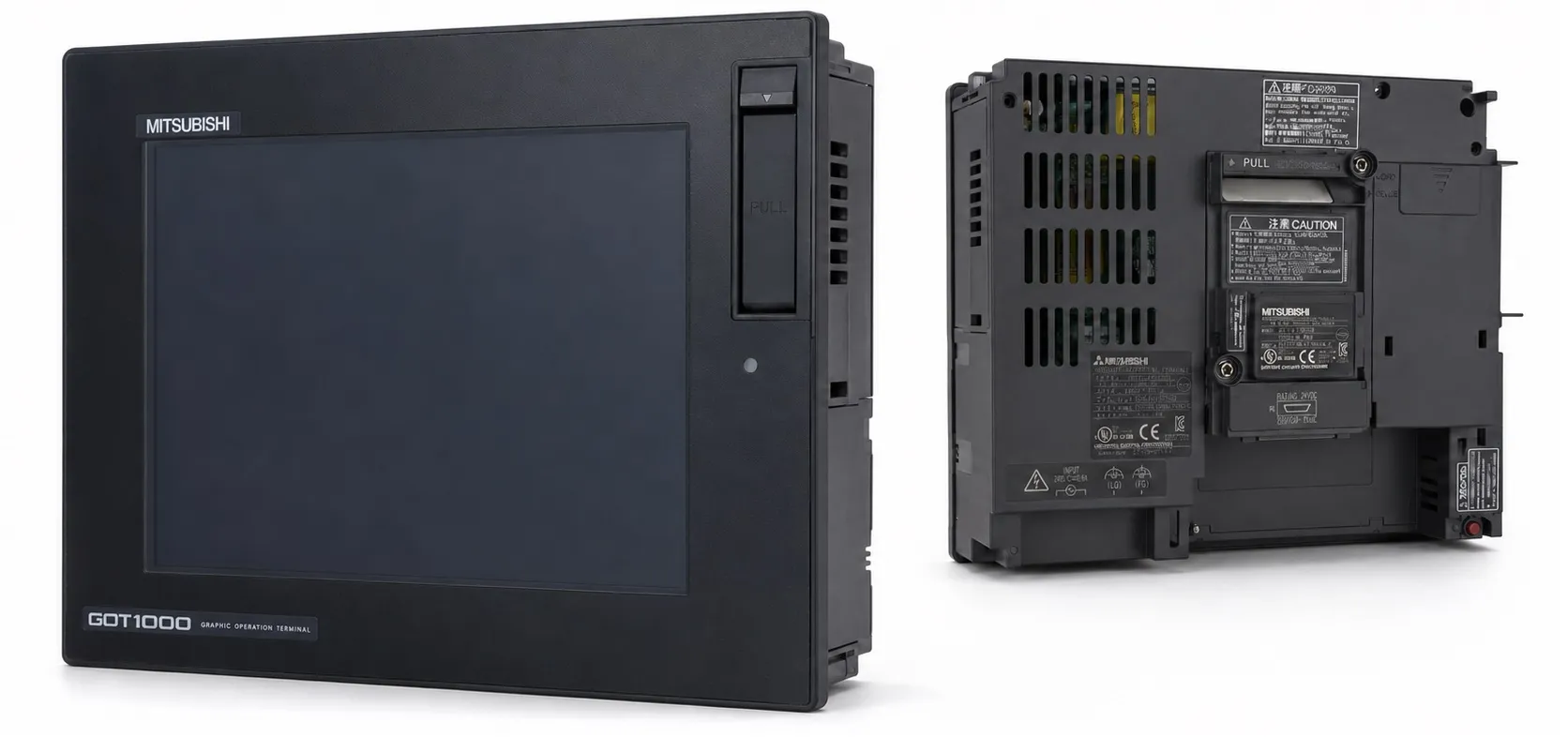
The GT1665M Series consists of high-performance HMI models designed to handle complex monitoring and control tasks in demanding industrial environments. Its advanced multimedia functions, extensive communication options and high-resolution display enable the creation of clear, detailed and interactive operator interfaces.
Key Technical Specifications of the GT1665M Series
Display Specifications
Display Type: High-brightness TFT color LCD with a wide viewing angle.
Resolution: 800 × 600 pixels — SVGA, allowing detailed visualization of process values, graphics and production data.
Color Capacity: Supports 65,536 colors for clearer presentation of complex graphics and dynamic process information.
Touchscreen: The analog resistive touchscreen provides reliable operation in demanding industrial environments. Its single-point touch operation enables precise use of buttons and control areas.
Communication Connections
Serial Ports: Supports RS-232 and RS-422/485 connections for communication with different industrial controllers and field devices.
Ethernet: Includes a 100BASE-TX Ethernet connection for centralized control, network integration and remote-access applications.
USB: USB host and USB device ports simplify data transfer, system updates and direct communication with compatible peripheral devices.
CompactFlash Card Slot: Provides CF card support for data logging, project backup and data transfer between devices.
Power Supply: Different GT1665M models may be available with 100–240 VAC or 24 VDC power-supply options. The complete model code and rated supply voltage should be verified before ordering or connecting the unit.
Memory and Data Management
User Memory: Includes 15 MB of built-in flash memory for large projects and extensive data logging. Storage capacity can be expanded up to 57 MB by using a CF card.
Battery-Backed Memory: Alarm records, clock information and essential operating data can be retained through battery-backed SRAM during a power interruption.
Supported Software and Programming Tools
The GT1665M Series is compatible with Mitsubishi’s GT Works3 software package, which includes the following tools:
GT Designer3: Project-development software used to create HMI screens, buttons, indicators, graphics and operator pages.
GT Simulator3: Allows an HMI project to be operated and tested on a PC before it is transferred to the physical operator panel.
Functions and Highlighted Features
Multimedia Capabilities
When compatible hardware and modules are used, the GT1665M can provide real-time video display and multimedia playback. These functions may be used for operator training, machine monitoring and fault-detection applications.
RGB video support enables compatible external video sources and cameras to be integrated into the system.
Alarm Management
Scrollable alarm lists, color-coded notifications and historical alarm records help operators evaluate faults more quickly.
Alarm history can be stored on a CompactFlash card, allowing records to be reviewed later for troubleshooting, maintenance and reporting.
Recipe and Multi-Language Support
Integrated recipe management allows multiple operating configurations to be stored and recalled for different products and processes. This capability saves time on flexible production lines with frequent product changes.
Unicode-based multi-language support allows operator interfaces to be localized for international facilities and production sites where multiple languages are used.
Energy Saving
Backlight control can be activated when the screen is not being used, helping to reduce energy consumption and extend the operating life of the display backlight.
Applications of the GT1665M Series
Networked and Distributed Control Systems: Ethernet, USB and serial communication connections allow the panel to be integrated into large and interconnected automation systems.
Industrial Applications with High Multimedia Requirements: Video and RGB capabilities make the panel suitable for camera monitoring, operator training and visual fault-detection applications.
Flexible Production Facilities: Multi-language and recipe functions provide practical operation on production lines with frequent product changes and in facilities employing operators who use different languages.