
Ge VAT2000 fault codes
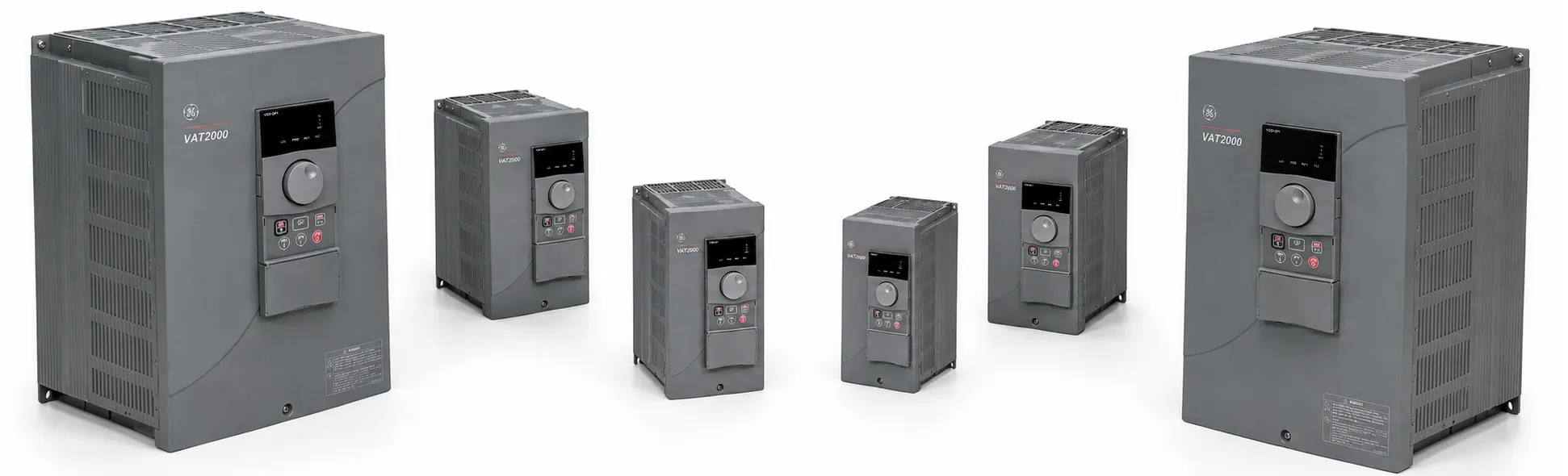
Hi everyone,
General Electric VAT2000 VFD Troubleshooting without a Fault Display
When there's no fault display, here's how to figure out what might be wrong and what to do:
Motor Doesn't Start
- Check the Wiring: Make sure the input/output wiring is correct. There might be a problem with the power supply or a phase might be missing.
- Check the Load: The motor might be stuck, or the load might be too heavy. Try lightening the load.
- Check Settings: Make sure the reverse run interlock function (C09-3) and other settings are correct.
- Check the Voltage: Make sure the VAT2000 is sending out the right voltage to the motor.
- Check Local/Remote Setting: Make sure it's set to the right mode for your setup.
- Check the Encoder Signal: Make sure it's being received correctly.
Motor Runs in the Opposite Direction
- Check the Phase Sequence: Make sure the U, V, and W output terminals are connected in the right order.
- Check the Wiring for Forward/Reverse Run: Make sure the wires are connected to the right terminals. For forward run, connect RUN to RY0. For reverse run, connect PSI1 to RY0 (when the input terminal function setting is C03-0=1, which is the default value).
Motor Runs but Speed Doesn't Change
- Check the Load: It might be too heavy. Try reducing it.
- Check the Frequency Setting: The signal level might be too low. Make sure the circuit and signal level are correct.
Motor Acceleration/Deceleration Isn't Smooth
- Adjust the Time Settings: The acceleration/deceleration time setting (A01-0, 1) might be too low. Try increasing it.
Motor Speed Varies During Constant Speed Operation
- Check the Load: It might be changing too much or be too heavy. Try reducing the load or its fluctuation.
- Check the Inverter-Motor Ratings: Make sure they match the load. If not, select a set that does.
Motor Speed Is Too High or Low
- Check the Motor Specifications: The number of poles or voltage might be wrong.
- Check the Frequency Settings: The maximum frequency (speed) or base frequency might be set incorrectly.
- Check the Terminal Voltage: It might be too low. Try using a thicker output cable.
Overcurrent Trip (OC-1 to 9)
- The inverter stops and cuts off the output if the current goes above a preset value.
Overvoltage Trip / ou (OV-1 to 9)
- The inverter stops and cuts off the output if the DC voltage in the main circuit goes above a preset value.
Undervoltage Trip/ou (UV-1 to 9)
- The inverter stops and cuts off the output if the DC voltage drops to about 65% or less during operation, possibly due to a power failure or voltage drop.
Overcurrent Limit
- If there's an overload, the output frequency automatically adjusts so the current stays below the overcurrent limit (usually 150%) set with B18-0.
+ Ge VAT2000 VFD User manual >>
+ General Electric 2. Main page >
+ VFD Homepage >
 -