
What is the power consumption and energy efficiency of the device?
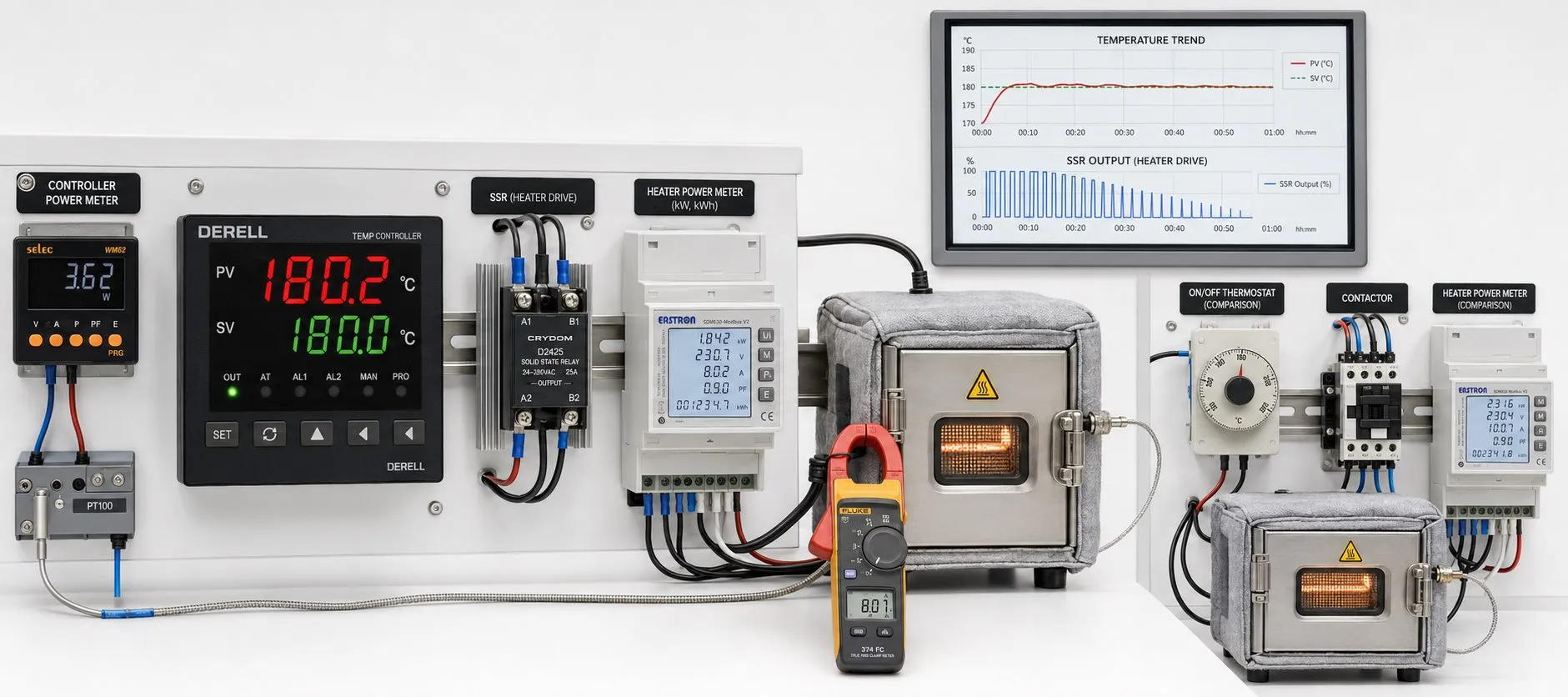
A small controller can manage a much larger energy load
Hello, a temperature controller's own power consumption must be distinguished from the consumption of the heater or cooling equipment it controls. The electronics may consume a few watts while the connected system uses kilowatts. The exact figure depends on the complete model code, supply voltage and hardware options; there is no single consumption figure for all controllers.
Which circuit does the consumption specification describe?
The controller's supply consumption covers its display, processor, measurement circuits, communications hardware and internal output-driving circuits. External heaters, compressors, fans, contactor coils and power supplies must be accounted for separately. A published maximum consumption is also not a fixed value that will necessarily be measured throughout operation.
For example, an output rating of 250 VAC, 3 A describes the relay contact's switching limit under the specified load conditions; it does not describe the controller's own consumption. Similarly, an SSR drive output usually provides a control signal to an external solid-state relay. Check the separation between the control circuit and the power circuit during installation and wiring.
Editor's note: With the heating output off, the controller normally continues measuring, operating its display and making control decisions. An inactive heater does not mean the controller consumes no energy. If a separate standby or sleep mode exists, check its actual behaviour in the product manual.
Why are W, VA and kWh different?
Watts (W) express active power, volt-amperes (VA) express apparent power, and kilowatt-hours (kWh) express active energy consumed over time. A specification of 6 VA should not automatically be treated as 6 W. With an AC supply, the relationship between active and apparent power depends on the power factor.
When constant or average active power is known, use Energy (kWh) = Power (W) × Time (hours) / 1000. A controller averaging 5 W for 8 hours per day uses 0.04 kWh per day, or 1.2 kWh over 30 such days. These are illustrative values. The corresponding energy charge is calculated by multiplying consumption by the applicable unit energy price.
A heater's rated power is not its continuous consumption
Consider a heater bank whose actual power when energised is 6 kW. If it operates at full power for a total of 40% of an eight-hour period, its average power is approximately 2.4 kW and its energy consumption is 19.2 kWh. This excludes the controller and auxiliary equipment. Initial warm-up, product loading and heat losses all affect the operating duty cycle.
This example assumes switching a constant-power heater fully on and off. A displayed 40% control output does not mean 40% measured power in every system. Phase-angle power controllers, nonlinear loads and different output scaling can change that relationship. An output command is not an energy measurement.
Does PID control automatically save energy?
Properly tuned PID control can reduce overshoot and oscillation. However, using PID alone does not guarantee lower kWh consumption. Under the same production conditions, the required process heat and environmental losses still have to be supplied. Savings depend on how much unnecessary overheating, product rejection or inefficient operation is eliminated.
The control loop settings must suit the application. Auto-tuning may introduce temporary temperature changes; this does not mean the controller electronics necessarily consume more power. The temperature setpoint should also be assessed against the process's actual requirements.
Assess the sensor, switching method and heat losses together
Suitable sensor selection, correct positioning and measurement accuracy help avoid unnecessary heating. The sensor's thermal lag is different from the controller's response time. A slow sensor can provide delayed information even when the electronics respond quickly.
An SSR can support more frequent switching, but does not guarantee energy savings by itself and has its own conduction losses. Excessively short switching periods are unsuitable for mechanical relays or contactors. Poor insulation, leaking access doors and unnecessary hot-holding periods should also be investigated.
Regular maintenance and suitable ambient conditions support stable operation. If heating continues despite an off command, treat it as a potential fault rather than an efficiency adjustment: investigate the power-switching components and relevant fault causes.
How should savings be measured?
First define the measurement boundary: the controller alone, the heater circuit or the entire machine? Measuring the controller's supply does not capture heater consumption. To measure total consumption, use a suitable active energy meter or power analyser covering the relevant supply.
Compare before-and-after results under equivalent product, load, starting-temperature and quality conditions. Alongside daily kWh, track indicators such as kWh per product or kWh per kilogram. Recording temperature and output data through communications helps the investigation, but a communications interface does not mean the controller directly measures energy.
When selecting a controller, consider control stability, sensor compatibility, output type and logging capabilities alongside its own consumption. Establish any savings percentage through measurements on your process, rather than a general catalogue claim.
Temperature controllers | Temperature controller FAQ | Temperature controller prices