
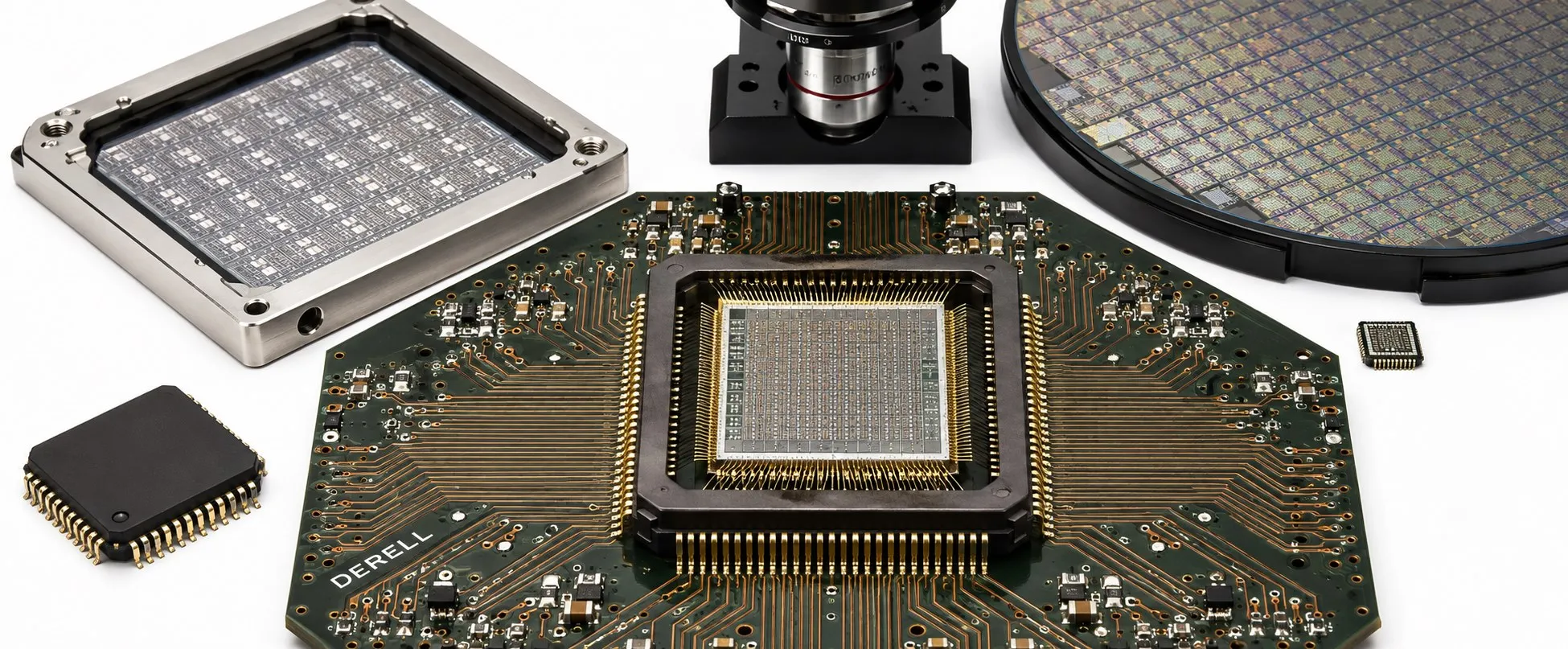
Memory whose contents are built into the silicon
Mask ROM, also called Mask Read-Only Memory or MROM, is a type of ROM whose contents are defined during semiconductor manufacturing. Normal operation provides no way to erase or rewrite them. It is non-volatile memory: stored information survives without a supply or backup battery.
The distinction is about how the data is established. A Mask ROM is not an ordinary blank chip with software loaded afterward. The bit pattern is encoded in the manufactured structure. Connecting a programmer does not make it rewritable like Flash or EEPROM.
What does the mask do?
The name refers to a manufacturing mask used to define features on the chip. Depending on the design, data can be encoded through connection patterns or the electrical characteristics of selected transistors. One approach uses ion implantation to give selected cells different read behavior. There is no single physical coding method shared by every Mask ROM.
When the processor selects an address, the read circuitry returns the corresponding bits. In a simple illustration, address 0 could contain 10100101 and address 1 00111100. Those values are part of the manufactured content, not variables that software can overwrite. Counters and intermediate calculations require RAM or another suitable writable memory.
How it differs from other ROM technologies
| Memory | How content is set | Can it be changed later? |
|---|---|---|
| Mask ROM | Physically encoded during chip fabrication. | Not through normal operation. |
| PROM / OTP | Uses a structure programmed once after fabrication. | Programmed content cannot normally be erased and rewritten. |
| EPROM | Loaded using a programmer. | Windowed UV-erasable versions can be erased and reprogrammed. |
| Flash / EEPROM | Electrically programmed. | Yes, subject to protection settings and cycling limits. |
Factory-programmed does not automatically mean Mask ROM. A supplier can deliver a Flash or OTP device with firmware already installed. Likewise, write-protected Flash remains Flash. Identify the technology from the full part number and datasheet, rather than whether a particular tool can write it.
Fixed content still has useful roles
Historical applications include game-cartridge content, printer font tables and embedded software that was not intended to change. Mask ROM also remains relevant as the location of the first code executed during startup in some processors.
In one documented Microchip boot architecture, code in Mask ROM loads an application from external non-volatile storage into SRAM and transfers execution to it. An immutable first stage does not make the application immutable. Renesas R-Car provides another example, using Mask ROM at the beginning of a secure boot chain. These are specific architectures, not a description of every processor.
A PLC or controller can similarly separate fixed startup functions from user programs and adjustable settings. Seeing “ROM” in a device description is not sufficient evidence that its Ladder program resides in Mask ROM.
The manufacturing trade-off
For large production runs with finalized content, a dedicated fixed-memory implementation can be economical. That decision must account for mask preparation, manufacturing lead time and the cost of a content change. Small batches and evolving firmware may favor other approaches. There is no universal production quantity at which Mask ROM becomes the cheaper option.
Assess capacity and access speed, read energy and operating temperature for the actual device. Retaining data without power does not mean it can be read without power. Mask ROM has no user erase/write cycling budget, but that does not imply unlimited reliability or lifetime.
What happens if the fixed software contains a bug?
The Mask ROM itself is not rewritten. Some processors provide a ROM patch mechanism that redirects execution to replacement code held elsewhere. Infineon's F2MC-16LX example loads correction code into RAM from external memory. This requires hardware support designed into the processor; it is not a general capability of every Mask ROM device.
A system can combine fixed Boot ROM, updateable application storage and a writable settings area. Frequently changing operational records may use a different technology such as FRAM. Immutable software can still contain mistakes or exploitable behavior. Its resistance to ordinary rewriting is one property, not a guarantee of complete system security.
Technical references: Renesas — Mask ROM and OTP variants · Microchip — The role of Boot ROM · Renesas — Secure boot · Infineon — ROM patch example