
What are the primary advantages of EtherCAT?
Hi everyone,
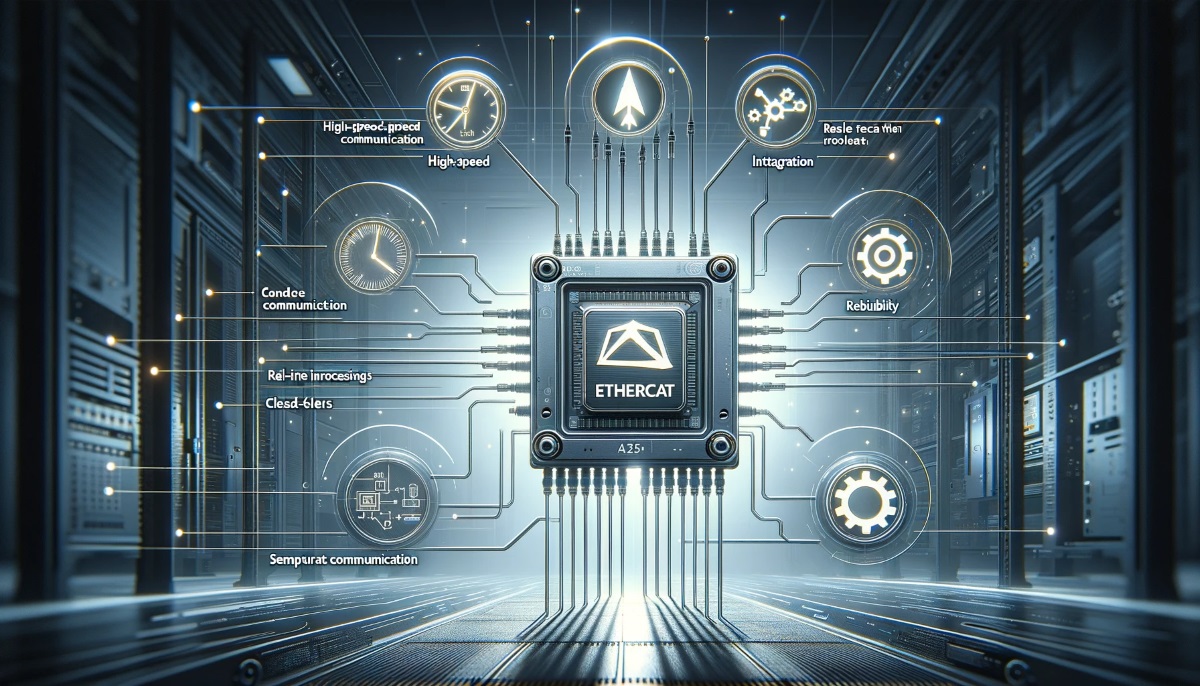
EtherCAT (Ethernet for Control Automation Technology) is a prominent industrial Ethernet protocol that offers several advantages for industrial automation and control systems. Here are the primary advantages of EtherCAT:
Real-time Performance:
EtherCAT provides deterministic, real-time communication. Its efficient processing of Ethernet frames allows for very short cycle times, often in the microsecond range.
High Speed:
EtherCAT operates at 100 Mbit/s, and with the newer EtherCAT G and G10 standards, it can go up to 1 Gbit/s and 10 Gbit/s, respectively.
Efficient Data Processing:
EtherCAT uses a unique principle where Ethernet frames are processed "on the fly." Each slave device reads the data relevant to it and inserts its data while the frame passes through, reducing latency.
Flexible Topology:
EtherCAT supports various topologies, including line, tree, star, or any combination thereof. This flexibility allows for tailored network configurations to suit specific application needs.
Cost-effective:
EtherCAT can utilize standard Ethernet hardware, making it a cost-effective solution, especially for smaller installations. Specialized hardware is available for higher performance needs but is not mandatory.
Large Number of Devices:
An EtherCAT network can theoretically support up to 65,535 devices, allowing for extensive and complex automation systems.
Integrated Safety:
Safety over EtherCAT (FSoE) provides integrated functional safety, allowing for the transmission of safety-relevant data over the same network, reducing the need for separate safety systems.
Distributed Clocks:
EtherCAT's distributed clock mechanism enables precise synchronization across devices, essential for applications that require tight coordination between multiple parts of a system.
Open Standard:
EtherCAT is an open standard, ensuring that it is not tied to a single manufacturer. This promotes competition, innovation, and choice in the market.
Extensive Diagnostics:
EtherCAT provides detailed diagnostic information that can be used for troubleshooting, predictive maintenance, and system optimization.
Scalability:
EtherCAT networks can be easily expanded or modified, allowing for scalability to meet growing or changing production needs.
Interoperability:
Due to its standardized nature and the efforts of the EtherCAT Technology Group (ETG), devices from different manufacturers can typically be integrated into an EtherCAT system with relative ease.
Redundancy Options:
EtherCAT offers various redundancy mechanisms, ensuring continued operation even in the event of certain network or hardware failures.
These advantages have made EtherCAT a preferred choice for many industrial automation applications, from simple control tasks to highly complex robotic systems.
"Platforms established on an EthernetCAT foundation have become increasingly popular in many sectors of industry. This technology, which is both practical and offers time/place savings, has evolved and branched out over time and has been embedded in third-party platforms as well. Below, we have tried to answer some of the main questions we received from our valued visitors about EtherCAT."
- What is EtherCAT?
- What are the primary advantages of EtherCAT?
- How does EtherCAT work?
- Why is EtherCAT used in the field of industrial automation?
- What are the differences between EtherCAT and traditional Ethernet?
- How does EtherCAT handle real-time performance?
- What is the topology of EtherCAT?
- Which devices and sensors can be integrated with EtherCAT?
- How do EtherCAT Master and Slave devices communicate with each other?
- How is security ensured in EtherCAT?
- What are the differences between EtherCAT and other industrial Ethernet protocols (e.g., PROFINET, Ethernet/IP)?
- What are the technical specifications of EtherCAT?
- Which programming languages and tools can be used with EtherCAT?
- What is the latency time of EtherCAT?
- What are the future trends and evolution of EtherCAT?
- What is the licensing and cost structure of EtherCAT?
- What versions of EtherCAT are available?
- How can you detect and resolve an error in an EtherCAT network?
- How does EtherCAT comply with industry standards?
- What are the limits and constraints of EtherCAT?
+ Back to Automation main page
"Please note, these questions may only satisfy general curiosities about the EtherCAT protocol.
Everyone or every student may have different questions specific to
their context or application. Our answers are not definitive judgments,
but merely serve as a guide. You are free to share our article by citing it as a source. If you have any questions, please fill out the form below." 08.2019 -
Your shopping cart is empty!