
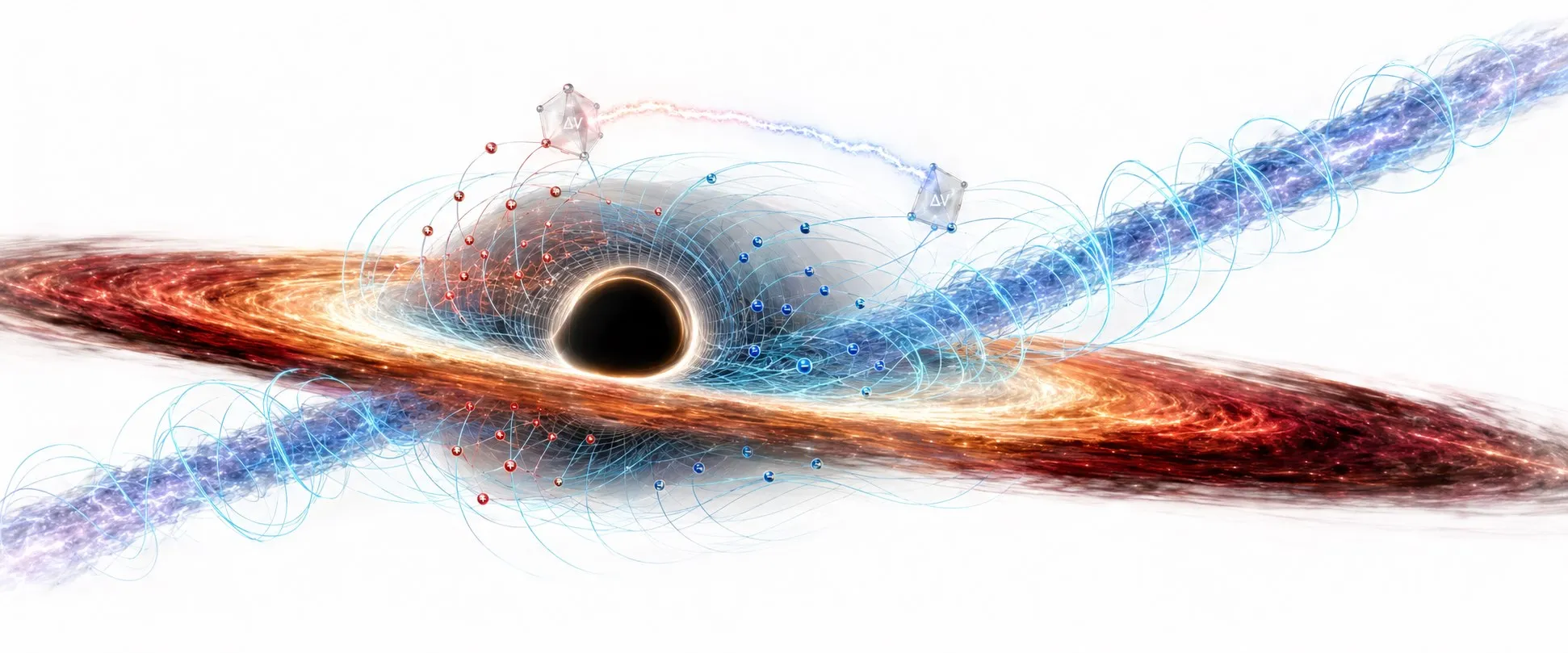
Do black holes have a voltage?
Electrical potential differences can matter in the environment around a black hole. The interesting physics involves charged particles, magnetic fields and energy flow. Calling the whole object a giant battery, however, hides the details that make the question meaningful. Start with what voltage means and the distinction between voltage and current: a potential difference requires a defined physical setting, rather than a label attached to an astronomical object.
Separate the object from its surroundings
A black hole can be surrounded by hot plasma containing mobile positive and negative charges. Their motion can support electric currents even when the plasma has little net charge. Strong electromagnetic activity does not, by itself, establish a strongly charged black hole. This distinction also helps frame the broader question of voltage in the universe.
The Kerr–Newman solution describes an idealised rotating black hole with electric charge. It is a legitimate mathematical model, but it does not establish that ordinary astrophysical black holes carry a large net charge. Interaction with surrounding particles can alter that charge. Conversely, a charge small enough to have little effect on spacetime can still affect the motion of individual charged particles.
Where do the magnetic fields come from?
Currents in surrounding plasma help generate and sustain magnetic fields. An isolated, uncharged rotating black hole does not automatically supply the strong fields associated with an active accretion system. The plasma, magnetic geometry and black hole spin must be considered together.
A generator offers a familiar way to think about energy conversion. Looking at how generators work also shows the limits of that analogy: the astrophysical system need not have wires, output terminals or a fixed supply voltage. The comparison is useful only while those differences remain visible.
Spin can supply energy without turning the hole into a battery
The Blandford–Znajek mechanism describes electromagnetic extraction of rotational energy under suitable magnetic and plasma conditions. The original Penrose process concerns particle energy exchange in the ergosphere. Both involve rotational energy, but they are distinct mechanisms rather than interchangeable names for voltage generation.
Engineers already encounter conversion of mechanical energy in regenerative systems. That comparison identifies the energy source; it does not make the two systems equivalent. Likewise, the relationship between voltage and wattage reminds us that a large potential difference alone does not determine power. P = V × I is useful for a simple circuit, not a complete model of a relativistic jet.
Even ordinary voltage distribution in a circuit depends on connections and reference points. Near a black hole, curved spacetime and observer motion add further requirements. There is no single universal black hole voltage that can be quoted without specifying the model and physical configuration.
What can a telescope actually tell us?
Polarised light from the region around M87* provides evidence about magnetic field structure. Jets involve processes outside the event horizon; they are not streams of material escaping from inside it. Such observations constrain electromagnetic models, but they are not a direct reading between two electrical terminals.
Compare this with measuring voltage using a multimeter. Astronomy measures radiation and uses models to infer conditions at the source. A detector may produce an electrical signal: a photodiode, for example, responds to incoming light. The detector signal is not the source object's voltage.
Hawking radiation is a different question
Hawking radiation is a theoretical prediction involving quantum fields in curved spacetime. It should not be presented as an established electrical output from observed astrophysical black holes. The familiar story of a particle pair splitting at the horizon is a teaching analogy, rather than a complete account of the calculation.
Our quantum physics FAQ and discussion of voltage at the quantum level provide routes into the underlying concepts. For engineering readers, standardised voltage levels belong to another context: an inferred cosmic potential scale does not automatically correspond to an electrical installation category.