
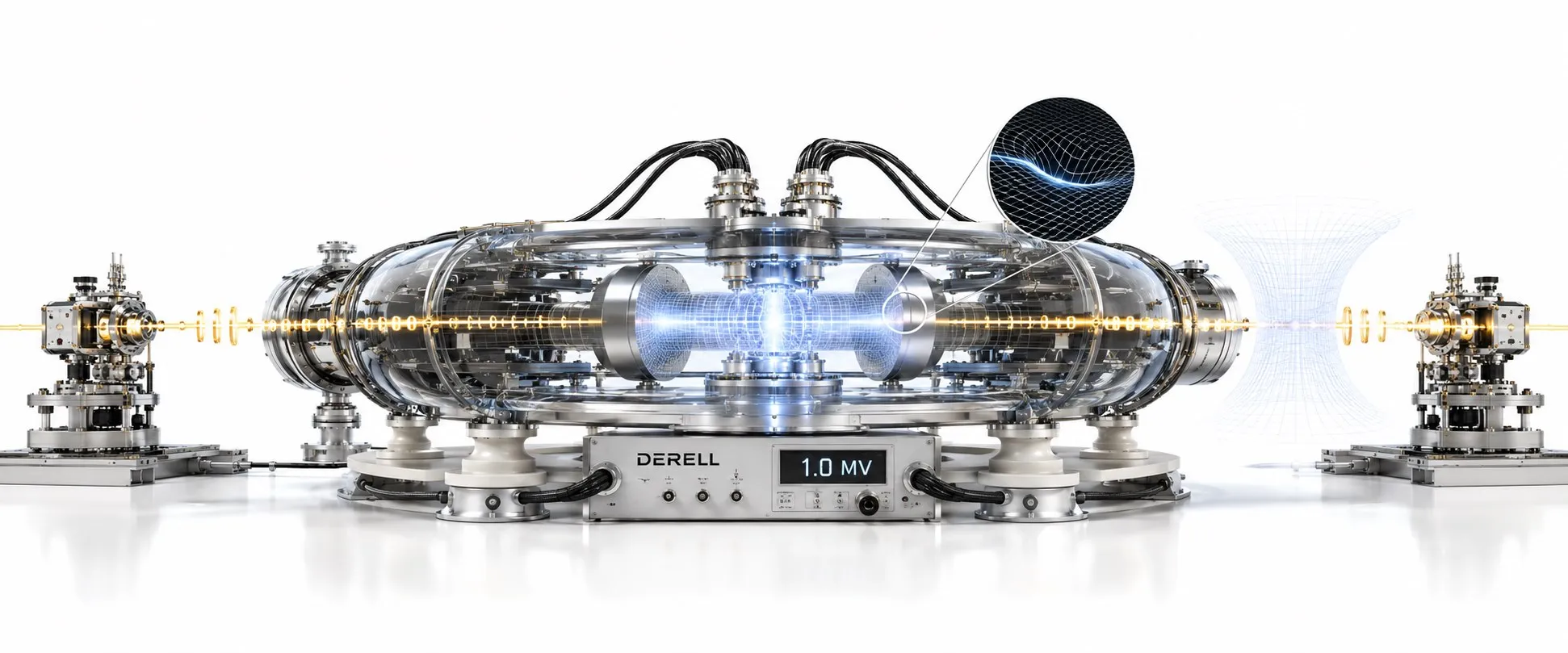
Could high voltage make time travel possible?
There is no verified method of travelling into the past by increasing voltage. Voltage is an electrical potential difference, not a setting that reverses time. The useful starting point is to separate measured relativistic effects from hypothetical spacetime models and fictional devices.
The real effect: different clocks can accumulate different times
Relativity predicts differences in elapsed time for clocks experiencing different motion or gravitational conditions. Atomic-clock experiments have measured these effects. Time dilation is not simply an electronic clock malfunction. It concerns the elapsed time measured by physical processes.
A traveller returning from a sufficiently fast journey can have aged less than people who stayed behind. Popular accounts sometimes call this travelling into the future. The traveller still proceeds forward through their own experienced time; they have not returned to an earlier event. This is distinct from turning up an electrical supply and stepping into yesterday.
A voltage figure does not describe an energy budget
The difference between voltage and current explains why “more volts” is not a complete account of energy. The relationship between voltage and wattage concerns power, while energy also involves duration. For an ideal capacitor, stored energy is E = ½ × C × V². Capacitance matters alongside voltage.
Selecting alternating current or direct current does not select a direction of time. Electromagnetic fields carry energy and contribute to gravity in general relativity, but that statement does not provide a recipe for a time machine. The broader discussion of voltage in the universe needs the same distinction between established physics and an unsupported application.
Black holes are not demonstrated time portals
The electromagnetic environment around black holes is a legitimate subject of research. It does not establish a route into the past. Wormholes occur in theoretical discussions, but a mathematical solution alone does not show that such a structure exists in nature or can be traversed.
Some spacetime models contain closed timelike curves, which raise questions about travel to earlier events. Their physical formation, stability and causal consequences remain separate problems. Hawking's chronology protection conjecture addresses this issue; it should not be presented as a definitive experimental verdict. Nor do parallel-universe proposals supply an established engineering solution.
Quantum tunnelling is not a tunnel into yesterday
Quantum tunnelling concerns access to the far side of a potential barrier that classical physics would forbid. A scanning tunnelling microscope uses an applied voltage in connection with tunnelling current between a tip and a surface. This practical example does not send particles into the past by raising the voltage.
Our discussion of voltage at the quantum level and the quantum physics FAQ provide routes into the underlying ideas. Adding the word “quantum” does not supply a missing mechanism or missing evidence.
A changed clock display is not enough
Measuring voltage checks an electrical quantity; it does not directly measure spacetime. Changes in a device's supply voltage can change circuit behaviour. Voltage fluctuations may reset a counter or disrupt operation. A voltage regulator controls the supply, not the passage of time.
A claimed time effect therefore needs independent reference clocks and controls for instrument errors and experimental conditions. Meanwhile, high-voltage hazards are real. A demonstration inspired by science fiction does not become an established physics experiment merely because its voltage is impressive.