
Toshiba VF-S15 User manual
Toshiba VF-S15 User Manuals and Technical Documents
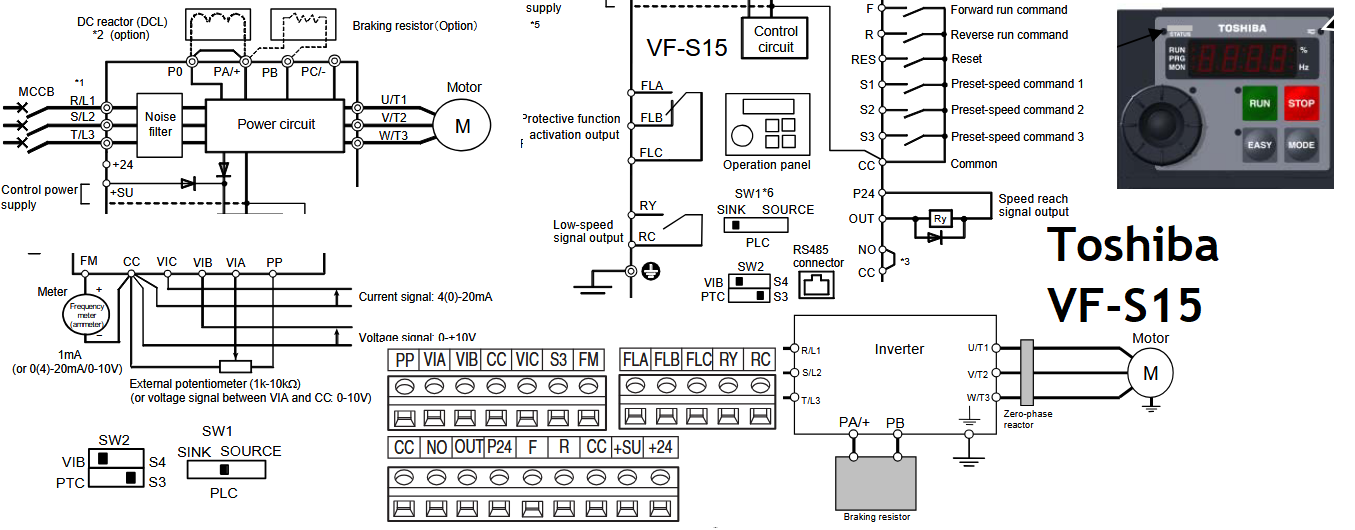
The Toshiba VF-S15 uses sinusoidal PWM control to regulate motor output voltage and frequency. It supports several motor control methods, including constant V/f, variable torque, automatic torque boost, sensorless vector control, energy-saving modes and PM motor control.
The drive can operate over an output frequency range of 0.1 to 500 Hz. The standard operating range is normally set to 0.5 to 60 Hz, while the maximum frequency parameter can be adjusted between 30 and 500 Hz depending on the application.
Motor control options include constant V/f, variable-torque control, automatic torque boost, vector control, automatic energy saving, dynamic energy-saving control for fan and pump applications, PM motor control, five-point V/f adjustment and auto-tuning.
The base frequency can be adjusted between 20 and 500 Hz, torque boost between 0 and 30%, and the starting frequency between 0.1 and 10 Hz. These values should always be set according to the motor nameplate and the mechanical limits of the machine.
Base-frequency voltage: The related voltage parameter can be set from 50 to 330 V on 240 V-class models and from 50 to 660 V on 500 V-class models. This is a V/f setting parameter and does not mean that the drive can produce a higher voltage than the available supply.
Protection functions: The VF-S15 includes a wide range of built-in protection and monitoring functions. These include stall prevention and current limiting, overcurrent, output short circuit, overvoltage, undervoltage, ground fault detection, input and output phase loss, electronic thermal overload protection, overtorque, undercurrent, overheating, emergency stop and braking resistor overload protection.
The drive also provides pre-alarm and warning functions, allowing some developing problems to be detected before the inverter trips completely.
Monitoring functions: The operator can view output frequency, frequency command, forward/reverse operation, output current, input voltage, output voltage, torque, inverter load, motor load, braking resistor load, input and output power and the status of the programmable terminals.
Additional service information includes PID feedback, CPU/software versions, accumulated running time, number of starts, maintenance warnings and the causes of the previous eight trips. These records can be especially useful when troubleshooting faults that only appear occasionally.
The VF-S15 also includes restart functions, parameter memory and fault-history features. Automatic restart should only be used after considering the possibility of the machine starting again without warning.
Operating environment: Depending on the model and installation conditions, the VF-S15 can be used at ambient temperatures from -10°C up to +60°C. At higher temperatures, cabinet ventilation, installation spacing, carrier frequency and output-current derating must be considered. Relative humidity should remain between 5% and 95% with no condensation.
The documents below cover wiring, setup, parameters, communication options, commissioning and application-specific functions for the Toshiba VF-S15.
Toshiba VF-S15 – Manuals and Download Files
+ VF-S15 CANopen Manual (PDF)
+ VF-S15 CANopen EDS Files (ZIP)
+ VF-S15 CC-Link Manual (PDF)
+ VF-S15 Detailed User Manual (PDF)
+ VF-S15 Detailed User Manual – Additional Version (PDF)
+ VF-S15 DeviceNet Manual (PDF)
+ VF-S15 DeviceNet EDS Files (ZIP)
+ VF-S15 Low-Voltage Operation (PDF)
+ VF-S15 EtherCAT Manual (PDF)
+ VF-S15 EtherCAT Configuration Files (ZIP)
+ VF-S15 Ethernet / Modbus Configuration Files (ZIP)
+ VF-S15 Modbus TCP / Ethernet Manual (PDF)
+ RKP002Z Remote Keypad Manual (PDF)
+ VF-S15 Hit-and-Stop Control Manual (PDF)
+ VF-S15 Quick Start Guide (PDF)
+ VF-S15 Catalog (PDF)
+ VF-S15 Load Reduction and Installation Notes (PDF)
+ VF-S15 Parameter List (PDF)
+ VF-S15 PID Control Guide (PDF)
+ VF-S15 PROFIBUS DP Manual (PDF)
+ VF-S15 PROFIBUS GSD Files (ZIP)
+ VF-S15 RS485 / Modbus Manual (PDF)
Toshiba VF-S15 – User Manuals and Fault Codes
VF-S15 main page | VF-S15 user manuals | Fault codes and troubleshooting | Fault code index
Fault Codes 1: Overcurrent, phase loss and overvoltage
Fault Codes 2: Drive overload, motor overload, torque and overheating
Fault Codes 3: Emergency stop, memory, communication and auto-tuning faults
Fault Codes 4: Ground fault, synchronization loss, overspeed and hardware faults
Fault Codes 5: PM motor auto-tuning, status messages and warnings
Toshiba main page | VFD main page
* The manuals, commissioning notes, fault-code information and troubleshooting suggestions on this page are provided as technical reference material. For actual commissioning or repair work, always check the original Toshiba documentation together with the motor data and the operating conditions of the machine. If you have field experience that could improve this page, you are welcome to contribute through the Otomasyon AVM Community or contact us.