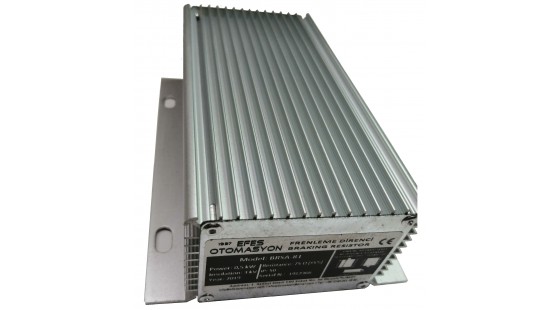
1000W (1KW) Braking resistors
Hello,
You are on the page for our 1000 watt (1 KW) braking resistor.
As with all of our products, braking resistors are classified into different models based on variables such as voltage, ohms, watts, and size, and not every product may be suitable for every application.
Additionally, the braking resistor value is different for each brand. For example, the braking resistor value for a 7.5 kW X brand drive may differ from that of a 7.5 kW Y brand drive. These values are listed for each drive in the user manual, and the ohm values are specified within a certain range.
Please note: the resistor and power ranges listed in the user manuals for drives vary by application. For instance:
Drive = 7.5 kW - 380 volts
Resistor value = 50 ohms
At this point, the braking resistor value is 50 ohms, but the wattage calculation for the resistor varies depending on the load of the connected motor. If the same motor drives a belt or conveyor, a 500 watt resistor would be sufficient. However, if the motor is connected to a carpet washing machine or crane hook motor, a 2500 watt resistor would be needed. This is because horizontal movement requires less drag, while vertical or oscillating loads require higher wattage (with the ohm value remaining the same). For this reason, a separate section has been created for applications requiring high-power braking resistors. For more detailed information, please read our "What is a Braking Resistor?" article.
Please note: according to Kirchoff's law, when resistors are connected in series, their ohm values and watt values double. When connected in parallel, their ohm values halve while their watt values double (assuming both resistor values are the same). For example, if two 500 watt 100 ohm resistors are connected in parallel, they are equivalent to a 50 ohm 1 kW resistor. If they are connected in series, they are equivalent to a 200 ohm 1 kW resistor. You can use this formula to find a suitable product if the value you are looking for is not in stock.
You are on the page for our 1000 watt (1 KW) braking resistor.
As with all of our products, braking resistors are classified into different models based on variables such as voltage, ohms, watts, and size, and not every product may be suitable for every application.
Additionally, the braking resistor value is different for each brand. For example, the braking resistor value for a 7.5 kW X brand drive may differ from that of a 7.5 kW Y brand drive. These values are listed for each drive in the user manual, and the ohm values are specified within a certain range.
Please note: the resistor and power ranges listed in the user manuals for drives vary by application. For instance:
Drive = 7.5 kW - 380 volts
Resistor value = 50 ohms
At this point, the braking resistor value is 50 ohms, but the wattage calculation for the resistor varies depending on the load of the connected motor. If the same motor drives a belt or conveyor, a 500 watt resistor would be sufficient. However, if the motor is connected to a carpet washing machine or crane hook motor, a 2500 watt resistor would be needed. This is because horizontal movement requires less drag, while vertical or oscillating loads require higher wattage (with the ohm value remaining the same). For this reason, a separate section has been created for applications requiring high-power braking resistors. For more detailed information, please read our "What is a Braking Resistor?" article.
Please note: according to Kirchoff's law, when resistors are connected in series, their ohm values and watt values double. When connected in parallel, their ohm values halve while their watt values double (assuming both resistor values are the same). For example, if two 500 watt 100 ohm resistors are connected in parallel, they are equivalent to a 50 ohm 1 kW resistor. If they are connected in series, they are equivalent to a 200 ohm 1 kW resistor. You can use this formula to find a suitable product if the value you are looking for is not in stock.