
What is A Lead-Acid battery?
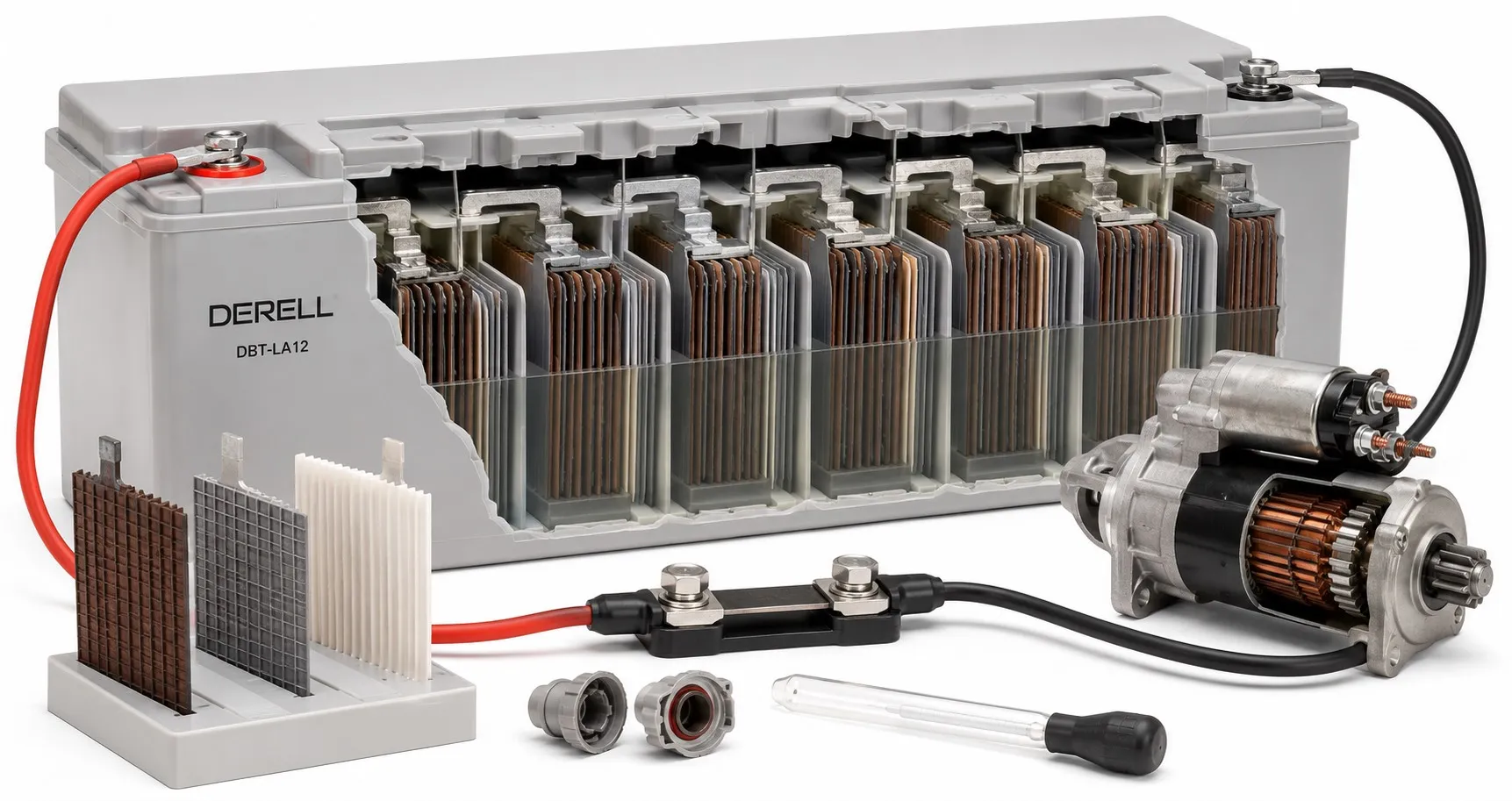
Separating starting power from energy storage capacity
A lead-acid battery is a rechargeable energy storage system. In its charged state, the negative electrode's active material is lead, the positive electrode's is lead dioxide, and the electrolyte is a solution of sulfuric acid and water. Like other battery technologies, it converts between chemical and electrical energy. Common applications include engine starting, UPS systems, emergency lighting, telecommunications and, with an appropriate design, cyclic energy storage.
What happens inside a cell?
During discharge, the active materials of both electrodes are converted to lead sulfate, and the acid concentration in the electrolyte decreases. Correct charging reverses this process. A lead-acid cell has a nominal voltage of approximately 2 V, so a common 12 V battery contains six cells in series. Nominal voltage does not mean that a meter will always read exactly 12 V; the reading depends on state of charge, load, temperature and when the measurement is taken.
Flooded, AGM and gel construction
In a flooded battery, the electrolyte remains liquid. Serviceable models may require electrolyte level checks and water replenishment according to the manufacturer's instructions. However, not every flooded battery has caps that users are permitted to open; follow the product's maintenance classification and manual.
In an AGM battery, the electrolyte is retained in an absorbent glass-fibre separator. In a gel battery, it is immobilized in a gel. Both commonly belong to the VRLA, valve-regulated lead-acid, family. AGM and gel are not chemistries separate from lead-acid.
A substantial proportion of the gases produced in a VRLA battery recombines internally, but it must not be treated as a completely gas-free, hermetically sealed box. Incorrect charging can cause gas venting and permanent water loss. These batteries are not routinely topped up with water or acid, and their ventilation requirements must still be considered.
Starting, deep-cycle and standby designs
A starting battery is designed to deliver high current briefly. A deep-cycle battery is developed for repeated discharge and recharge. A standby battery usually remains on float charge and supplies power during an outage. Comparing battery banks only by voltage and ampere-hours overlooks these distinctions.
An AGM battery is not automatically a deep-cycle battery. Likewise, repeatedly deeply discharging a starting battery in daily energy storage is inappropriate. Assess depth of discharge, cycle life, high-current performance and suitability for standby operation using the specific model's technical data.
What does the Ah rating mean in practice?
Ampere-hours and watt-hours represent different quantities. For a 12 V, 100 Ah battery, the nominal energy calculation is 12 × 100 = 1,200 Wh. This does not guarantee 1.2 kWh of usable energy at the load: permitted discharge, temperature, ageing, current and converter losses all affect the result.
A 100 Ah rating at C20 is based on approximately 5 A for 20 hours, at the specified test temperature and discharge endpoint voltage. Available capacity can decrease at higher discharge currents, a behaviour associated with the Peukert effect. Instead of treating Ah divided by load current as an exact battery runtime, use the manufacturer's relevant discharge curve. A starting battery's CCA rating is also not a substitute for its Ah capacity.
Correct charging and sulfation
Charging voltage, current limits and temperature compensation must suit the battery model. The float voltage specified for standby use may differ from the charging voltage for cyclic operation. A single “12 V battery charging setting” is inappropriate for every flooded, AGM and gel product. Procedures such as equalization charging should only be used where the manufacturer explicitly permits them.
Leaving a battery discharged or persistently undercharged can promote hard-to-reverse sulfation and capacity loss. Overcharging increases corrosion, water loss and heating. A lead-acid battery does not need to be fully discharged before recharging. Chemical additives or arbitrary high-voltage treatment are not validated maintenance methods.
Temperature, storage and condition checks
Available capacity and power decrease in the cold; lead-acid cannot therefore be described as outperforming every other chemistry at low temperatures. High temperatures may temporarily increase capacity but generally shorten service life and accelerate self-discharge. A stored battery also loses charge; inspection and supplementary charging intervals should follow the manufacturer's temperature-dependent instructions.
Assessing charge and health requires more than an unloaded voltage reading. An aged battery may show a normal voltage and then collapse under load. Consider capacity or appropriate load testing alongside connections and the charging system. In series and parallel battery banks, do not casually mix blocks of different ages, capacities or service histories.
Safety and recycling
Even at a low nominal voltage, a lead-acid battery can deliver very high short-circuit current. Suitable protection, connections and terminal insulation matter. The electrolyte is corrosive, and hydrogen released during charging must be kept away from ignition sources. Instead of opening or attempting to recharge a swollen, cracked or leaking battery, take it out of service and arrange appropriate professional handling and collection.
Lead is toxic, and acidic electrolyte must not be released into the environment. End-of-life batteries should not enter household rubbish or ordinary packaging recycling; return them through the local lead-acid battery collection and recovery system. The ability to recover lead and casing materials does not make uncontrolled dismantling safe.
Lead-acid's strengths include high-current delivery in suitable applications and a relatively low initial investment in many comparisons. Its main limitations are weight, restricted usable energy and service life that depends strongly on operating conditions. When switching to a lithium-based system, matching nominal voltage alone is insufficient; charging, protection and equipment compatibility must be reassessed.
Editor's note: “Maintenance-free” usually means that water replenishment is not required. It does not remove the need to check terminals, casing, charging conditions and performance. In UPS and emergency power systems, a battery remaining connected does not demonstrate that it will deliver the required capacity during an outage.
Related battery topics
AGM, gel and LiFePO4 comparison, lithium-ion battery technology, NiMH rechargeable batteries, battery and accumulator standards, battery accessories.
Related system components and calculations
Uninterruptible power supplies, DC–AC power inverters, battery chargers, DC fuses, battery capacity calculations for solar systems.
Battery types main page. Batteries and chargers main page.
Technical references
Panasonic: VRLA construction and electrochemical operation.
GS Yuasa: VRLA operating, charging, temperature and inspection instructions.
Trojan Battery: Battery maintenance and charging; lead-acid technical FAQs.
Victron Energy: Capacity, discharge rate and the Peukert effect; lead-acid battery types.
US EPA: Safe collection and recycling of used lead-acid batteries.