
Where is memory technology headed in the future?
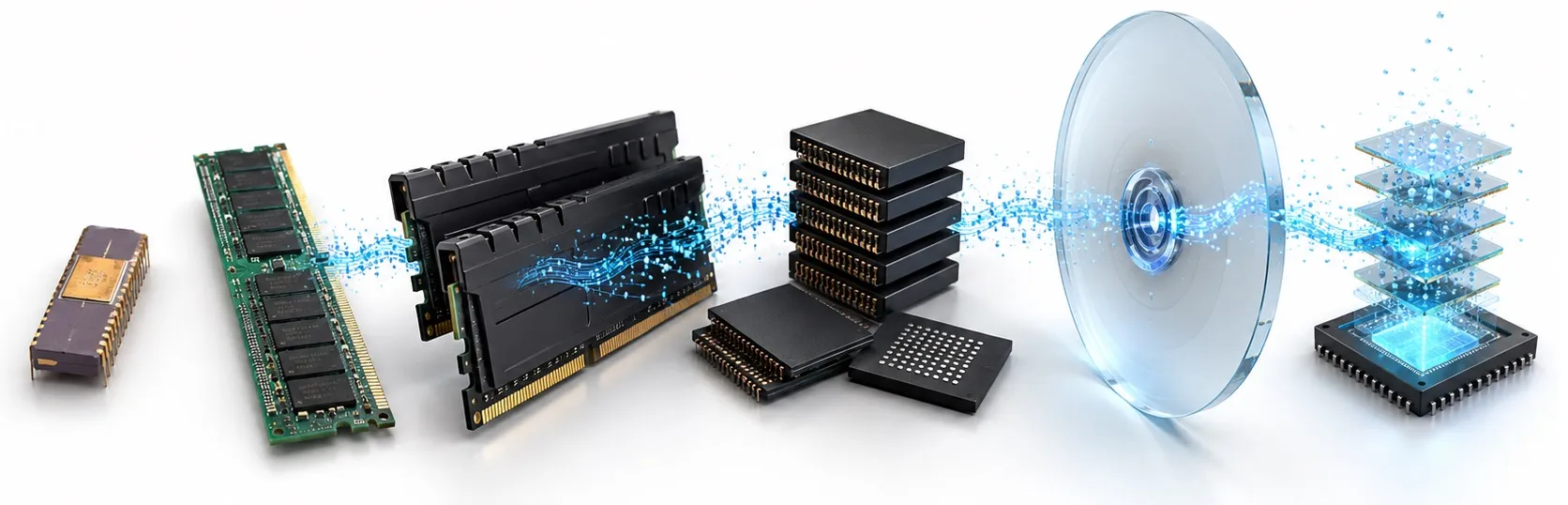
Memory is becoming a data-movement problem
The next generation of memory must do more than hold additional bits. Designers are pursuing higher density, faster data delivery, lower energy use and more dependable persistent storage. These goals lead to different solutions. The application using the memory matters more than the promise of one technology replacing everything else.
1. AI needs a wider path between memory and compute
A microprocessor or AI accelerator can spend time waiting even when it has ample computing power. Its data has to arrive first. For RAM, this makes bandwidth a central design concern. Bandwidth measures how much data can move per second; latency measures how long an individual access takes. Improving one does not automatically improve the other.
High-bandwidth memory, or HBM, combines stacked DRAM dies with wide connections to supply AI and high-performance computing workloads. Commercial HBM4 production is a concrete example of this direction. HBM remains volatile DRAM: it is not intended to retain data when power is removed. The distinctions between DRAM and SRAM and the capacity–speed trade-off still apply.
2. Flash capacity is growing vertically
In flash storage, 3D NAND places cells across many layers rather than relying solely on shrinking a flat array. Another route stores more bits in each cell: TLC holds three bits and QLC four. Both approaches increase density, but distinguishing more cell states makes sensing and programming more demanding.
Layer count alone therefore says little about whether a device fits a workload. Controllers, error correction, write patterns and temperature all matter. NOR and NAND flash serve different purposes, and firmware storage has different requirements from a large data archive. Compare write endurance and retention alongside capacity.
3. Persistence is becoming more useful for frequently changing data
MRAM stores data through magnetic properties, while FRAM uses ferroelectric properties. Both already have commercial implementations. Depending on the device, they can support frequent persistent updates, low write energy or designs that avoid a backup battery for data retention.
That does not make them universal replacements for flash or DRAM. Density, price, interfaces and manufacturing integration differ. Also, NVRAM describes a broader class of persistent-memory solutions rather than one particular cell design.
A simple example: how moving data holds up a processor
Under ideal conditions, transferring 1 GB at 1 GB/s takes one second; at 10 GB/s it takes one tenth of a second. This ignores protocol overhead and other delays, but captures the problem: faster arithmetic cannot eliminate the time needed to fetch data. Placing memory closer to compute, or transferring fewer bytes, can help. Memory power consumption also depends on accesses and transfers, not just the amount stored.
4. CXL changes how servers allocate memory
Compute Express Link, or CXL, is an interconnect rather than a new storage cell. With suitable hardware and software, it supports memory expansion and memory pooling. A pool can allocate capacity where it is needed instead of leaving resources tied to a particular workload.
Pooling is distinct from sharing the same data among processors. Nor should CXL-attached memory be assumed to perform identically to local RAM: the access path and software affect the result. This is primarily a server architecture development, not a general upgrade that can be applied directly to a small controller board.
5. Some computation will move to the memory
In-memory computing aims to perform selected operations without repeatedly shipping the data to a separate processor. Analog arrays can contribute to matrix–vector operations used in neural networks. Phase-change and resistive memories are among the technologies explored for this purpose; digital implementations also exist.
Research demonstrations, including IBM's phase-change-memory analog AI chip, show the potential. However, numerical accuracy, device variability, conversion energy and software integration remain significant engineering challenges. The approach could benefit AI and robotics, but a research accelerator should not be treated as an off-the-shelf replacement for a general-purpose processor.
6. What should improve inside an industrial controller?
For a PLC or embedded controller, useful progress means dependable counter storage, lower-energy updates and consistent records after a power interruption. Saving a counter once per second produces approximately 31.5 million save operations per year. That is not necessarily the number of writes to one cell: record layout and wear distribution change the relationship. It does show why capacity is only part of the decision.
Preventing memory data loss requires attention to interrupted writes, record validation and power-loss handling. The ROM family and one-time programmable memory may still serve fixed startup-code or permanent-configuration roles. Recovering stored data does not imply that machinery should restart automatically.
Technical references: Micron — HBM4 · Micron — Choosing NAND · Everspin — Industrial MRAM · Texas Instruments — FRAM · CXL — Memory pooling · Nature — Analog in-memory computing