
ATV 21 fault codes
E-18 Break in VIA signal cable
- Meaning: The VIA analog signal is below the level set by parameter F633.
- Cause: Signal loss at VIA.
- Solution: Check the signal at VIA and rectify the cause of the signal loss. Verify that parameter F633 is set correctly.
E-19 CPU communications error
- Meaning: Communication error between control CPUs.
- Cause: Internal communication fault.
- Solution: Contact Schneider Electric to repair the drive.
E-20 Excessive torque boost
- Meaning: Torque boost parameter F402 is set too high, or the motor impedance is too low.
- Cause: Incorrect parameter setting or low motor impedance.
- Solution: Repeat the drive auto-tune and then adjust down parameter F402.
E-21 CPU fault 2
- Meaning: The control board CPU is inoperable.
- Cause: CPU failure.
- Solution: Contact Schneider Electric to repair the drive.
EEP1 EEPROM fault 1
- Meaning: A data writing error has occurred.
- Cause: Data writing error.
- Solution: Cycle power to clear the fault.
EEP2 EEPROM fault 2
- Meaning: Power was removed from the drive during a parameter reset operation resulting in a data writing error.
- Cause: Power interruption during parameter reset.
- Solution: Cycle power to clear the fault and try the parameter reset operation again. If the fault does not clear, contact Schneider Electric to repair the drive.
EEP3 EEPROM fault 3
- Meaning: A data reading error has occurred.
- Cause: Data reading error.
- Solution: Cycle power to clear the fault.
EF2 Ground fault
- Meaning: Ground fault in motor or motor cables.
- Cause: Ground fault.
- Solution: Using a 1000 V megger, check the motor and motor cables for ground faults.
EPHI Input phase loss
- Meaning: Loss of one input phase.
- Cause: Missing input phase.
- Solution: Determine the cause of the missing input phase and rectify. Set parameter F608 to 0.
EPHO Output phase loss
- Meaning: Loss of one or more output phases.
- Cause: Missing output phase.
- Solution: Determine the cause of the missing output phase and rectify the problem. Set parameter F605 to 0.
Err1 Frequency setting point error alarm
- Meaning: Parameters F202, F203, F210, or F212 are set improperly.
- Cause: Incorrect parameter settings.
- Solution: Set the parameters to the correct settings.
Err2 Control board RAM fault
- Meaning: The control board RAM is inoperable.
- Cause: RAM failure.
- Solution: Contact Schneider Electric to repair the drive.
Err3 Control board ROM fault
- Meaning: The control board ROM is inoperable.
- Cause: ROM failure.
- Solution: Contact Schneider Electric to repair the drive.
Err4 CPU fault 1
- Meaning: The control board CPU is inoperable.
- Cause: CPU failure.
- Solution: Contact Schneider Electric to repair the drive.
Err5 Communication fault
- Meaning: Serial communication error.
- Cause: Communication error.
- Solution: Check network control devices and cables. Check the setting of the communication timeout parameter, F803. Check the remote graphic display terminal cable.
Err7 Current sensor fault
- Meaning: A motor current sensor is inoperable.
- Cause: Sensor failure.
- Solution: Replace the drive.
Err8 Network error
- Meaning: Network communication error.
- Cause: Network communication fault.
- Solution: Check the network control devices and cables.
Etn1 Auto-tuning error
- Meaning: Error during auto-tuning due to incorrect parameter settings, motor size, cable gauge, motor rotation, or wrong motor type.
- Solution: Set parameters F401–F494 correctly, use a larger drive if the motor is too large, use a larger gauge motor cable, ensure the motor is stopped before starting auto-tune, and use the drive only with a 3-phase induction motor.
EtYP Drive type fault
- Meaning: The main control board is inoperable.
- Solution: Set parameter tYp to 6. If the error persists, replace the drive.
h999 Accumulated input power error
- Meaning: The accumulated input power value exceeds 999.999 kWh.
- Solution: Clear the accumulated input power value using logic input function 51 or parameter F748.
OC1 Overcurrent during acceleration
- Meaning: Overcurrent detected during acceleration due to short acceleration time, incorrect Pt parameter setting, starting into a rotating load, low impedance motor, or ground fault.
- Solution: Increase acceleration time (ACC or F500), select the correct setting for parameter Pt, enable catch on the fly (F301), adjust the switching frequency (F300), and set parameter F316 to 1 or 3.
OC1P Ground fault
- Meaning: Short circuit or ground fault during acceleration.
- Solution: Use a 1000 V megger to check the motor and motor cables for ground faults.
OC2 Overcurrent during deceleration
- Meaning: Overcurrent detected during deceleration due to short deceleration time or ground fault.
- Solution: Increase deceleration time (dEC or F501) and set parameter F316 to 1 or 3.
OC2P Ground fault
- Meaning: Short circuit or ground fault during deceleration.
- Solution: Use a 1000 V megger to check the motor and motor cables for ground faults.
OC3 Overcurrent during constant speed operation
- Meaning: Overcurrent detected during constant speed operation due to abrupt load fluctuations or abnormal load conditions.
- Solution: Reduce load fluctuations, check the load, and set parameter F316 to 1 or 3.
OC3P Ground fault
- Meaning: Short circuit or ground fault during constant speed operation.
- Solution: Use a 1000 V megger to check the motor and motor cables for ground faults.
OCA Arm overcurrent during startup
- Meaning: Overcurrent detected during startup due to ground fault.
- Solution: Use a 1000 V megger to check the motor and motor cables for ground faults.
OCL Short Circuit
- Meaning: Phase-to-phase output short circuit or low motor impedance.
- Solution: Use a 1000 V megger to check the motor and motor cables for ground faults.
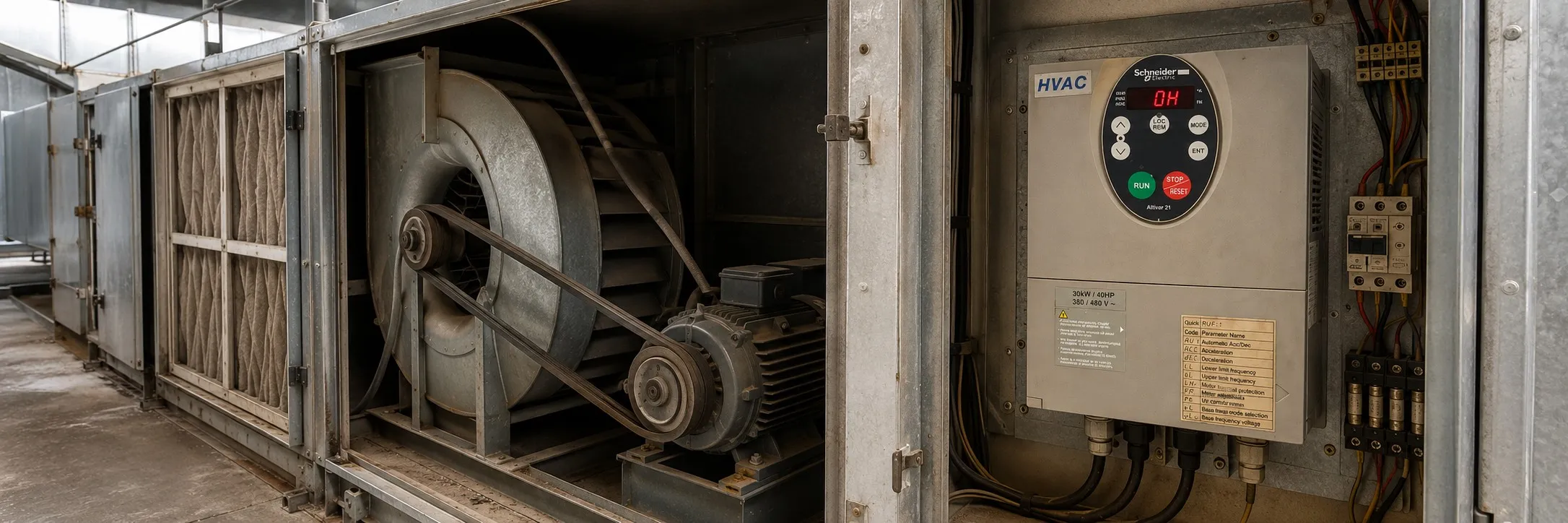
OH Drive overtemperature fault
- Meaning: Drive overheating due to faulty cooling fan, high ambient temperature, blocked air vent, heat source proximity, or malfunctioning heatsink temperature sensor.
- Solution: Reset the drive fault after cool-off, decrease ambient temperature by increasing free space around the drive and removing heat sources.
OH2 Motor PTC overtemperature fault
- Meaning: External PTC embedded in motor windings indicates motor overtemperature condition.
- Solution: Correct the motor overload condition and check the PTC for correct operation.