
ATEX Zone 22 Combustible Dust Atmospheres
ATEX Zone 22 Combustible Dust Atmospheres
ATEX Zone 22 is an area where an explosive cloud of combustible dust in air is not expected during normal operation and, if it occurs, remains for only a short period. The criterion concerns the likelihood and duration of an explosive dust atmosphere, rather than the mere presence of dust on surfaces. Within the ATEX framework, hazardous area classification provides an essential input to equipment selection and workplace precautions.
Zone 22 still requires explosion precautions. Even an infrequent dust cloud can encounter an effective ignition source. Flour, certain wood dusts and combustible polymer dusts are examples of materials that may require assessment. Combustibility and explosion characteristics should be considered using information relevant to the actual dust present in the process.
How Zones 20, 21 and 22 differ
In Zone 20, an explosive dust cloud is present continuously, for long periods or frequently. In Zone 21, it is expected occasionally during normal operation. In Zone 22, it is not expected during normal operation and persists only briefly if it occurs. A routine dust release should not be assigned to Zone 22 simply because each release is described as temporary.
Zone 0, Zone 1 and Zone 2 form the separate classification series for gases, vapours and mists. IEC 60079-10-1 addresses gas area classification, while IEC 60079-10-2:2026 addresses dust area classification. Where gas and dust can coexist, identifying the dust zone alone does not cover every hazard.
Determining the extent of the zone
Assessment starts with dust properties, release points and the way the process operates. Containment, the potential for dust to become airborne, extraction and housekeeping must be considered. Dust layers, deposits and heaps can become sources of an explosive cloud when disturbed. IEC 60079-10-2:2026 treats dust clouds and layers separately; where effective housekeeping is absent, classification includes potential clouds arising from accumulated layers.
There is no universal Zone 22 radius for every installation. Boundaries should not be based solely on a machine name or an arbitrary distance. The drawing should identify release sources, horizontal and vertical limits, operating conditions and housekeeping assumptions. Changes to the material, process or operating arrangements require those assumptions to be reviewed.
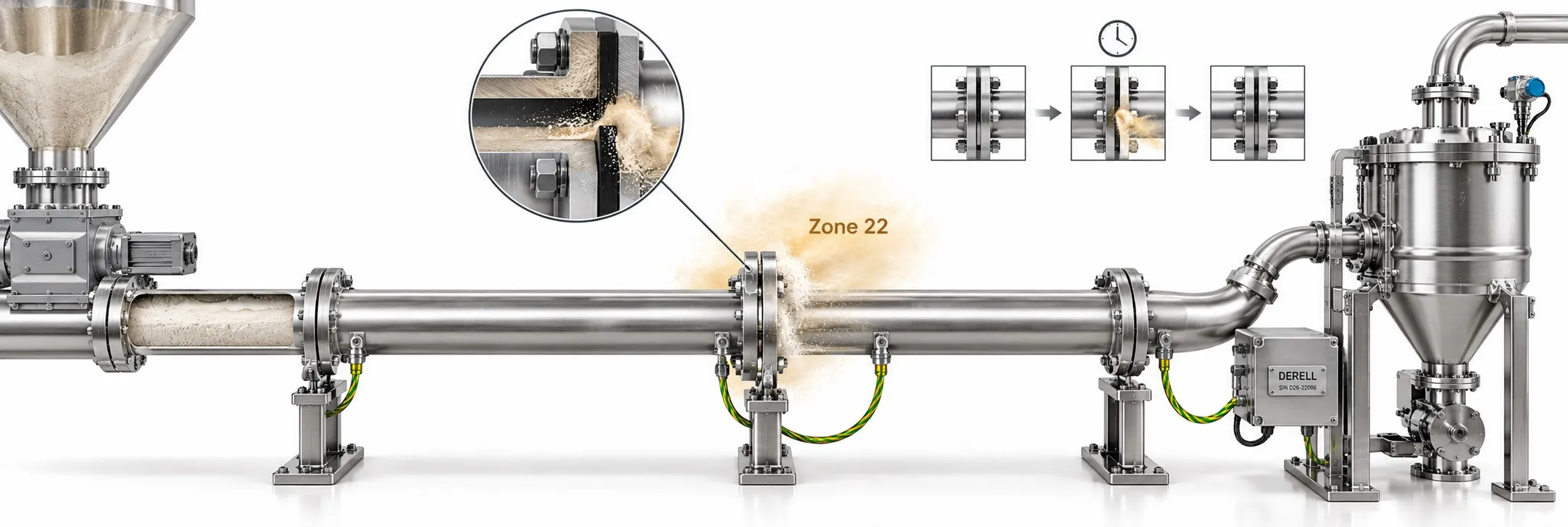
Example: the surroundings of an enclosed dust conveyor
Consider an enclosed conveying line that does not release dust during normal operation. If a containment problem covered by the assessment could produce a brief dust cloud, a defined area outside the line may be assessed as Zone 22. This is an illustrative scenario, rather than an automatic classification result. The interior may have a different zone. Repeated leakage, clouds during routine discharge or persistent deposits require the initial assumptions to be reconsidered.
Equipment selection for Zone 22
Under the general ATEX category selection framework, dust-suitable Group II category 3D equipment can be used in Zone 22. Suitable 2D or 1D equipment can also be selected. In ATEX equipment groups and categories, the letter D identifies dust use. A higher category alone does not establish suitability where material properties or temperature conditions are incompatible.
The zone classifies the area; the category concerns the equipment protection level. Review the product marking, EU declaration of conformity, instructions and any relevant certificate scope together. The current EU product framework is Directive 2014/34/EU. IECEx certification is a separate international system and does not automatically replace the ATEX conformity process required for the EU market.
Ex t protection and IP ratings
Ex t dust ignition protection uses an enclosure and surface temperature limitation. IEC 60079-31:2022 addresses its design, construction and testing requirements. Assess the protection method together with the selected product’s marking and conditions of use. A single product type should not be assumed mandatory for every Zone 22 application.
An IP protection rating concerns protection against ingress. An IP65 or IP67 label alone does not establish Zone 22 suitability. When reviewing Ex protection methods and markings, also consider temperature, the intended environment, installation requirements and the product’s conformity documentation.
Surface temperature and dust layers
Dust clouds and dust layers can have different ignition behaviour. Layer thickness and contact time with a hot surface influence the assessment. The permissible equipment surface temperature must be established using the relevant dust data and selection rules. A single temperature limit should not be applied to every combustible dust. Deposits that interfere with motor or luminaire cooling also belong in the maintenance assessment.
Sensors, connections and electrical installations
Low-power sensors also require assessment. Where Ex i intrinsic safety is used, the device and its connected circuit must be considered together. IEC 60079-11 and IEC 60079-25 introduce the relevant equipment and system topics. Installing a barrier does not automatically make every connected product suitable for Zone 22.
IEC 60079-14:2024 covers electrical installation design, selection and erection. Cable entries, covers, seals and connections must follow the manufacturer’s instructions. An inspection and maintenance approach based on IEC 60079-17:2023 helps track damage and changes that may affect the protection over time.
Housekeeping and operation
Housekeeping is an operating condition that must support the area assessment. Blowing deposits with compressed air can create a new dust cloud. Select the cleaning method and collection equipment for both the environment and the dust involved. Include overhead beams, shelves and equipment tops in inspections. Earthing, mechanical friction and hot surfaces require separate consideration as potential ignition sources.
Before commissioning, record the answers to practical questions: Which dust is handled? Where can a cloud form? Which assumptions define the boundary? Does the selected product suit those conditions? Who is responsible for cleaning and inspection? These records provide a useful comparison when equipment or processes change.
Editor’s note: This page is a general guide to the relationships between ATEX, IECEx and explosive atmosphere standards. Final Zone 22 boundaries and the suitability of a particular product require site-specific information and competent assessment. An IEC publication, its EN adoption and its EU harmonised status are separate matters. A publication year stated here does not by itself establish harmonised status.
Related topics
Zone 20 | Zone 21 | ATEX groups and categories | Dust area classification | Ex t enclosure protection | Ex inspection and maintenance
External reference links
1999/92/EC – workplaces, zone definitions and equipment selection
European Commission – ATEX product legislation
IEC 60079-10-2:2026 – dust area classification
IEC 60079-31:2022 – dust ignition protection by enclosure
IEC 60079-14:2024 – electrical installation selection and erection
IEC 60079-17:2023 – inspection and maintenance
HSE – definitions of Zones 20, 21 and 22
HSE HSG103 – safe handling of combustible dusts