
ATEX Zone 21 Combustible Dust Atmospheres
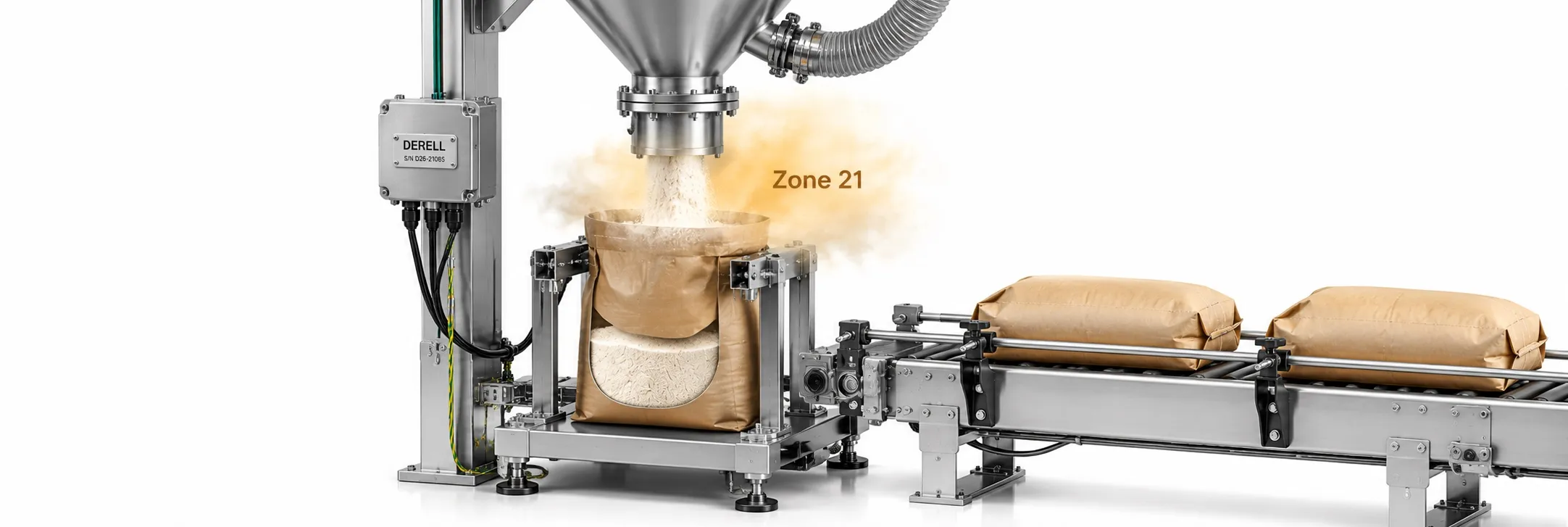
ATEX Zone 21 Combustible Dust Atmospheres
ATEX Zone 21 describes an area where combustible dust suspended in air can occasionally form an explosive cloud during normal operation. Visible dust alone does not determine the classification: the likelihood and duration of an explosive dust-air mixture matter. Within the ATEX framework, this classification informs equipment selection and operating precautions.
The difference between Zones 20, 21 and 22
In Zone 20, an explosive dust cloud is present continuously, frequently or for extended periods. In Zone 21, occasional formation is expected during normal operation. In Zone 22, formation is not expected during normal operation; if it occurs, it remains only briefly. The zone number does not describe explosion severity. It describes the occurrence of the hazardous atmosphere.
Areas near bag emptying stations, filling openings or open transfer points may be Zone 21 in some processes. These examples do not automatically classify a location. The IEC 60079-10-2 approach considers release sources, process conditions, dust characteristics and housekeeping. Equipment interiors and their surroundings may have different classifications; boundaries must follow the site assessment.
What do Category 2D and EPL Db mean?
Under the EU workplace directive’s standard selection approach, dust-suitable Category 1 or Category 2 equipment is used in Zone 21. The dust designations are 1D and 2D. Within ATEX equipment categories, 2D is the common designation associated with this zone; equipment marked only 3D does not provide the same selection level.
In the IEC equipment protection level system, Db is associated with Zone 21, and suitable Da equipment can also be used. Category and EPL are separate marking systems. Both must be checked alongside dust group, temperature and conditions of use. Gas designations such as G, Ga or Gb alone do not demonstrate dust suitability.
Dust groups and Ex protection methods
IIIA, IIIB and IIIC describe different dust characteristics: IIIA covers combustible flyings and fibres, IIIB nonconductive dust, and IIIC conductive dust. Material information and any necessary testing should establish the group rather than the product name alone. The certified group must suit the material present at the site.
Among Ex protection markings, Ex t describes dust ignition protection using an enclosure and control of surface temperature. IEC 60079-31 addresses equipment and component requirements for this method. Ex tb / Db markings can be encountered in Zone 21 applications. Other methods, such as Ex i intrinsic safety, also require verification of the applicable dust suitability and protection level.
Reading an example equipment marking
II 2D Ex tb IIIC T135°C Db is an illustrative marking only. II identifies the ATEX equipment group for non-mining applications, 2D the dust category, tb the enclosure protection level, IIIC the conductive dust group, T135°C the maximum surface temperature under the specified conditions, and Db the EPL. This page does not recommend 135°C as a universal limit.
Read the marking together with the certificate scope, ambient temperature range, mounting requirements and any specific conditions of use. A dust temperature marking expressed in degrees must not be confused with the T1–T6 temperature classes used for gases. A T4 marking alone does not establish Zone 21 suitability.
Assess dust clouds and dust layers together
Deposited dust can become airborne again when disturbed. It can also ignite on hot surfaces and interfere with equipment cooling. Selection therefore considers more than cloud ignition temperature: layer ignition temperature, deposit thickness and thermal insulation effects also matter. A temperature assessment for a thin layer cannot simply be applied to a thick accumulation.
Housekeeping maintains the operating conditions assumed in area classification. Stop the dust-generating activity safely before removing deposits. The cleaning method and vacuum equipment must suit both the location and the combustible dust collected. Cleaning that disperses deposits into the air can increase the hazard.
Why IP65 or IP66 alone is insufficient
IEC 60529 ratings such as IP65 and IP66 describe enclosure ingress protection. An IP rating is neither an ATEX category nor an EPL. Restricting dust entry matters, but temperature, electrostatic effects, mechanical strength and preservation of the certified construction also require assessment. Changing a cable gland or cover can affect the protection conditions of approved equipment.
Static electricity and motor applications
Electrostatic charging during dust conveying and discharge can create an ignition source. IEC TS 60079-32-1 provides guidance for assessing these hazards. Appropriate equipotential bonding and continuity of conductive parts must be considered alongside material and process measures. Adding an earth connection alone does not resolve every electrostatic hazard.
For a motor supplied by a variable speed drive, check cooling at low speed, load limits and temperature protection. Follow the motor rating plate and manufacturer’s instructions. An ATEX protective function in a drive does not establish approval of the motor-drive combination for every application. The installed motor’s dust suitability must also be verified.
Installation, documentation and maintenance
IEC 60079-14 addresses electrical installation design, selection, installation and initial inspection; IEC 60079-17 addresses inspection and maintenance. Check the equipment marking, certificate and manufacturer’s instructions together. An X suffix on the certificate number indicates specific conditions of use. Within IECEx certification, a component certificate must be distinguished from the certificate for complete equipment.
Editor’s note: This page provides a general technical explanation. Competent personnel determine zone boundaries and final equipment selection using site material data, the explosion protection document, certificates and applicable legislation. In the EU framework, 2014/34/EU addresses products and 1999/92/EC workplace precautions; these responsibilities complement each other.
Related topics: ATEX, IECEx and explosive atmosphere standards, Zone 20, Zone 22, dust area classification and dust ignition protection by enclosure.
External Reference Links
EUR-Lex — 1999/92/EC · EUR-Lex — 2014/34/EU · IEC 60079-10-2:2026 · IEC 60079-31:2022 · IEC 60079-14:2024 · IEC 60079-17:2023 · IEC TS 60079-32-1 · IECEx — Ex Protection Techniques · IECEx — Certified Equipment Scheme · HSE — HSG103 · HSE — ATEX Practical Issues · ABB — ATEX Certified Safety Functions