
Low torque error
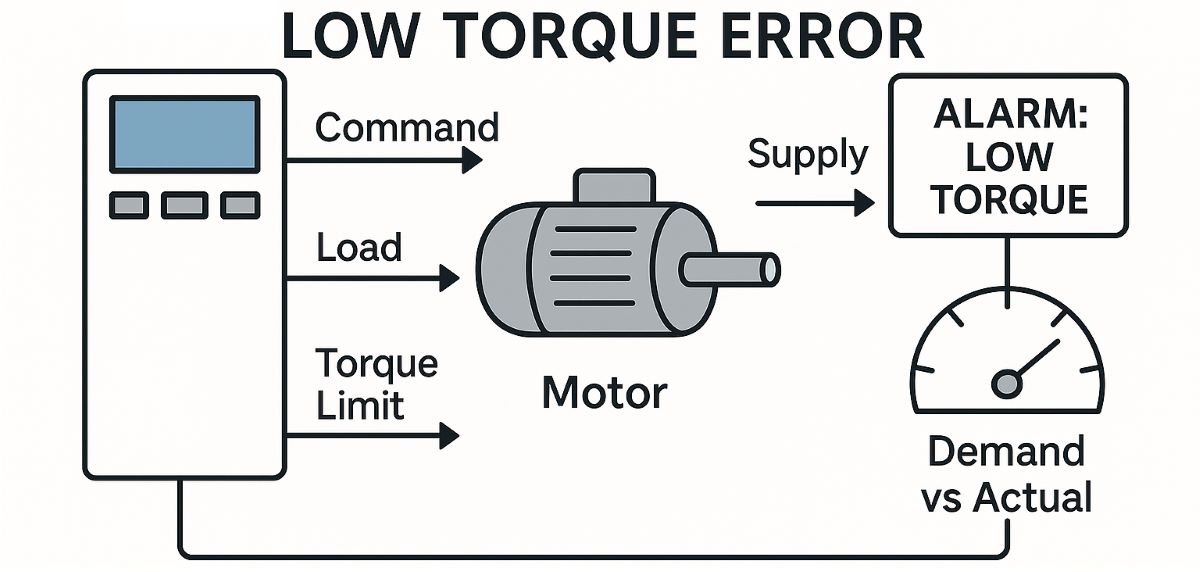
In the context of Variable Frequency Drives (VFDs) used in industrial automation and motor control, a “Low Torque Error” is an alarm or fault condition indicating that the motor is unable to generate the required torque to perform its intended function. This error can arise from various issues related to the motor, the drive, or the application itself. Understanding the causes, implications, and troubleshooting steps for a low torque error is crucial for maintaining the efficiency and reliability of VFD systems.
Inputs
Notes
Change scenario and sliders. Alarm triggers when actual torque stays below demand for a short window.
Motor
Signal (Torque Demand vs Actual)
Causes of Low Torque Error:
Undersized Motor or Drive: If the motor or VFD is not adequately sized for the application’s torque requirements, it may lead to a low torque error.
Incorrect Settings: Improper configuration of VFD parameters such as acceleration time, deceleration time, or torque limits can result in insufficient torque output.
Supply Voltage Issues: Fluctuations or drops in the supply voltage to the VFD can affect the output voltage and, consequently, the torque produced by the motor.
Load Characteristics: Abrupt changes in the load or operating conditions that exceed the motor’s capability can trigger a low torque error.
Mechanical Issues: Mechanical problems such as bearing failures, coupling issues, or increased friction in the driven equipment can reduce the effective torque output.
Thermal Overload: Overheating of the motor or drive due to continuous operation or environmental conditions can lead to a reduction in torque output.
Implications of Low Torque Error:
Reduced Performance: Inability to meet the required torque can lead to suboptimal performance of the machinery or process.
Equipment Damage: Prolonged operation under low torque conditions can cause damage to the motor, drive, or mechanical components.
Safety Risks: In some applications, insufficient torque can pose Safety risks, especially if the machinery is part of a critical process.
Troubleshooting Steps:
Check Motor and Drive Ratings: Ensure that the motor and VFD are appropriately sized for the application’s torque requirements.
Verify VFD Settings: Review and adjust the VFD parameters related to torque control, acceleration, and deceleration.
Inspect Supply Voltage: Monitor the supply voltage to the VFD for stability and adequacy.
Evaluate Load Conditions: Assess the load characteristics and ensure they are within the motor’s capabilities.
Examine Mechanical Components: Inspect the mechanical parts of the system for wear, damage, or alignment issues.
Monitor Temperature: Check the temperature of the motor and drive to ensure they are operating within safe limits.
Consult Manufacturer’s Documentation: Refer to the VFD and motor manuals for specific troubleshooting guidance and error codes.
In conclusion, a low torque error in a VFD system signals an issue with the motor’s ability to generate the necessary torque. Identifying and addressing the underlying cause is essential for restoring optimal performance and preventing potential damage to the system.
Bottom line: When a VFD throws a Low Torque Error, don’t panic—work the stack. First confirm line voltage and core VFD parameters (especially torque limit, acc/dec). Validate the load profile; if demand spikes beyond spec, either lighten the mechanics or right-size the motor/drive. On the mechanical side, check coupling alignment, bearings, and friction points; on thermal, ensure cooling/ventilation and temperature monitoring. Finally, match symptoms with the vendor’s error code table and log every change you make—next time, your diagnostics will be faster. In short, stabilize electrical + mechanical + parameter fundamentals and the fault quietly disappears, bringing the system back to a stable, repeatable run.
Your shopping cart is empty!