
What is Zero phase reactors?
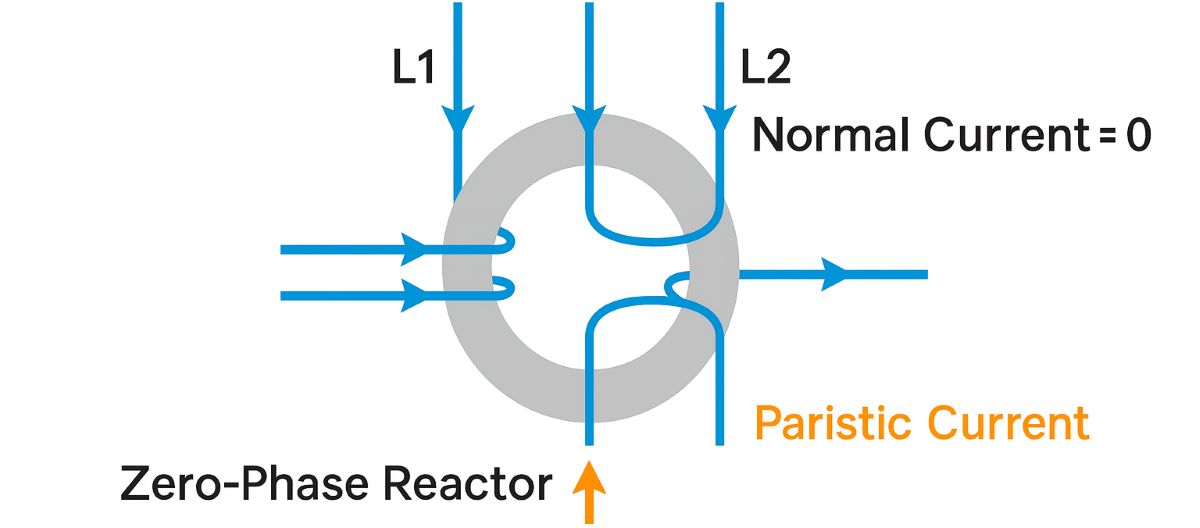
Zero-phase reactors are electrical components specifically designed to suppress common-mode currents and electromagnetic noise that can occur in three-phase electrical systems. Unlike standard line reactors, they act simultaneously on all three phases passing through the same magnetic core, effectively reducing unwanted interference.
In balanced three-phase systems, the sum of all phase currents is ideally zero. However, due to asymmetrical loads or inverter-generated harmonics, residual currents can appear in the neutral or ground path. The zero-phase reactor detects these unbalanced currents and generates an opposing magnetic field to suppress them — without affecting normal operation current.
Zero-Phase Reactor Working Principle
In a balanced three-phase system, the vector sum of all phase currents equals zero. A zero-phase reactor suppresses the remaining common-mode current caused by unbalanced loads or inverter noise.
In summary, a zero-phase reactor is not a power factor or voltage stabilizer — it is a noise suppression device that eliminates unwanted ground currents and protects connected electronics from high-frequency interference.
Do they provide protection for devices like TVs and radios?
Yes. Zero-phase reactors are highly effective in reducing radio frequency interference (RFI) that occurs when sensitive devices are placed near variable-frequency drives or switching power supplies. They provide excellent attenuation over a wide frequency range, from the AM band up to around 10 MHz.
By stabilizing current flow and eliminating common-mode noise, these reactors prevent malfunction or distortion in nearby audio, video, and communication devices. This not only improves sound quality but also protects circuits from unnecessary stress caused by interference.
However, their effectiveness depends on system wiring, grounding quality, and the type of electrical noise present. In some cases, combining them with shielded cables or additional EMI filters may be necessary for optimal noise suppression.
As a technician, I can say that the real power of zero-phase reactors becomes evident in industrial environments. When multiple inverters and switching supplies run close together, the system can generate invisible noise currents that trip earth-leakage breakers for no clear reason. A correctly sized zero-phase reactor instantly resolves this issue — no more random tripping or equipment resets.
In my own tests with DERELL drive systems, these reactors noticeably reduced bearing currents on AC motors. This prolongs the motor’s life and minimizes shaft voltage problems, which often lead to premature bearing wear in continuous-duty applications.
Another advantage is the silent improvement in EMC performance. When connected near the output of a VFD or inverter, the reactor prevents high-frequency energy from radiating through the motor cable. This makes compliance with EMC standards much easier, especially in sensitive automation networks.
In short, I see zero-phase reactors as the unsung heroes of clean power delivery. They don’t shine like controllers or HMIs, but they silently keep systems stable, quiet, and compliant — something every serious automation engineer should appreciate.
Your shopping cart is empty!